Industry-Verified Manufacturing Data (2026)

Induction Coil

Based on aggregated insights from multiple verified factory profiles within the CNFX directory, the standard Induction Coil used in the Basic Metal Manufacturing sector typically supports operational capacities ranging from standard industrial configurations to heavy-duty production requirements.

Technical Definition & Core Assembly

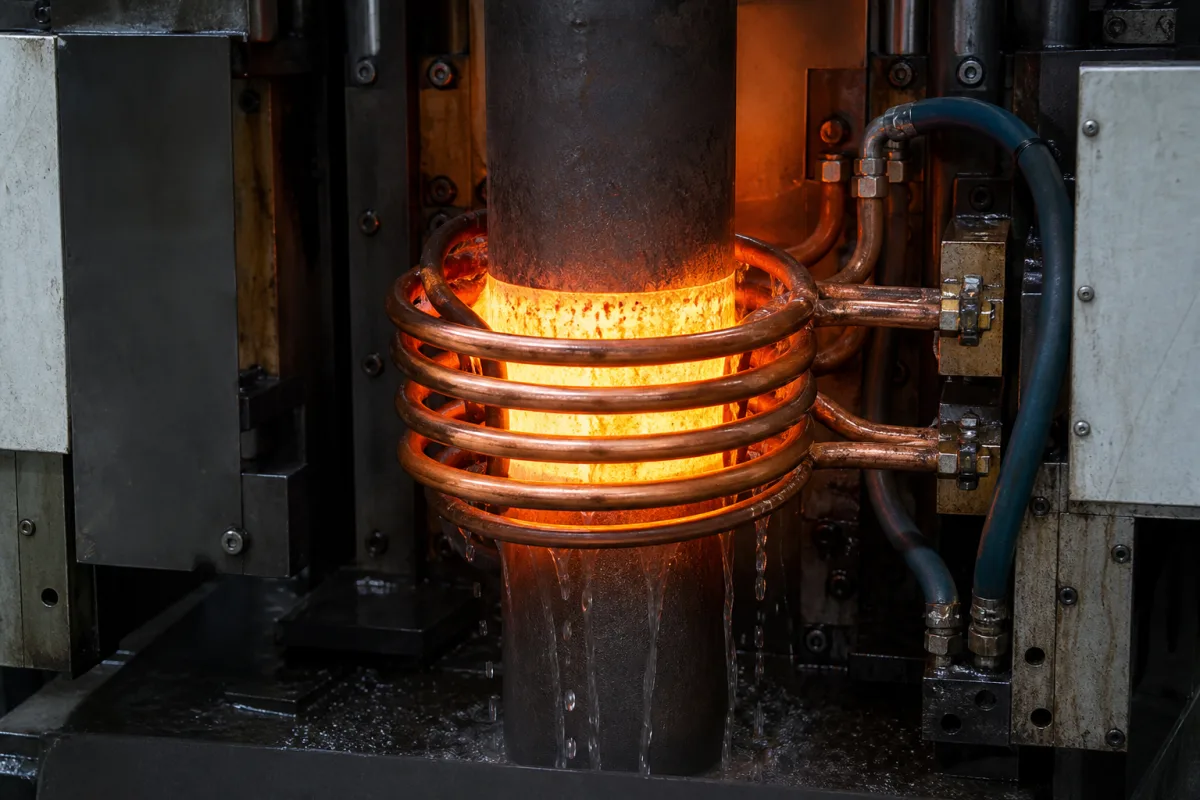
A canonical Induction Coil is characterized by the integration of Copper Conductor Tubing and Cooling Water Jacket/Ports. In industrial production environments, manufacturers listed on CNFX commonly emphasize Oxygen-Free High Conductivity (OFHC) Copper construction to support stable, high-cycle operation across diverse manufacturing scenarios.

A conductive coil that generates an alternating electromagnetic field to induce eddy currents in non-ferrous metals for heating and melting.
Product Specifications

Technical details and manufacturing context for Induction Coil

Definition
The induction coil is the core electromagnetic component of a non-ferrous metal induction melting furnace. It is a precisely wound, water-cooled copper conductor that, when energized with high-frequency alternating current, creates a rapidly alternating magnetic field. This field penetrates the non-ferrous metal charge (e.g., aluminum, copper, brass) placed within or near the coil, inducing powerful eddy currents within the metal. The electrical resistance of the metal to these currents generates intense, localized heat (Joule heating), efficiently raising the metal's temperature to its melting point. The coil's design directly influences heating efficiency, melt rate, and temperature uniformity.
Working Principle
Operates on the principle of electromagnetic induction. A high-frequency alternating current (from a power supply/inverter) is passed through the water-cooled copper induction coil, creating a corresponding alternating magnetic field. When a non-ferrous metal workpiece is placed within this field, the changing magnetic flux induces circulating eddy currents within the metal. The electrical resistivity of the metal causes these currents to generate heat directly within the material's volume, leading to rapid and efficient heating and eventual melting.
Common Materials
Oxygen-Free High Conductivity (OFHC) Copper, High-Purity Water (for cooling)
Technical Parameters
  • Inner diameter of the coil, critical for determining the size of the crucible or charge it can accommodate. (mm) Customizable
Components / BOM
  • Copper Conductor Tubing
    Carries the high-frequency alternating current and is formed into the coil shape. Its hollow core allows for internal water cooling.
    Material: OFHC Copper
  • Cooling Water Jacket/Ports
    Inlet and outlet connections for the closed-loop cooling water system that prevents the coil from overheating due to its own electrical resistance.
    Material: Stainless Steel or Brass
  • Insulation & Structural Support
    Electrical insulation (e.g., mica, ceramic beads, high-temperature sleeves) between coil turns and structural framework to maintain coil geometry under electromagnetic forces and thermal cycling.
    Material: Ceramic, Mica, Fiberglass, Steel Frame
Engineering Reasoning
50-5000 A at 50-10000 Hz, 20-2000 V, 500-1500°C surface temperature
Copper conductor temperature exceeding 1085°C (melting point), insulation breakdown at 200°C continuous/250°C peak, magnetic saturation at 1.6 T for ferrite cores
Design Rationale: Joule heating (I²R losses) exceeding Peltier cooling capacity, dielectric breakdown of polyimide insulation at 200 V/mil, Curie temperature transition at 350°C for MnZn ferrites
Risk Mitigation (FMEA)
Trigger Water ingress exceeding 100 ppm conductivity in cooling channels
Mode: Electrical short circuit between coil turns causing immediate 300% current surge
Strategy: Hermetic sealing with Viton O-rings rated for 200°C, dielectric strength monitoring with 1000 VDC hipot testing
Trigger Cyclic thermal stress from 500-1500°C temperature differential at 0.5 Hz frequency
Mode: Copper work hardening and intergranular cracking after 10⁶ cycles
Strategy: Annealed OFHC copper with 0.1% silver doping, serpentine coil geometry with 5 mm bend radius

Industry Taxonomies & Aliases

Commonly used trade names and technical identifiers for Induction Coil.

Applied To / Applications

This component is essential for the following industrial systems and equipment:

Industrial Ecosystem & Supply Chain DNA

Complementary Systems
Downstream Applications
Specialized Tooling

Application Fit & Sizing Matrix

Operational Limits
pressure: Atmospheric (no pressure rating required)
other spec: Frequency range: 50 Hz - 400 kHz, Power density: 1-1000 kW/m²
temperature: Ambient to 500°C (coil cooling dependent)
Media Compatibility
✓ Aluminum alloys ✓ Copper and brass ✓ Stainless steel (non-magnetic)
Unsuitable: Ferromagnetic materials (e.g., iron, carbon steel) due to magnetic saturation effects
Sizing Data Required
  • Required heating power (kW)
  • Workpiece material and geometry
  • Desired heating rate or final temperature

Reliability & Engineering Risk Analysis

Failure Mode & Root Cause
Insulation breakdown
Cause: Thermal cycling and overheating leading to degradation of dielectric materials, moisture ingress, or electrical overstress from power surges.
Coil deformation or cracking
Cause: Mechanical stress from improper handling or mounting, thermal expansion mismatches, or fatigue from repeated heating/cooling cycles.
Maintenance Indicators
  • Unusual arcing sounds or visible sparks from the coil during operation
  • Localized discoloration (bluing or blackening) or blistering on the coil surface indicating overheating
Engineering Tips
  • Implement regular thermographic inspections to detect hot spots and ensure cooling systems (air/water) are functioning optimally to prevent thermal degradation.
  • Use proper torque specifications and vibration-resistant hardware for mounting, and avoid mechanical shock during installation/transport to prevent physical damage.

Compliance & Manufacturing Standards

Reference Standards
ISO 9001:2015 - Quality Management Systems IEC 60529 - Degrees of Protection Provided by Enclosures (IP Code) EN 55011 - Industrial, Scientific and Medical Equipment - Radio-Frequency Disturbance Characteristics
Manufacturing Precision
  • Coil Diameter: +/-0.5% of nominal dimension
  • Insulation Resistance: >100 MΩ at 500 V DC
Quality Inspection
  • High-Potential (Hi-Pot) Test - Dielectric Strength Verification
  • Resistance and Inductance Measurement - Electrical Parameter Validation

Factories Producing Induction Coil

Verified manufacturers with capability to produce this product in China

✓ 95% Supplier Capability Match Found

P Project Engineer from Brazil Jan 21, 2026
★★★★★
"Reliable performance in harsh Basic Metal Manufacturing environments. No issues with the Induction Coil so far."
Technical Specifications Verified
S Sourcing Manager from Canada Jan 18, 2026
★★★★★
"Testing the Induction Coil now; the technical reliability results are within 1% of the laboratory datasheet."
Technical Specifications Verified
P Procurement Specialist from United States Jan 15, 2026
★★★★★
"Impressive build quality. Especially the technical reliability is very stable during long-term operation."
Technical Specifications Verified
Verification Protocol

“Feedback is collected from verified sourcing managers during RFQ (Request for Quote) and factory evaluation processes on CNFX. These reports represent historical performance data and technical audit summaries from our B2B manufacturing network.”

18 sourcing managers are analyzing this specification now. Last inquiry for Induction Coil from Thailand (58m ago).

Supply Chain Compatible Machinery & Devices

Continuous Casting Machine

Industrial machine for solidifying molten metal into continuous billets/blooms/slabs.

Explore Specs →
Electromagnetic Induction Heater

Industrial heating device using electromagnetic induction for metal processing

Explore Specs →
Vacuum Induction Melting Furnace

Industrial furnace for melting metals under vacuum using electromagnetic induction

Explore Specs →
Electroslag Remelting Furnace

Secondary refining furnace for high-quality metal ingots

Explore Specs →

Frequently Asked Questions

What are the advantages of using OFHC copper in induction coils?

OFHC (Oxygen-Free High Conductivity) copper provides superior electrical conductivity, minimal energy loss, and excellent thermal performance, ensuring efficient electromagnetic field generation and extended coil lifespan in demanding industrial applications.

How does the water cooling system work in this induction coil?

High-purity water circulates through the copper conductor tubing and cooling jacket, dissipating heat generated during operation. This maintains optimal coil temperature, prevents overheating, and ensures consistent performance during continuous metal heating and melting processes.

What types of non-ferrous metals can this induction coil effectively heat?

This induction coil is designed for efficient heating and melting of various non-ferrous metals including aluminum, copper, brass, bronze, and zinc alloys through induced eddy currents, making it ideal for basic metal manufacturing applications.

Can I contact factories directly on CNFX?

CNFX is an open directory, not a transaction platform. Each factory profile provides direct contact information and production details to help you initiate direct inquiries with Chinese suppliers.

Get Quote for Induction Coil

Request technical pricing, lead times, or customized specifications for Induction Coil directly from verified manufacturing units.

Your business information is encrypted and only shared with verified Induction Coil suppliers.

Thank you! Your message has been sent. We'll respond within 1–3 business days.

Need to Manufacture Induction Coil?

Connect with verified factories specializing in this product category

Add Your Factory Contact Us
Previous Product
Inclusion Absorbers
Next Product
Induction Melting Furnace