Industry-Verified Manufacturing Data (2026)

Induction Stirring Coil

Based on aggregated insights from multiple verified factory profiles within the CNFX directory, the standard Induction Stirring Coil used in the Basic Metal Manufacturing sector typically supports operational capacities ranging from standard industrial configurations to heavy-duty production requirements.

Technical Definition & Core Assembly

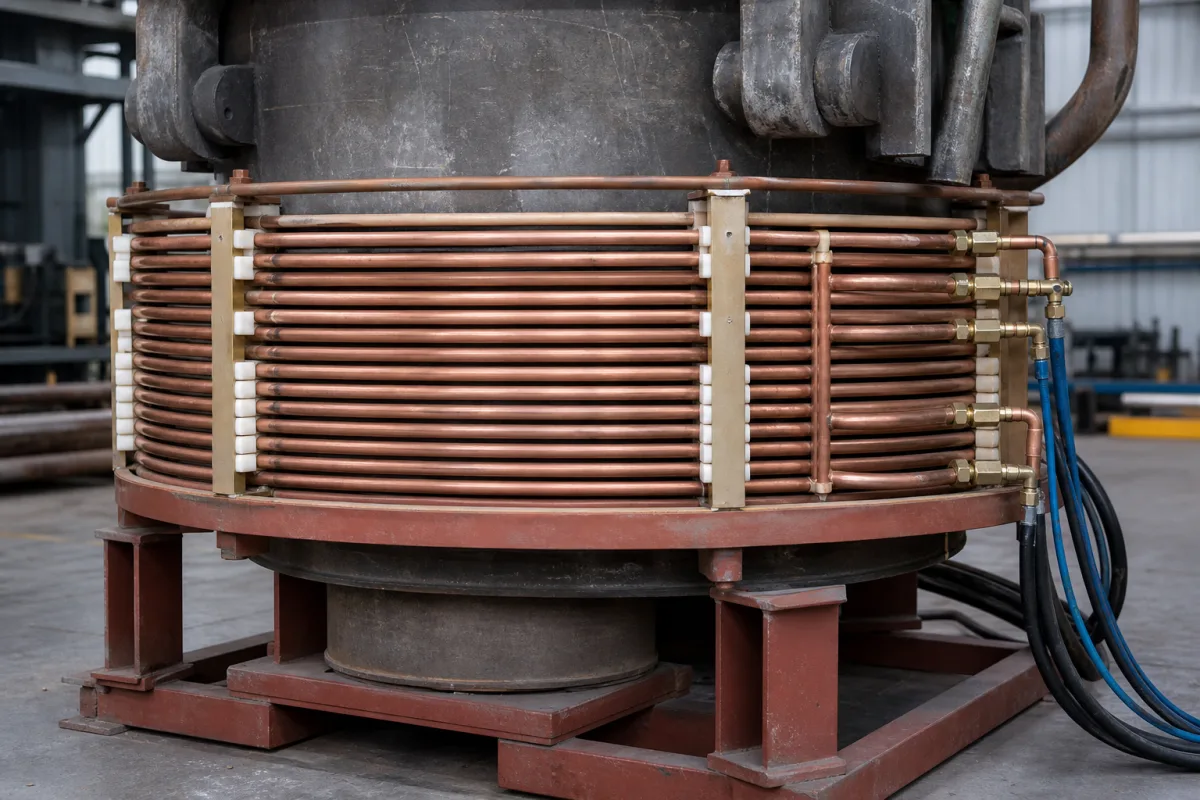
A canonical Induction Stirring Coil is characterized by the integration of Copper Conductor Tubing and Electrical Insulation Layers. In industrial production environments, manufacturers listed on CNFX commonly emphasize High-purity copper tubing construction to support stable, high-cycle operation across diverse manufacturing scenarios.

Electromagnetic coil that generates alternating magnetic fields to induce eddy currents in molten metal, creating stirring motion within a vacuum induction degassing unit.
Product Specifications

Technical details and manufacturing context for Induction Stirring Coil

Definition
A critical component of vacuum induction degassing (VID) units used in metal refining processes. This specialized coil generates high-frequency alternating magnetic fields that penetrate the vacuum chamber and induce eddy currents in the molten metal bath below. These currents create electromagnetic forces that stir the molten metal without physical contact, promoting homogenization, temperature uniformity, and efficient removal of dissolved gases and impurities during the degassing process.
Working Principle
Operates on electromagnetic induction principles. When alternating current passes through the coil, it generates a time-varying magnetic field. This field penetrates the vacuum chamber walls and induces circulating eddy currents in the conductive molten metal. The interaction between these eddy currents and the magnetic field creates Lorentz forces that drive the molten metal in a controlled stirring pattern, typically creating a double-loop circulation that brings material from the bottom to the surface.
Common Materials
High-purity copper tubing, High-temperature electrical insulation, Cooling water channels
Technical Parameters
  • Coil diameter and dimensions must match the crucible size and vacuum chamber configuration (mm) Customizable
Components / BOM
  • Copper Conductor Tubing
    Carries high-frequency alternating current and provides cooling water passage
    Material: High-purity oxygen-free copper
  • Electrical Insulation Layers
    Prevents electrical breakdown between coil turns and to ground
    Material: High-temperature mica or ceramic-based insulation
  • Cooling Water Connections
    Inlet and outlet ports for closed-loop cooling system
    Material: Stainless steel or brass fittings
  • Structural Support Frame
    Maintains coil geometry and provides mounting points
    Material: Stainless steel or high-temperature composite
Engineering Reasoning
50-5000 A at 50-1000 Hz, generating 0.01-1.0 T magnetic flux density
Copper conductor temperature exceeding 180°C (Class H insulation limit) or water cooling flow rate dropping below 2.0 L/min per kW of coil loss
Design Rationale: Joule heating (I²R losses) exceeding cooling capacity, causing insulation breakdown via thermal degradation at 180°C, following Arrhenius equation with activation energy of 1.2 eV for polyimide insulation
Risk Mitigation (FMEA)
Trigger Cooling water pH dropping below 6.5, causing acidic corrosion of copper conductors
Mode: Conductor cross-section reduction leading to localized overheating at 250 A/mm² current density threshold
Strategy: Install titanium-lined cooling channels with pH monitoring and automatic neutralization system
Trigger Mechanical vibration at 120 Hz resonance frequency from electromagnetic forces (Lorentz force density exceeding 10⁵ N/m³)
Mode: Insulation abrasion and turn-to-turn short circuit at 0.1 mm displacement amplitude
Strategy: Epoxy vacuum impregnation with 70% silica filler and constrained-layer damping using 2 mm viscoelastic polymer interleaves

Industry Taxonomies & Aliases

Commonly used trade names and technical identifiers for Induction Stirring Coil.

Industrial Ecosystem & Supply Chain DNA

Complementary Systems
Downstream Applications
Specialized Tooling

Application Fit & Sizing Matrix

Operational Limits
pressure: Vacuum to 1 atm (operating pressure range)
other spec: Power input: 50-500 kW, Frequency: 50-1000 Hz, Cooling water flow: 10-50 L/min
temperature: Up to 1800°C (molten metal temperature)
Media Compatibility
✓ Molten steel alloys ✓ Molten copper alloys ✓ Molten aluminum alloys
Unsuitable: Conductive solid metals (non-molten state)
Sizing Data Required
  • Molten metal volume (m³)
  • Required stirring intensity (RPM or velocity)
  • Vessel geometry and coil positioning constraints

Reliability & Engineering Risk Analysis

Failure Mode & Root Cause
Insulation breakdown
Cause: Thermal cycling and moisture ingress degrading electrical insulation, leading to short circuits or ground faults.
Coil deformation or cracking
Cause: Thermal stress from repeated heating/cooling cycles and electromagnetic forces causing mechanical fatigue.
Maintenance Indicators
  • Audible arcing or buzzing sounds during operation
  • Visible discoloration, hot spots, or smoke from coil insulation
Engineering Tips
  • Implement regular thermographic inspections to detect hot spots and uneven heating patterns before failure occurs.
  • Maintain proper cooling system operation and ensure clean, dry operating environment to prevent insulation degradation.

Compliance & Manufacturing Standards

Reference Standards
ISO 9001:2015 - Quality Management Systems CE Marking - Electromagnetic Compatibility Directive 2014/30/EU ASTM E1251-17a - Standard Test Method for Analysis of Aluminum and Aluminum Alloys by Spark Atomic Emission Spectrometry
Manufacturing Precision
  • Coil Bore Diameter: +/- 0.5 mm
  • Coil Flatness: 0.2 mm per 100 mm length
Quality Inspection
  • High Voltage Insulation Resistance Test
  • Dimensional Verification with CMM

Factories Producing Induction Stirring Coil

Verified manufacturers with capability to produce this product in China

✓ 92% Supplier Capability Match Found

P Project Engineer from United States Jan 21, 2026
★★★★★
"The Induction Stirring Coil we sourced perfectly fits our Basic Metal Manufacturing production line requirements."
Technical Specifications Verified
S Sourcing Manager from United Arab Emirates Jan 18, 2026
★★★★★
"Found 49+ suppliers for Induction Stirring Coil on CNFX, but this spec remains the most cost-effective."
Technical Specifications Verified
P Procurement Specialist from Australia Jan 15, 2026
★★★★★
"The technical documentation for this Induction Stirring Coil is very thorough, especially regarding technical reliability."
Technical Specifications Verified
Verification Protocol

“Feedback is collected from verified sourcing managers during RFQ (Request for Quote) and factory evaluation processes on CNFX. These reports represent historical performance data and technical audit summaries from our B2B manufacturing network.”

17 sourcing managers are analyzing this specification now. Last inquiry for Induction Stirring Coil from Thailand (54m ago).

Supply Chain Compatible Machinery & Devices

Continuous Casting Machine

Industrial machine for solidifying molten metal into continuous billets/blooms/slabs.

Explore Specs →
Electromagnetic Induction Heater

Industrial heating device using electromagnetic induction for metal processing

Explore Specs →
Vacuum Induction Melting Furnace

Industrial furnace for melting metals under vacuum using electromagnetic induction

Explore Specs →
Electroslag Remelting Furnace

Secondary refining furnace for high-quality metal ingots

Explore Specs →

Frequently Asked Questions

How does an induction stirring coil work in metal degassing?

The coil generates alternating magnetic fields that induce eddy currents in molten metal, creating controlled stirring motion within vacuum induction degassing units to remove impurities.

What materials ensure durability in high-temperature applications?

Constructed with high-purity copper tubing for conductivity, high-temperature electrical insulation layers, and integrated cooling water channels to withstand extreme molten metal environments.

What are the key components of this induction stirring coil?

Includes copper conductor tubing, electrical insulation layers, structural support frame, and cooling water connections for reliable operation in basic metal manufacturing processes.

Can I contact factories directly on CNFX?

CNFX is an open directory, not a transaction platform. Each factory profile provides direct contact information and production details to help you initiate direct inquiries with Chinese suppliers.

Get Quote for Induction Stirring Coil

Request technical pricing, lead times, or customized specifications for Induction Stirring Coil directly from verified manufacturing units.

Your business information is encrypted and only shared with verified Induction Stirring Coil suppliers.

Thank you! Your message has been sent. We'll respond within 1–3 business days.

Need to Manufacture Induction Stirring Coil?

Connect with verified factories specializing in this product category

Add Your Factory Contact Us
Previous Product
Induction Melting Furnace
Next Product
Industrial Metal Rolling Mill