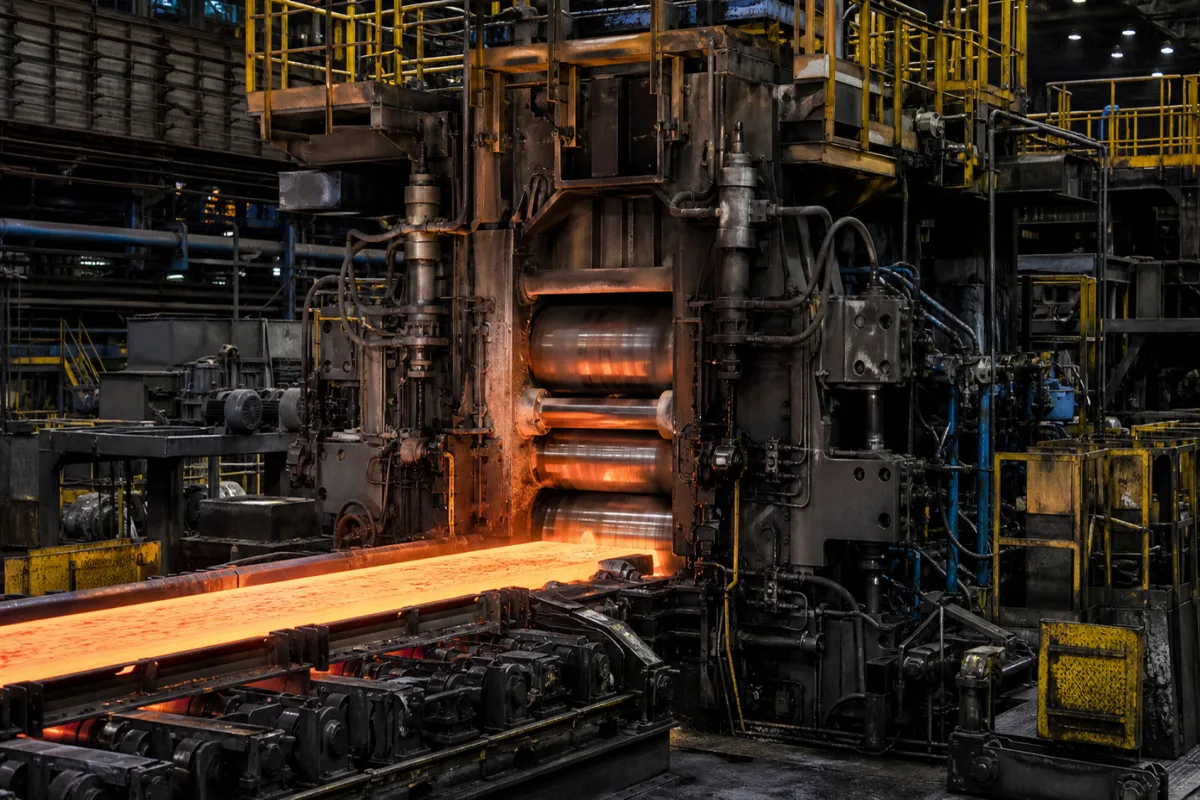
Steckel mill: hot reversing strip mill that coils the strip in furnaces between passes
Hot reversing strip mill with coiler furnaces · single- and twin-stand Steckel mills for 0.8–1.5 million t a year, strip 1.5–20 mm thick and up to 2,100 mm wide, carbon, HSLA and stainless
A continuous hot strip mill passes the strip once through a row of finishing stands. A Steckel mill does the finishing passes on one stand — or two in tandem — by reversing the strip: after each pass the strip is wound onto a coiler inside a furnace, held hot, and fed back through the stand the other way. That is why the furnaces, not only the stand, define the mill. The three mills compared here are rated at 0.8 to 1 million tonnes a year, one of them for stainless steel. This page compares three published Steckel mills and what each one's order specified.
Steckel (hot reversing strip) mills: one or two reversing stands with coiler furnaces, with the descaler, crop shear, laminar cooling and downcoiler that complete the line. Individual hot strip and plate stands, their stiffness and roll stacks are covered on the Heavy-duty rolling mill stand page; work rolls, mill housings and hydraulic gap control on their own pages. Continuous multi-stand hot strip mills as complete lines are covered on the Integrated hot strip rolling and finishing system page, and the downcoiler and run-out cooling on the Downcoiler and Laminar cooling system pages; cold rolling mills and long-product mills are outside this page.
CNFX editorial research · Sources checked October 12, 2026 · 3 sources
Output, width, thickness and grade on three published Steckel mills
Each supplier announcement states the mill's annual output and product window, which together are the first two lines of a Steckel mill specification.
Primetals' scope at Gerdau covered the Steckel stand with coiler furnaces, a crop shear, a laminar-flow cooling section, the downcoiler and coil handling, and the electrical and automation equipment; the main drives of its two rolling mills there use non-salient-pole synchronous motors fed by voltage-source converters. [1] Hitachi's mill at North American Stainless was designed with work-roll single crossing and in-line roll grinding, for coils of up to 38.8 tons. [3]
Editorial calculation: 60 in is 1,524 mm and 0.06 in is about 1.5 mm. 800,000 t a year over an assumed 7,500 operating hours is about 107 t an hour; ask the supplier for the hourly rate and utilisation its tonnage assumes.
Mill
Stands
Annual output
Width (mm)
Thickness (mm)
Product
Gerdau Ouro Branco, Brazil — Primetals Technologies, ordered 2010, final acceptance 2016
Coiler furnaces and the second stand: holding temperature through the finishing passes
SMS Demag's announcement explains the role of the furnaces: for the finishing passes, the strip is kept at a constant temperature in the Steckel furnaces. In a twin-stand Steckel mill without a separate roughing stand, the two tandem stands do both roughing and finish rolling. [2]
SMS Demag described the twin-stand Steckel concept as suited to economical rolling of carbon steels at 1 to 1.5 million tonnes a year, combining Steckel technology with continuous rolling; Maghreb Steel's mill was the first twin-stand Steckel mill with CVC plus stands. [2] Its supply scope listed the two stands, the Steckel furnaces, the descaler and the coiler, together with mill automation. [2]
The three mills sit at 0.8 to 1 million tonnes a year. [1][2][3] Editorial note: a buyer comparing a Steckel mill with a continuous hot strip mill should set the planned annual tonnage, product thickness window and grade mix against these published examples, and ask the supplier for coiler-furnace temperature, pass schedule and number of passes for the thinnest product.
Ask how the strip ends, which leave the furnace on each reversal, are kept within the rolling-temperature window, and what the supplier's guaranteed minimum thickness is for each grade and width.
03
What a Steckel mill order fixed in these three projects
The announcements list the scope each supplier carried, which shows what has to be decided at order stage beyond the stand itself.
Explore company information and manufacturing capabilities, then discuss the scope of your project with a relevant supplier.
Share this page
Compiled and source-reviewed by the CNFX editorial team.
Each manufacturer above links to the page on that company's own website where the product is listed, with the date we checked it. How we source and review
· Page last updated 13 October 2026
Buyer questions
What is a Steckel mill?
A hot reversing strip mill in which the strip is coiled in heated coiler furnaces between passes so that one or two stands can do the finishing passes; SMS Demag notes the strip is kept at constant temperature in the furnaces. [2]
What sizes does a Steckel mill roll?
Primetals' mill at Gerdau rolls 900–2,100 mm wide and 2–20 mm thick; SMS Demag's twin-stand mill for Maghreb Steel was designed for 600–1,575 mm and 1.5–20 mm. [1][2]
How much does a Steckel mill produce?
The three published mills here are rated at 800,000 t to 1 million t a year; SMS Demag puts twin-stand Steckel mills at 1–1.5 million t a year for carbon steel. [1][2][3]
Can a Steckel mill roll stainless steel?
Yes; Hitachi's Steckel mill for North American Stainless was rated at 1 million t a year of stainless and reached 2 mm strip within three months. [3]
Sources and what still needs a direct check
Sources checked 2026-10-12. Mill data from three supplier announcements: Primetals Technologies on Gerdau Ouro Branco (2016), SMS Demag on Maghreb Steel as reported by AIST (2007), and Hitachi America on North American Stainless (1998).