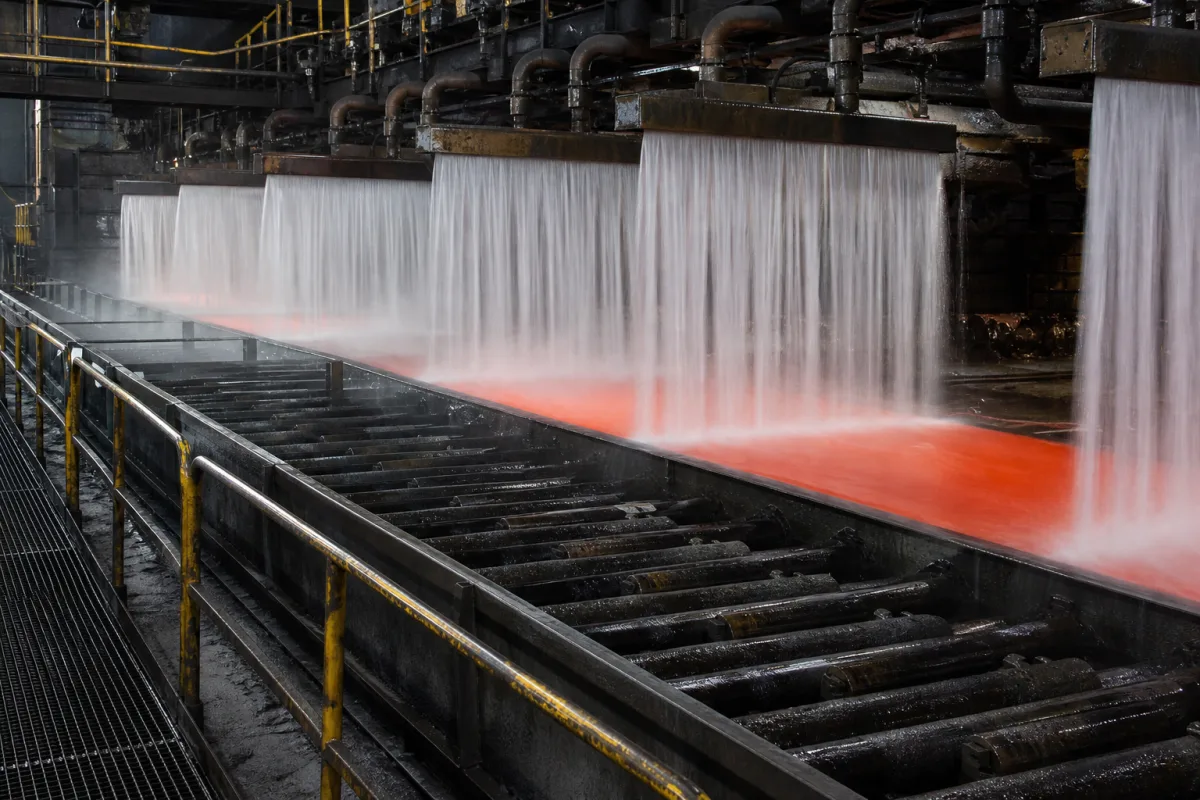
Run-out table cooling for hot strip mills · Laminar headers versus turbulent and spray headers, water curtains above and below the strip, water pooling on the top surface, symmetric top and bottom cooling, header layout and control
A laminar cooling system sits on the run-out table between the last stand of a hot strip mill and the coiler. Rows of headers apply stable streams or curtains of water to the top of the moving strip, with headers below it as well, to cool the strip before it is coiled. Ask three things first: what strip grades, thicknesses and speeds it must cool, how headers are arranged and switched along the table, and how top and bottom cooling and width uniformity are controlled.
Laminar flow cooling headers, bottom sprays, side sprays, water supply and their control on hot strip mill run-out tables. Mill stands, work rolls (see heavy-duty rolling mill work roll), gap control, coilers and plate mill accelerated cooling as a whole are outside this page except where compared.
CNFX editorial research · Sources checked October 12, 2026 · 4 sources
US patent 7,406,850 B2 (Hot rolled strip cooling device with coolant header, POSCO) states that hot rolled strips are cooled while passing over the run-out table by coolant from header nozzles, and that headers are of turbulent, spray or laminar flow type. Turbulent headers need pressure-raising equipment, adding complexity and cost, and their high jet velocity makes the flow unstable, which can cause large temperature deviations across the strip width; spray headers cover the surface evenly through small nozzles but deliver too little flow at normal pressure to cool quickly, so strip temperature is hard to control; laminar headers discharge relatively stabilised coolant and cool evenly across the width. [1]
US patent 4,610,144 A (Cooling of metal strip) describes coolant applied as continuous curtains each reaching from edge to edge of the strip; it says "it is usual for these curtains to extend in mutually parallel relation at right angles to the direction of movement of the strip", on both the upper and lower surfaces. With high flows an appreciable amount of water builds up on the upper surface, and where water from adjacent curtains meets, eddies form and give unstable, non-uniform cooling; its headers are inclined so curtains are spaced further apart at one edge than the other. [2]
Editorial note: ask the supplier how its header design keeps flow stable across the width and how standing water on the strip is removed between headers.
Give the supplier the strip grades, thickness and width range, finishing and target coiling temperatures, strip speed, run-out table length and roll pitch, header type and number of top and bottom banks, flow per header and total water, water pressure and quality, side sprays or edge masking, valve switching speed, model-based control and pyrometer locations, and the cooling-rate targets for each grade.
02
Balance top and bottom cooling
US patent 4,047,985 A (Method and apparatus for symmetrically cooling heated workpieces) concerns strip or slab leaving a mill or caster that passes between coolant headers above and below it, where the upper and lower surfaces cool at different rates; it varies the effective discharge of the headers to equalise them. In its worked example the water flowing on the top surface between headers gave an estimated effective surface coefficient of 130 BTU/ft²·h·°F, while the bottom surface, which touches the table rollers and has no water pooling, was estimated below 20 BTU/ft²·h·°F with the same header spacing. [3]
Editorial calculation: 130 BTU/ft²·h·°F is about 740 W/m²·K and 20 BTU/ft²·h·°F about 114 W/m²·K, a ratio of about 6.5 to 1 between top and bottom in that example; ask the supplier how its bottom headers and control make up the difference for your thicknesses. [3]
03
Plan for boiling stages and re-reddening after the water stops
A 2021 study in Materials by Xu and co-authors measured a 300 × 300 × 35 mm Q235B steel plate heated to about 800 °C and run at 3 m/min under a matrix laminar cooling rig of 100 nozzles of 3 mm diameter, 465 mm above the plate, with 25 °C water at a nozzle water flow of 0.125 m³/h, using thermocouples buried 1 mm below the top surface. The fast cooling stage came in the first 1.5 s of water contact, with the measured temperature falling by 8%; the departure from nucleate boiling followed at about 14 s, transition boiling lasted from 14 to 44 s, and stable film boiling continued until 155 s. Water spraying ended at 77 s, after which heat from the plate's core raised the near-surface temperature from 395 to 535 °C, the re-reddening the authors report as an increase of 35% in their results section and 37% in their abstract (395 to 535 °C is about 35%; confirm with the authors' data), before air cooling resumed. [4]
Editorial calculation: 3 m/min is 0.05 m/s, so a point on the plate travels about 3.2 m during the 64.5 s of water cooling (12.5 to 77 s); a near-surface rise of 140 °C after the water stops shows why coiling or finishing temperature should be measured after equalisation, not at the last header. Ask a supplier for its cooling model's treatment of film boiling and re-reddening for your thickest product, and for where it places pyrometers. [4][3]
Top laminar headers, bottom sprays, curtain layout, water supply and discharge control
The run-out table rolls are listed because the bottom surface touches them and carries no pooled water, which is why the bottom cools so much more slowly in the US 4,047,985 example. [3]
Water flow, pressure, strip speed, width uniformity and header type for a run-out table order
The only figures here, 25 °C water and 3 m/min, come from a laboratory rig rather than a mill, so flow, zone length, thickness range, control accuracy and the remaining fields have to come from the supplier for your line. [4]
Field
What it means and published values
Ask the supplier for
Cooling Water Flow Rate (m³/h)
Per header and total.
Values.
Cooling Water Temperature (°C)
Supply temperature; e.g. 25 °C in a laboratory rig. [4]
Explore company information and manufacturing capabilities, then discuss the scope of your project with a relevant supplier.
Share this page
Compiled and source-reviewed by the CNFX editorial team.
Each manufacturer above links to the page on that company's own website where the product is listed, with the date we checked it. How we source and review
· Page last updated 13 October 2026
Buyer questions
Why use laminar headers on a run-out table?
POSCO's patent says turbulent headers need high pressure and give unstable flow, spray headers lack flow, and laminar headers give stable, even cooling across the width. [1]
Why does the top of the strip cool faster than the bottom?
Water pools on the top surface; one patent example estimated about 130 BTU/ft²·h·°F on top versus below 20 underneath. [3]
What causes uneven cooling with water curtains?
At high flows water builds up on the top surface and eddies form where flows from adjacent curtains meet (US 4,610,144). [2]
Why does steel strip get hotter again after laminar cooling?
Heat from the core flows back to the surface after the water stops; one laboratory study measured the near-surface temperature rising from 395 to 535 °C after cooling ended. [4]
Sources and what still needs a direct check
Sources checked 2026-10-12. The three US patents describe run-out table cooling in their own terms, and the heat transfer values are one patent's worked estimates; the Xu et al. study in Materials reports measurements on a laboratory matrix laminar cooling rig, not a mill.