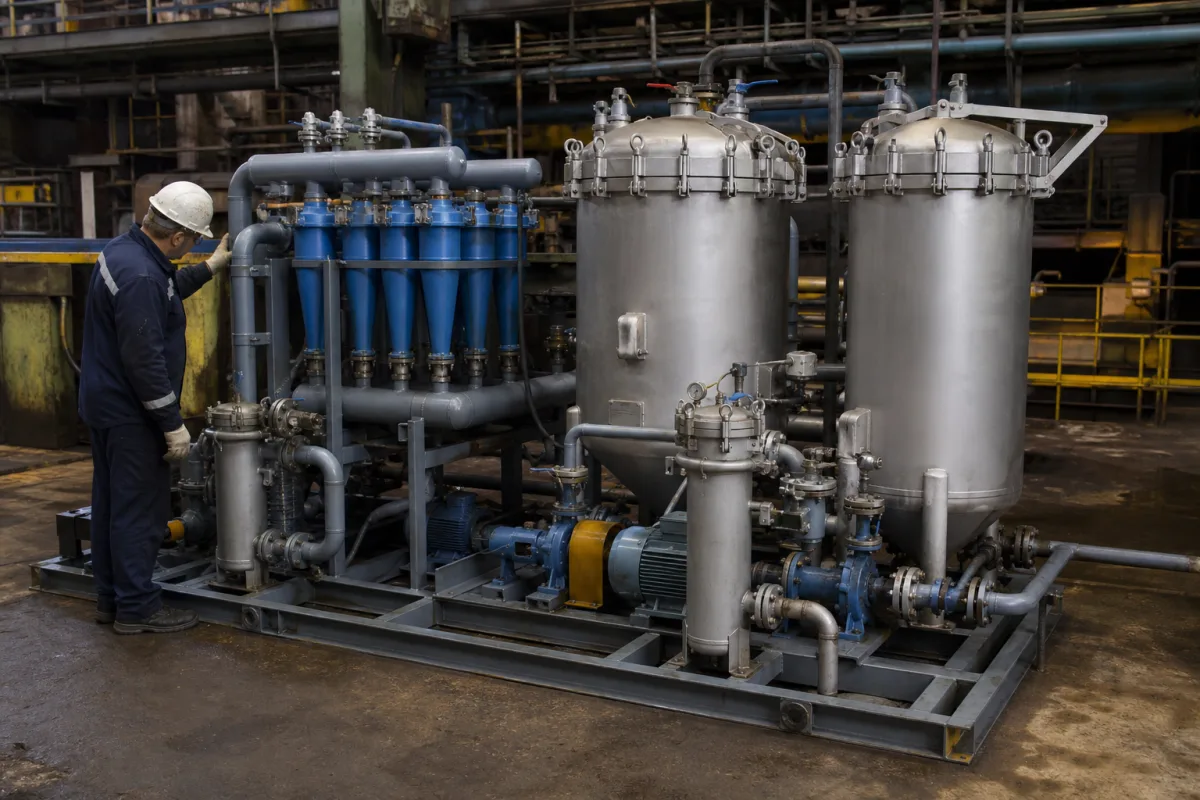
Multi-stage filtration skid for steel-plant spray and quench water: centrifugal separators that remove mill scale, followed by bag and cartridge vessels for the finer solids
Steel plants · the skid that takes mill scale out of casting and rolling spray water in stages, centrifugal separators first, then bag or cartridge vessels, before the water reaches the nozzles again
Water that has sprayed hot steel in a caster or a rolling mill comes back carrying mill scale, slag and other fines, and it is pumped round again to the same spray nozzles. A multi-stage filtration skid cleans it on the way: a centrifugal stage takes out the heavy, settleable scale without screens, and bag or cartridge vessels catch what is too fine or too light for the separator. Sizing it starts from the flow, the density and size of the solids, and how fine the nozzles downstream can tolerate.
Skid-mounted, multi-stage filtration of recirculated spray, quench and descaling water in steel and primary-metal plants: centrifugal (vortex) separators with solids purge, followed by bag, basket or cartridge filter vessels, with the pumps and piping that link them. Rotary degassing of molten aluminium is covered on the Molten aluminium degassing system page, and molten steel vacuum treatment on the Vacuum induction degassing unit and Vacuum pumping system for steel degassing pages. Sand and multimedia pressure filters are covered on the Pressure filter vessels for media filtration page; closed cooling loops with plate heat exchangers on the Closed-loop cooling water system with plate heat exchanger for steel plants page and the Oxygen lance cooling water system page; bag pre-filters ahead of membranes in chemical plants on the Pre-filtration unit page; solvent filtration on the Solvent filtration skid page; hydrocyclone cones and apexes for mineral slurries on their own pages; Y-type and basket strainers on the Pipeline strainer page; pump packages without filtration on the Pumping system page; and the high-pressure descaling pumps, headers and nozzles that this water feeds on the Hydraulic descaling system page.
CNFX editorial research · Sources checked October 13, 2026 · 4 sources
The separator stage: what a centrifugal separator removes from mill scale water, and at what pressure loss
LAKOS's steel-application literature describes the first stage: a separator with no screens or filter elements that spins the water so that mill scale, slag and other settleable fines drop into a collection chamber and are purged.
The removal chart in the same brochure gives efficiency for particles above 74 µm, 74–40 µm and 40–20 µm at four specific gravities, for single pass and for recirculated flow; in every group the 40–20 µm band is the lowest bar. [1] LAKOS names flow rate and liquid velocity as the key factors in removal, and its sizing steps start with the actual flow and a check that the solids are settleable. [1] That is the reason a separator alone does not finish the job where nozzles or heat exchangers need finer water: the fine and light fraction passes on to the next stage.
Two LAKOS application reports give plant-scale figures. At POSCO's continuous casting plant a separator with automatic purge was put on the full-stream recirculated cooling water, 7,500 US gpm (1,700 m³/h), after a self-cleaning strainer had proved inadequate; LAKOS reports a 90 % reduction in spray nozzle maintenance and replacement and a 30 % reduction in product reject within three months. [2] At Dong Kuk Steel in Inchon, a manifold of two separators filters 3,300 US gpm (750 m³/h) of quench water and separates 2,000 lb (907 kg) of mill scale an hour, with a screw auger carrying the purged solids out while loose liquid drains back. [3] Editorial calculation from the Dong Kuk figures: 907 kg an hour in 750 m³/h is about 1.2 kg of scale removed per cubic metre of water.
Before quoting, a separator supplier needs the actual flow, a sample or settling test of the solids, their specific gravity, the allowable pressure loss and how the purged scale is to be collected.
02
The bag and cartridge stage: twin size-2 bag vessels for the fines that pass the separator
Rosedale's Model 82 is an example of a vessel that can serve as the second stage: a dual-basket housing that takes either filter bags or pleated cartridges.
Editorial calculations from the Rosedale data: two baskets give 8.8 sq ft of filter area; 440 US gpm is about 100 m³/h, or about 50 gpm per square foot of basket surface at the maximum flow. [4] Rosedale notes that pleated cartridges in the same housing give greater dirt-holding capacity than bags, and its literature gives viscosity correction factors for the pressure-drop chart, so the clean pressure drop has to be read for the actual element and liquid. [4]
Editorial comparison of the two published ranges: one dual Model 82 at 440 gpm covers less than a fifteenth of the 7,500 gpm full stream treated at POSCO, so on a loop of that size the fine stage would need more than one vessel in parallel or a side stream taken off the main flow. [4][2] The image of this page shows that arrangement on one skid: a bank of cyclone separators on one manifold, two large swing-bolt vessels and smaller cartridge housings, with centrifugal pumps on the base frame.
Rosedale Model 82 dual housing
Published value
Elements
Trade size 2 filter bags or pleated cartridges; also usable as a basket strainer [4]
Baskets
Two; each 30 in nominal depth, 6.7 in diameter, 4.4 sq ft surface area [4]
Specify the fraction of the flow the fine stage must treat, the finest nozzle orifice or heat-exchanger passage it protects, the element rating wanted, and whether the vessels must run duty and standby so that bags can be changed without stopping the water.
03
Data for a spray-water filtration skid enquiry
Paste it into your enquiry below or into an email to a maker, then replace every bracket.
Water: [spray, quench or descaling; flow; pressure; temperature]
Solids: [mill scale, slag, sand, oil; settling test or sample; specific gravity]
Separator stage: [allowable pressure loss; purge to barrel, hopper or auger]
Fine stage: [bag or cartridge; rating; full stream or side stream; duty and standby]
Protected equipment: [nozzle orifice sizes; heat exchangers]
Skid: [footprint; pumps included; materials; pressure rating; code stamp]
Explore company information and manufacturing capabilities, then discuss the scope of your project with a relevant supplier.
Share this page
Compiled and source-reviewed by the CNFX editorial team.
Each manufacturer above links to the page on that company's own website where the product is listed, with the date we checked it. How we source and review
· Page last updated 13 October 2026
Buyer questions
What particle size of mill scale can a centrifugal separator remove?
LAKOS's steel brochure lists mill scale at specific gravity 6.6 against 35–55 µm, and its chart shows the lowest removal in the 40–20 µm band at each specific gravity. [1]
How much pressure does the separator stage cost?
LAKOS gives a pressure loss range of 3 to 12 psi (0.2 to 0.8 bar) for its industrial separators. [1]
What did a separator change on a continuous caster?
At POSCO, LAKOS reports a 90 % cut in spray nozzle maintenance and replacement and a 30 % cut in product reject within three months, on a 7,500 US gpm full stream. [2]
How much flow can one dual bag vessel take?
Rosedale rates its Model 82 dual housing, with two size-2 baskets of 4.4 sq ft each, for flows to 440 US gpm. [4]
Sources and what still needs a direct check
Sources checked 2026-10-13. A LAKOS steel-application brochure gives separator flow, pressure loss and separable particle sizes; two LAKOS application reports give results at a continuous caster and a quench-water system; Rosedale literature gives the data of a dual bag and cartridge vessel.