Industry-Verified Manufacturing Data (2026)

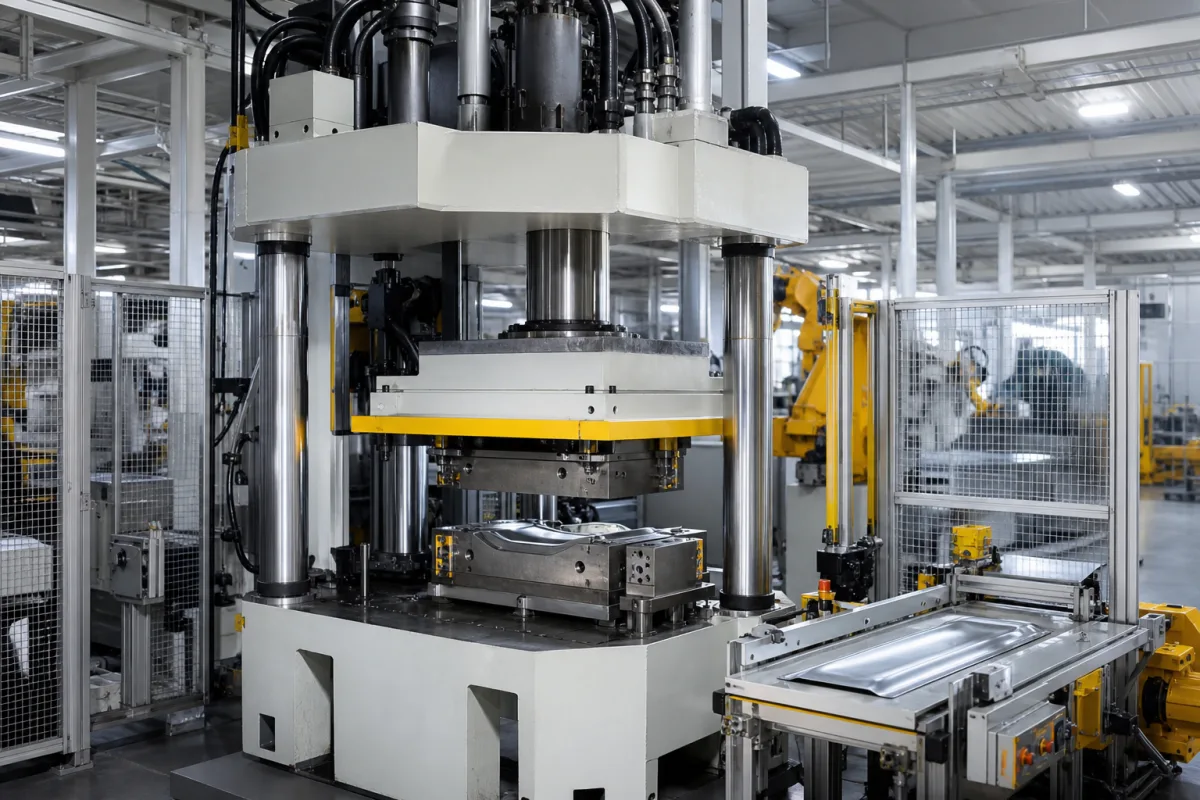
Precision Hydraulic Stamping Press

Based on aggregated insights from multiple verified factory profiles within the CNFX directory, the standard Precision Hydraulic Stamping Press used in the Basic Metal Manufacturing sector typically supports operational capacities ranging from standard industrial configurations to heavy-duty production requirements.

Technical Definition & Core Assembly

A canonical Precision Hydraulic Stamping Press is characterized by the integration of Hydraulic Power Unit and Main Cylinder. In industrial production environments, manufacturers listed on CNFX commonly emphasize High-Strength Steel construction to support stable, high-cycle operation across diverse manufacturing scenarios.

Hydraulic press for high-precision metal stamping operations

Product Specifications

Technical details and manufacturing context for Precision Hydraulic Stamping Press

Definition
A standalone hydraulic press specifically engineered for precision metal stamping applications. It delivers controlled force through hydraulic cylinders to form, cut, or shape sheet metal and plates with high dimensional accuracy. This machine is essential for producing complex, high-tolerance stamped parts in medium to high-volume manufacturing. It is commonly used in automotive, appliance, and electronics component production.
Working Principle
A hydraulic pump pressurizes fluid, which is directed to one or more cylinders. The pressurized fluid extends the piston rod, applying a controlled, high force to the ram. The ram drives the upper die against the lower die and workpiece, performing the stamping operation. Force, speed, and stroke are precisely regulated via hydraulic valves and programmable controls.
Common Materials
High-Strength Steel, Cast Iron
Technical Parameters
  • Maximum rated stamping force (kN) Customizable
  • Maximum daylight opening (mm) Customizable
Components / BOM
  • Hydraulic Power Unit
    Generates and regulates hydraulic pressure for the press
    Material: Steel Housing, Internal Steel Components
  • Main Cylinder
    Converts hydraulic pressure into linear force to drive the ram
    Material: Hardened Steel
  • Ram / Slide
    Moving component that holds the upper die and applies force to the workpiece
    Material: Forged Steel
  • Bed / Bolster Plate
    Stationary base that supports the lower die and workpiece
    Material: Cast Iron or Steel
Engineering Reasoning
15-35 MPa hydraulic pressure, 0.01-0.05 mm positioning accuracy, 0.5-5.0 mm/s ram speed
Hydraulic pressure exceeding 42 MPa causes seal extrusion failure, positioning error beyond 0.1 mm triggers scrap production, ram speed below 0.3 mm/s induces metal flow instability
Design Rationale: Seal failure occurs via extrusion through clearance gaps at 42 MPa due to Pascal's law pressure transmission; positioning errors beyond 0.1 mm exceed material elastic limits causing permanent deformation; slow ram speeds below 0.3 mm/s allow metal recrystallization during forming
Risk Mitigation (FMEA)
Trigger Hydraulic fluid contamination exceeding ISO 4406 18/16/13 cleanliness level
Mode: Servo valve spool sticking causing position control oscillation ±0.08 mm
Strategy: Install dual 3-micron absolute filtration with pressure differential monitoring at 0.15 MPa trigger
Trigger Platen parallelism deviation exceeding 0.02 mm/m over 1000 mm span
Mode: Uneven die loading causing 12% thickness variation in stamped parts
Strategy: Integrate laser alignment system with 0.005 mm resolution and automatic wedge adjustment

Industry Taxonomies & Aliases

Commonly used trade names and technical identifiers for Precision Hydraulic Stamping Press.

Industrial Ecosystem & Supply Chain DNA

Complementary Systems
Downstream Applications
Specialized Tooling

Application Fit & Sizing Matrix

Operational Limits
pressure: Up to 700 bar (system max), 300-500 bar typical working pressure
flow rate: 20-150 L/min (hydraulic pump capacity)
temperature: 5°C to 40°C (operating ambient)
slurry concentration: Not applicable - designed for clean hydraulic fluids (ISO 4406 Class 18/16/13 or better)
Media Compatibility
✓ Cold rolled steel sheets (0.5-6mm thickness) ✓ Aluminum alloys (series 1000-6000) ✓ Copper and brass alloys
Unsuitable: Corrosive chemical environments (acidic/alkaline atmospheres) due to potential hydraulic system contamination and component degradation
Sizing Data Required
  • Maximum required stamping force (kN or tons)
  • Workpiece material thickness and tensile strength
  • Required production cycle time (strokes per minute)

Reliability & Engineering Risk Analysis

Failure Mode & Root Cause
Hydraulic fluid contamination
Cause: Ingress of particulate matter, moisture, or air into the hydraulic system due to inadequate filtration, seal degradation, or improper fluid handling, leading to valve sticking, pump wear, and component abrasion.
Seal and gasket failure
Cause: Thermal degradation, chemical incompatibility with hydraulic fluids, excessive pressure spikes, or mechanical wear from misalignment, resulting in fluid leaks, pressure loss, and contamination ingress.
Maintenance Indicators
  • Audible knocking or hammering sounds from hydraulic lines, indicating cavitation or air entrapment in the system.
  • Visible hydraulic fluid leaks around seals, fittings, or cylinders, especially if accompanied by a drop in system pressure or erratic press operation.
Engineering Tips
  • Implement a proactive hydraulic fluid analysis program to monitor contamination levels, moisture content, and additive depletion, allowing for scheduled filtration or fluid changes before failure occurs.
  • Regularly inspect and maintain alignment of the press ram and guides to prevent off-center loading, which reduces stress on hydraulic cylinders, seals, and structural components, extending service life.

Compliance & Manufacturing Standards

Reference Standards
ISO 12100:2010 - Safety of machinery ANSI B11.1 - Mechanical Power Presses CE Marking - Machinery Directive 2006/42/EC
Manufacturing Precision
  • Ram parallelism: +/-0.02 mm per 100 mm stroke
  • Bed flatness: 0.05 mm over entire surface
Quality Inspection
  • Hydrostatic pressure test at 1.5x operating pressure
  • Dimensional accuracy verification using CMM

Factories Producing Precision Hydraulic Stamping Press

Verified manufacturers with capability to produce this product in China

✓ 93% Supplier Capability Match Found

P Project Engineer from Germany Jan 22, 2026
★★★★★
"Reliable performance in harsh Basic Metal Manufacturing environments. No issues with the Precision Hydraulic Stamping Press so far."
Technical Specifications Verified
S Sourcing Manager from Brazil Jan 19, 2026
★★★★★
"Testing the Precision Hydraulic Stamping Press now; the Rated Force (kN) results are within 1% of the laboratory datasheet."
Technical Specifications Verified
P Procurement Specialist from Canada Jan 16, 2026
★★★★★
"Impressive build quality. Especially the Rated Force (kN) is very stable during long-term operation."
Technical Specifications Verified
Verification Protocol

“Feedback is collected from verified sourcing managers during RFQ (Request for Quote) and factory evaluation processes on CNFX. These reports represent historical performance data and technical audit summaries from our B2B manufacturing network.”

18 sourcing managers are analyzing this specification now. Last inquiry for Precision Hydraulic Stamping Press from Poland (16m ago).

Supply Chain Commonly Integrated Components

Infrared Pyrometer

A non-contact temperature measurement device that detects infrared radiation emitted by objects to determine their surface temperature.

Explore Specs →
Signal Processor

Electronic device that conditions, amplifies, filters, and converts raw sensor signals into standardized outputs for temperature measurement systems

Explore Specs →
Purge Air System

A system that provides controlled airflow to clear optical paths and protect sensors in molten metal temperature measurement applications.

Explore Specs →
Degassing Chamber

A specialized vessel within a molten metal degassing system where dissolved gases are removed from molten metal through controlled processes.

Explore Specs →

Frequently Asked Questions

What materials can the Precision Hydraulic Stamping Press handle?

This press is designed for high-strength steel and cast iron materials, making it ideal for demanding metal forging and stamping applications.

What are the key specifications of this hydraulic stamping press?

Key specs include adjustable press speed (SPM), rated force in kN, customizable shut height and stroke length in mm, and various table size options to suit different production needs.

What maintenance does the hydraulic system require?

Regular maintenance of the hydraulic power unit and main cylinder is essential, including fluid checks, filter replacements, and seal inspections to ensure consistent performance and longevity.

Can I contact factories directly on CNFX?

CNFX is an open directory, not a transaction platform. Each factory profile provides direct contact information and production details to help you initiate direct inquiries with Chinese suppliers.

Get Quote for Precision Hydraulic Stamping Press

Request technical pricing, lead times, or customized specifications for Precision Hydraulic Stamping Press directly from verified manufacturing units.

Your business information is encrypted and only shared with verified Precision Hydraulic Stamping Press suppliers.

Thank you! Your message has been sent. We'll respond within 1–3 business days.

Need to Manufacture Precision Hydraulic Stamping Press?

Connect with verified factories specializing in this product category

Add Your Factory Contact Us
Previous Product
Precision Forged Gear Blank
Next Product
Precision Mechanical Stamping Press