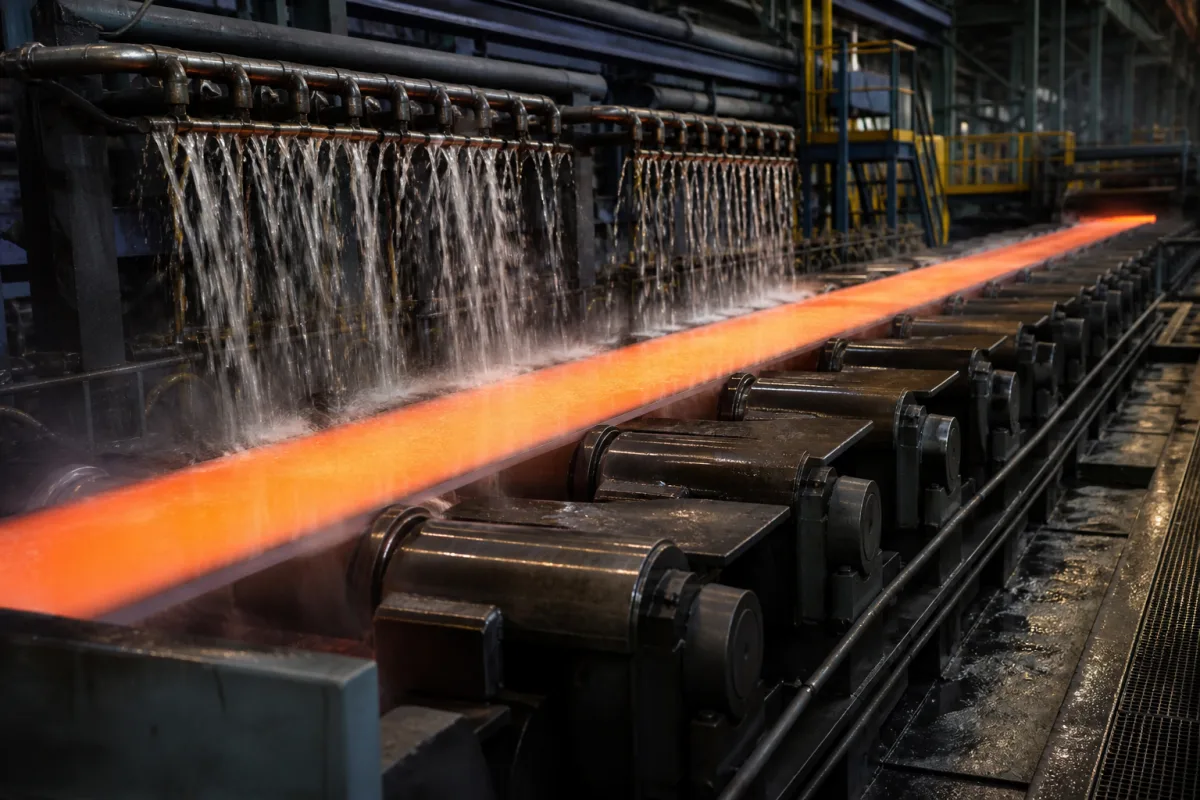
Caster run-out roller table: carrying cut slabs and billets from the cut-off to the cooling bed or the mill
The roller table after a continuous caster's cut-off · casting-speed and accelerated roller zones, sideways transfer of cut slabs and billets to the cooling bed, and insulated covers for hot charging
Once the torch or shear has cut the strand, each slab, bloom or billet lies on a roller table that has two jobs the caster itself does not: get the cut piece out of the way of the next one, and deliver it either sideways to a cooling bed or onward, still hot, to a reheating furnace or mill. This page is about that run-out table: how its rollers are split between casting speed and transport speed, how cut lengths are taken off it sideways without being dragged, and how an insulated table keeps the heat that hot charging pays for.
Run-out (delivery, discharge) roller tables of slab, bloom and billet continuous casters, from the cut-off to the cooling bed, transfer device or mill: roller speed zones, sideways transfer of cut lengths to the cooling bed, and insulated or covered tables for hot delivery. Run-out tables of hot strip mills, with laminar cooling banks between the finishing mill and the down-coiler, are covered on the Run-out table for a hot strip mill page; the cut-off machines that make the lengths on the Torch or shear cutting for continuous-cast strands page; complete casters on the Billet continuous caster page; billet casters linked endlessly to a bar mill on the Endless casting and rolling plant for rebar and wire rod page; withdrawal and straightening on the Withdrawal and straightening unit of a billet caster page. The table starts where the caster's own roller sections end: strand guide roller segments inside the caster are covered on the Strand guide system for continuous casters page, spray cooling of the strand on the Secondary cooling (spray) zone of a continuous caster page, mould oscillation on the Heavy-duty continuous casting mold oscillator page, and the furnaces that receive hot-charged pieces on the Reheating furnace page.
CNFX editorial research · Sources checked October 12, 2026 · 4 sources
Rollers under the strand stay at casting speed; rollers under the cut slab accelerate it away
Tippins Machinery's 1985 patent for in-line casting and rolling of thin slabs puts the slab, straight from the caster, onto a run-out table with driven rollers. Because the strand still being cast and a cut slab being drawn into the mill can be on the table at the same time, the patent says the roller speeds, or speeds of roller groups, must be individually controllable. [1]
The patent's worked example casts a 150-foot slab in 12 to 15 minutes, with the slab leaving the caster at about 2200 °F and needing 1850 °F, preferably 1950 °F, at the first rolling pass. [1] Editorial calculation: 150 ft is 45.7 m, so 12 to 15 minutes corresponds to a casting speed of about 3.0 to 3.8 m/min; 125% of a 150 ft slab is 187.5 ft (57.2 m) of table; 2200 °F is about 1204 °C, 1850 °F about 1010 °C and 1950 °F about 1066 °C.
In Concast AG's patent for a twin-strand billet caster, the cut lengths first run over compensation roller tables whose driven rolls carry them in an accelerated fashion to the transfer device, and the run-out roller tables at the transfer device itself have non-driven rolls. [2] Editorial note: which roller zones are driven, and at what speed range, therefore differs by layout; ask for a roller-by-roller drive list rather than a single table speed.
Rule in the Tippins patent
What it means for the table
The rollers at the entry end are always matched to casting speed [1]
The entry zone never pulls on the strand that is still in the caster.
Rollers under a cut slab accelerate it to the mill's suck-in speed [1]
The cut slab clears the table and crosses the unprotected gap to the first stand quickly, losing less heat.
Once the slab tail passes a roller, that roller drops back from suck-in speed to casting speed [1]
Each roller switches speed as the tail passes, so the table needs per-roller or per-group drives.
Table length at least 100 ft, or at least 125% of the individual slab length (claims) [1]
The whole cut slab fits on the table with room behind it.
Give the supplier the section sizes, cut lengths and maximum piece weight, casting speed range, number of strands, where the pieces go (cooling bed, furnace, mill), the transport speed wanted and the distance, and the temperature the pieces must keep.
02
Taking cut lengths off sideways: levers between the rolls, inclined carriages, and the 90° turn
Two Concast patents show two ways of moving hot cut lengths from the run-out tables across to a cooling bed, and what each avoids. [2][3]
Concast Inc's patent notes that the cast products can be red hot when they are discharged onto the run-out table. [3] In the Concast AG layout the cooling bed lies at the same level as the run-out tables, and a segmented chute runs from the table nearest the bed into the cooling bed plane. [2]
Editorial note: the transfer device dictates the table's roller spacing and structure, because levers or carriages have to pass between the rolls; fix the transfer method before the roller pitch is drawn.
Pivoting levers (Concast AG, US 4,262,733)
Wheeled carriages on inclined I-beams (Concast Inc, US 4,518,074)
How the piece is lifted
Levers on a single shared pivot shaft swing up between the rolls of the run-out table and push the strand section off with their curved flanks [2]
Carriages run between pairs of I-beams that cross the table and rise in the transfer direction; driven in synchronism, they lift each billet off the rollers along an inclined path [3]
More than one strand
One pivot mechanism transfers sections from different run-out tables together onto the cooling bed [2]
The carriages pick up the products one after another and group them as they travel [3]
Orientation
Each section is turned through about 90° about its length on the way to the cooling bed [2]
Path and carriage surface set at an acute angle to the support plane, less than about 10° in the claims [3]
What it avoids
A separate pivot mechanism, and extra cooling-bed pusher, for each strand [2]
Sliding transfer that scratches or nicks the products [3]
03
Covered or insulated tables for hot charging: what entering the furnace at 700 °C instead of 110 °C saves
Tippins' patent encloses the rollers of its run-out table in an insulated, box- or tunnel-shaped structure, preferably with a reflective lining, to keep heat and even out temperature through the slab and from head to tail; it also proposes purging the enclosure with an inert or reducing gas to cut scale, and adding heat at the discharge end. [1]
SteelOnTheNet adds that the 28% gain needs all slabs in the furnace charged at that temperature, because the furnace is set for its coldest slab, and that Erdemir reported saving USD 13 million a year by hot charging 50% of its production at an average 586 °C. [4] Where caster and mill are far apart it describes covered rail wagons and insulated pits rather than a continuous table. [4]
Editorial calculation: 135 ÷ 105 = 1.29, the 28% productivity figure; 0.086 MMBTU × 6 (from 100 to 700 °C) = 0.52 MMBTU per ton, the figure SteelOnTheNet uses for its cost estimate. [4]
Hot charging figure (SteelOnTheNet)
Value
Target charging temperature in automotive hot mills
If pieces are to be hot charged, state the temperature they must reach the furnace at, the time from cut-off to charging, and whether the table needs covers, an enclosure or heating at its end.
04
What to send for a caster run-out table
Paste it into your enquiry below or into an email to a maker, then replace every bracket.
Caster: [slab, bloom or billet; sections; strands; casting speed range]
Pieces: [cut lengths; maximum weight; temperature at cut-off]
Destination: [cooling bed; furnace; mill; distance]
Roller zones: [which driven; speed range; acceleration]
Transfer: [levers, carriages, pusher; turning required]
Heat: [covers or insulated enclosure; target charging temperature]
Controls: [piece detection; interface to caster and mill]
Explore company information and manufacturing capabilities, then discuss the scope of your project with a relevant supplier.
Share this page
Compiled and source-reviewed by the CNFX editorial team.
Each manufacturer above links to the page on that company's own website where the product is listed, with the date we checked it. How we source and review
· Page last updated 13 October 2026
Buyer questions
Why do rollers on a caster run-out table need separate speed control?
Tippins' patent notes that the strand being cast and a cut slab heading to the mill can be on the table together; the first rollers stay at casting speed while rollers under the cut slab accelerate it, then drop back once its tail passes. [1]
How are cut billets moved from the run-out table to the cooling bed?
Concast patents describe pivoting levers that swing up between the rolls and turn each section about 90°, and wheeled carriages on inclined I-beams that lift billets with little sliding. [2][3]
Why insulate a caster run-out table?
To keep heat for hot charging or direct rolling; SteelOnTheNet gives 105 instead of 135 minutes of reheating for slabs charged at 700 °C rather than 110 °C. [1][4]
Sources and what still needs a direct check
Sources checked 2026-10-12. Roller speed zones, table length and insulation come from a Tippins Machinery patent; sideways transfer from two Concast patents (Concast AG and Concast Inc, one group); hot charging temperatures, furnace time and fuel figures from SteelOnTheNet's hot charging analysis.