Industry-Verified Manufacturing Data (2026)

Run-Out Table

Based on aggregated insights from multiple verified factory profiles within the CNFX directory, the standard Run-Out Table used in the Basic Metal Manufacturing sector typically supports operational capacities ranging from standard industrial configurations to heavy-duty production requirements.

Technical Definition & Core Assembly

A canonical Run-Out Table is characterized by the integration of Drive Rollers and Support Frame. In industrial production environments, manufacturers listed on CNFX commonly emphasize Carbon Steel construction to support stable, high-cycle operation across diverse manufacturing scenarios.

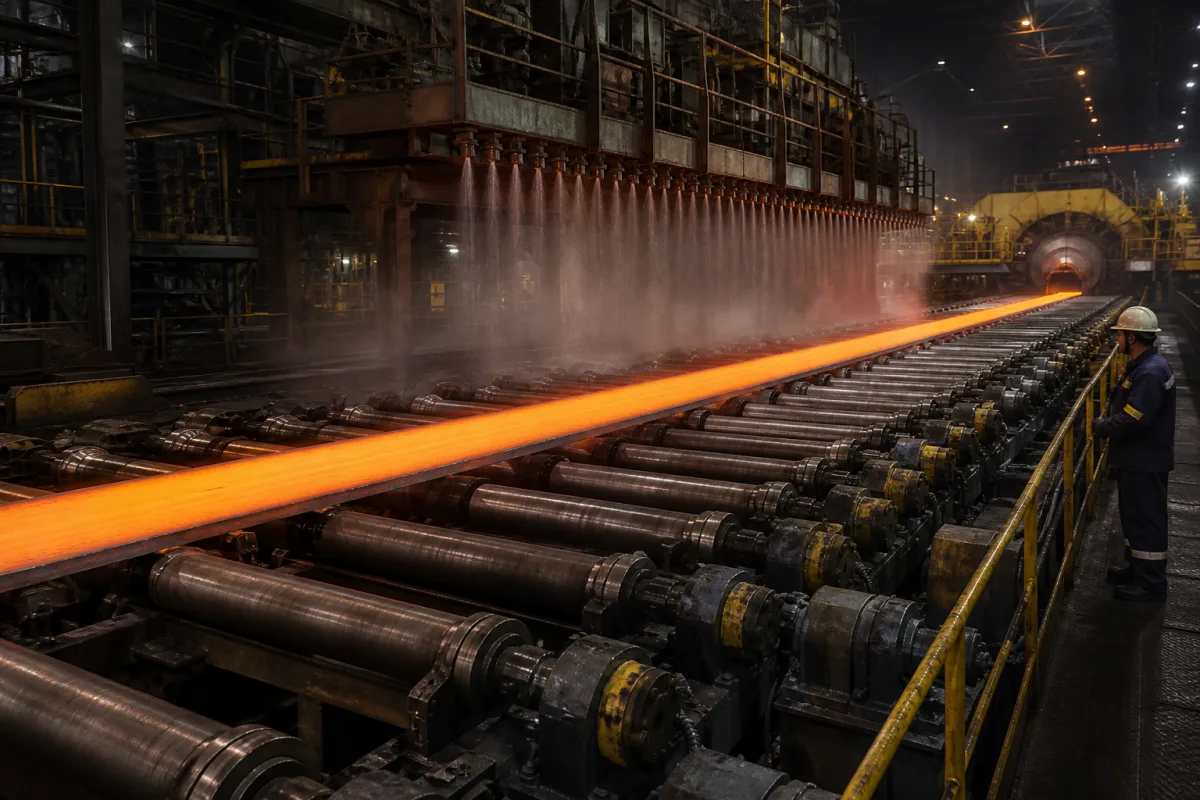
A horizontal conveying table that receives and transports processed materials from a production line.
Product Specifications

Technical details and manufacturing context for Run-Out Table

Definition
The Run-Out Table is a critical component within an Industrial System, typically positioned at the discharge end of a processing unit (like a rolling mill, furnace, or press). Its primary role is to receive hot or processed materials, provide controlled cooling or stabilization, and transport them to the next stage (e.g., cooling bed, shear, or stacking area) while maintaining product alignment and integrity.
Working Principle
The Run-Out Table operates by utilizing a series of powered rollers or a driven conveyor belt. As material exits the main processing equipment, it is transferred onto the table surface. The rollers or belt are driven by motors, often with variable speed control, to match the output speed of the upstream process and provide controlled, continuous linear movement. It may include features like water spray systems for cooling or side guides for alignment.
Common Materials
Carbon Steel, Alloy Steel
Technical Parameters
  • Length of the Run-Out Table (meters) Per Request
Components / BOM
  • Drive Rollers
    Provide the motive force to transport material along the table
    Material: Hardened Alloy Steel
  • Support Frame
    Structural base that supports all table components and withstands operational loads
    Material: Structural Carbon Steel
  • Drive Motor & Gearbox
    Provides controlled rotational power to the drive rollers
    Material: Various (Motor: Copper, Steel; Gearbox: Cast Iron, Steel)
  • Side Guides Optional
    Vertical plates or rollers to keep material centered on the table during transport
    Material: Abrasion-Resistant Steel
  • Cooling Spray System Optional
    Optional system of nozzles to apply water or mist for controlled cooling of hot material
    Material: Stainless Steel, Brass
Engineering Reasoning
0.5-3.0 m/s conveying speed, 0-80°C ambient temperature, 0-85% relative humidity
Bearing temperature exceeding 120°C, roller deflection >2.5 mm/m, motor current >115% rated FLA for >30 seconds
Design Rationale: Roller bearing seizure due to lubricant thermal breakdown at 120°C, belt tensile failure at >150 kN/m stress, motor insulation class F thermal degradation at 155°C
Risk Mitigation (FMEA)
Trigger Misalignment-induced vibration exceeding 4.5 mm/s RMS velocity
Mode: Roller bearing raceway spalling and premature fatigue failure
Strategy: Laser alignment during installation with <0.05 mm/m tolerance, vibration monitoring with ISO 10816-3 Category II limits
Trigger Material accumulation exceeding 15 kg/m² loading
Mode: Belt slip exceeding 2% relative to drive roller, motor overload trip
Strategy: Load cell integration with 0.5% accuracy, PID-controlled variable frequency drive maintaining 95-105% slip ratio

Industry Taxonomies & Aliases

Commonly used trade names and technical identifiers for Run-Out Table.

Applied To / Applications

This component is essential for the following industrial systems and equipment:

Industrial Ecosystem & Supply Chain DNA

Complementary Systems
Downstream Applications
Specialized Tooling

Application Fit & Sizing Matrix

Operational Limits
pressure: Atmospheric to 1.5 bar
flow rate: Up to 500 tons/hour
temperature: -20°C to 150°C
slurry concentration: Up to 60% solids by weight
Media Compatibility
✓ Hot rolled steel slabs ✓ Continuous cast billets ✓ Processed aggregates
Unsuitable: Highly corrosive chemical slurries
Sizing Data Required
  • Material throughput rate (tons/hour)
  • Material dimensions (length/width/height)
  • Required transport speed (m/min)

Reliability & Engineering Risk Analysis

Failure Mode & Root Cause
Bearing fatigue failure
Cause: Excessive cyclic loading from hot slab impacts and continuous rotation under high temperatures, leading to material degradation and spalling.
Roll surface thermal cracking
Cause: Rapid temperature fluctuations between hot slab contact and cooling water exposure, causing thermal stress exceeding material yield strength.
Maintenance Indicators
  • Visible surface spalling or flaking on roll contact surfaces
  • Abnormal vibration patterns or audible knocking during rotation
Engineering Tips
  • Implement predictive maintenance using vibration analysis and thermal imaging to detect early bearing degradation
  • Establish controlled cooling protocols and surface hardening treatments to minimize thermal shock damage

Compliance & Manufacturing Standards

Reference Standards
ISO 1101:2017 - Geometrical product specifications (GPS) - Geometrical tolerancing ANSI B4.1-1967 (R2019) - Preferred Limits and Fits for Cylindrical Parts DIN 7184-1:2018-06 - Machine tables - Part 1: Run-out tables
Manufacturing Precision
  • Flatness: ≤0.05 mm per 1000 mm length
  • Run-out tolerance: ≤0.02 mm TIR (Total Indicator Reading)
Quality Inspection
  • Surface Plate Inspection (using precision straightedges and dial indicators)
  • Coordinate Measuring Machine (CMM) Verification of Geometrical Tolerances

Factories Producing Run-Out Table

Verified manufacturers with capability to produce this product in China

✓ 95% Supplier Capability Match Found

S Sourcing Manager from Brazil Jan 04, 2026
★★★★★
"Testing the Run-Out Table now; the technical reliability results are within 1% of the laboratory datasheet."
Technical Specifications Verified
P Procurement Specialist from Canada Jan 01, 2026
★★★★☆
"Impressive build quality. Especially the technical reliability is very stable during long-term operation. (Delivery took slightly longer than expected, but technical support was excellent.)"
Technical Specifications Verified
T Technical Director from United States Dec 29, 2025
★★★★★
"As a professional in the Basic Metal Manufacturing sector, I confirm this Run-Out Table meets all ISO standards."
Technical Specifications Verified
Verification Protocol

“Feedback is collected from verified sourcing managers during RFQ (Request for Quote) and factory evaluation processes on CNFX. These reports represent historical performance data and technical audit summaries from our B2B manufacturing network.”

5 sourcing managers are analyzing this specification now. Last inquiry for Run-Out Table from Vietnam (15m ago).

Supply Chain Commonly Integrated Components

Purge Air System

A system that provides controlled airflow to clear optical paths and protect sensors in molten metal temperature measurement applications.

Explore Specs →
Degassing Chamber

A specialized vessel within a molten metal degassing system where dissolved gases are removed from molten metal through controlled processes.

Explore Specs →
Gas Control System

A system that regulates and controls the flow, pressure, and composition of gases used in molten metal degassing processes.

Explore Specs →
Burner Assembly

A combustion system component that generates controlled flame for heating applications in industrial preheating stations.

Explore Specs →

Frequently Asked Questions

What materials are used in run-out table construction?

Run-out tables are typically constructed from carbon steel or alloy steel for durability and strength in basic metal manufacturing environments.

What components are included in a run-out table BOM?

Standard BOM includes cooling spray system, drive motor & gearbox, drive rollers, side guides, and support frame for complete horizontal conveying functionality.

How does a run-out table function in metal production?

A run-out table receives processed materials from production lines and horizontally transports them to the next stage, ensuring continuous workflow in metal manufacturing.

Can I contact factories directly on CNFX?

CNFX is an open directory, not a transaction platform. Each factory profile provides direct contact information and production details to help you initiate direct inquiries with Chinese suppliers.

Get Quote for Run-Out Table

Request technical pricing, lead times, or customized specifications for Run-Out Table directly from verified manufacturing units.

Your business information is encrypted and only shared with verified Run-Out Table suppliers.

Thank you! Your message has been sent. We'll respond within 1–3 business days.

Need to Manufacture Run-Out Table?

Connect with verified factories specializing in this product category

Add Your Factory Contact Us
Previous Product
Roughing Mill Stands
Next Product
Runout Table