Industry-Verified Manufacturing Data (2026)

Smelting Furnace Module

Based on aggregated insights from multiple verified factory profiles within the CNFX directory, the standard Smelting Furnace Module used in the Basic Metal Manufacturing sector typically supports operational capacities ranging from standard industrial configurations to heavy-duty production requirements.

Technical Definition & Core Assembly

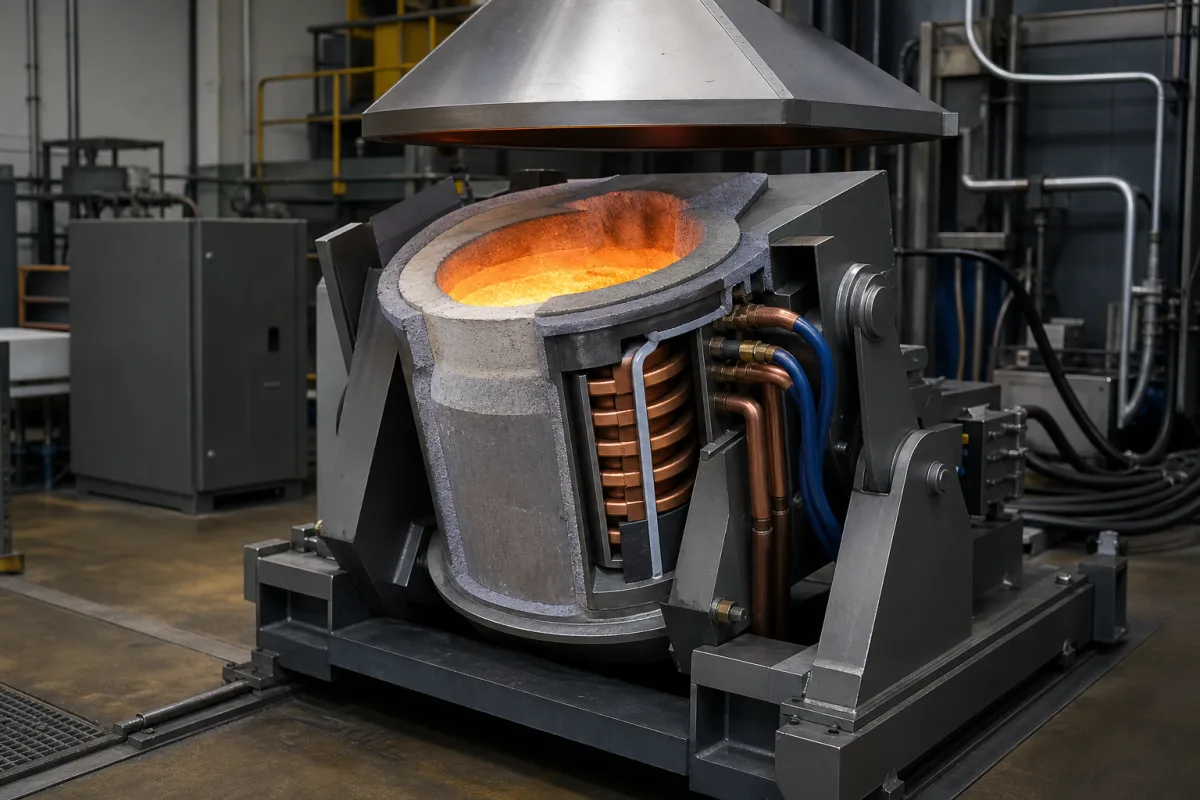
A canonical Smelting Furnace Module is characterized by the integration of Heating Zone and Thermal Insulation Layer. In industrial production environments, manufacturers listed on CNFX commonly emphasize Refractory Lining construction to support stable, high-cycle operation across diverse manufacturing scenarios.

A modular heating unit designed for melting non-ferrous metals within an integrated smelting and casting system.
Product Specifications

Technical details and manufacturing context for Smelting Furnace Module

Definition
The Smelting Furnace Module is a critical component of the Integrated Non-Ferrous Metal Smelting and Casting System, responsible for the controlled melting of metals such as aluminum, copper, zinc, and their alloys. It provides the precise thermal environment necessary to prepare molten metal for subsequent casting processes.
Working Principle
The module generates and contains intense heat, typically via electric resistance, induction, or gas-fired burners, to raise the temperature of the metal charge above its melting point. It maintains a controlled atmosphere to prevent oxidation and ensures uniform temperature distribution for consistent melt quality.
Common Materials
Refractory Lining, Heating Elements / Burners, Steel Casing
Technical Parameters
  • Rated heating power of the furnace module. (kW) Customizable
Components / BOM
  • Heating Zone
    The core chamber where the metal is heated and melted.
    Material: Refractory bricks and ceramics
  • Thermal Insulation Layer
    Minimizes heat loss to the environment and protects the outer structure.
    Material: Ceramic fiber blanket/board
  • Temperature Sensor
    Monitors and provides feedback on the internal temperature for process control.
    Material: Thermocouple (e.g., Type K)
Engineering Reasoning
800-1200°C heating element temperature, 0.5-2.0 MPa refractory lining pressure
1350°C heating element temperature (silicon carbide decomposition), 2.8 MPa refractory lining pressure (alumina-silica composite yield point)
Design Rationale: Thermal decomposition of silicon carbide heating elements above 1350°C, combined with refractory material yielding under excessive thermal expansion pressure
Risk Mitigation (FMEA)
Trigger Insufficient cooling water flow rate below 15 L/min
Mode: Refractory lining thermal shock cracking
Strategy: Redundant cooling circuits with flow sensors and automatic shutdown at 12 L/min
Trigger Power supply voltage fluctuation exceeding ±10% of 480V nominal
Mode: Silicon carbide heating element resistance runaway
Strategy: Voltage regulation system with ±5% tolerance and thermal monitoring feedback loop

Industry Taxonomies & Aliases

Commonly used trade names and technical identifiers for Smelting Furnace Module.

Industrial Ecosystem & Supply Chain DNA

Complementary Systems
Downstream Applications
Specialized Tooling

Application Fit & Sizing Matrix

Operational Limits
pressure: Atmospheric to 0.5 bar gauge (positive pressure operation)
flow rate: N/A (batch processing, not continuous flow)
temperature: Ambient to 1200°C (operating range: 600-1100°C)
heating rate: 100-300°C/hour (typical ramp rate)
thermal efficiency: 75-85% (energy input to metal melting)
max charge capacity: 500-5000 kg per batch (module dependent)
slurry concentration: N/A (designed for solid metal charge, not slurry)
Media Compatibility
✓ Aluminum alloys (e.g., A356, 6061) ✓ Copper alloys (e.g., C11000, C83600) ✓ Zinc alloys (e.g., ZA-8, ZA-27)
Unsuitable: Ferrous metals (steel, iron) - insufficient temperature capability and potential refractory damage
Sizing Data Required
  • Required melt capacity (kg/hour or kg/batch)
  • Target metal/alloy type and melting temperature
  • Available utilities (electrical power rating in kW, available voltage/phase)

Reliability & Engineering Risk Analysis

Failure Mode & Root Cause
Thermal fatigue cracking
Cause: Cyclic heating and cooling during furnace operation causes expansion and contraction stresses, leading to crack initiation and propagation in refractory linings and structural components.
Corrosive degradation
Cause: Exposure to molten metal, slag, and aggressive chemical atmospheres at high temperatures leads to material deterioration, particularly in refractory materials and furnace linings.
Maintenance Indicators
  • Visible cracks or spalling in refractory lining observed through inspection ports
  • Abnormal temperature gradients detected by infrared thermography or excessive heat radiation from furnace exterior
Engineering Tips
  • Implement predictive maintenance using thermal imaging and acoustic monitoring to detect early signs of refractory degradation before catastrophic failure occurs
  • Establish controlled heating and cooling protocols to minimize thermal shock, including gradual ramp-up/down procedures and maintaining proper furnace atmosphere control

Compliance & Manufacturing Standards

Reference Standards
ISO 13579-1:2013 (Thermal processing equipment - Safety requirements for furnaces) ASTM E2207-15 (Standard Practice for Strain-Controlled Axial-Torsional Fatigue Testing with Thin-Walled Tubular Specimens) CE Marking (EU Machinery Directive 2006/42/EC for safety and performance)
Manufacturing Precision
  • Temperature Uniformity: +/-5°C across heating zones
  • Refractory Lining Thickness: +/-3mm of specified dimension
Quality Inspection
  • Non-Destructive Testing (NDT) - Ultrasonic Testing for weld integrity and material flaws
  • Thermal Performance Test - Verification of heating rate, maximum temperature, and energy efficiency under load

Factories Producing Smelting Furnace Module

Verified manufacturers with capability to produce this product in China

✓ 96% Supplier Capability Match Found

T Technical Director from Australia Jan 06, 2026
★★★★★
"The Smelting Furnace Module we sourced perfectly fits our Basic Metal Manufacturing production line requirements."
Technical Specifications Verified
P Project Engineer from Singapore Jan 03, 2026
★★★★☆
"Found 54+ suppliers for Smelting Furnace Module on CNFX, but this spec remains the most cost-effective. (Delivery took slightly longer than expected, but technical support was excellent.)"
Technical Specifications Verified
S Sourcing Manager from Germany Dec 31, 2025
★★★★★
"The technical documentation for this Smelting Furnace Module is very thorough, especially regarding technical reliability."
Technical Specifications Verified
Verification Protocol

“Feedback is collected from verified sourcing managers during RFQ (Request for Quote) and factory evaluation processes on CNFX. These reports represent historical performance data and technical audit summaries from our B2B manufacturing network.”

17 sourcing managers are analyzing this specification now. Last inquiry for Smelting Furnace Module from India (13m ago).

Supply Chain Compatible Machinery & Devices

Continuous Casting Machine

Industrial machine for solidifying molten metal into continuous billets/blooms/slabs.

Explore Specs →
Electromagnetic Induction Heater

Industrial heating device using electromagnetic induction for metal processing

Explore Specs →
Vacuum Induction Melting Furnace

Industrial furnace for melting metals under vacuum using electromagnetic induction

Explore Specs →
Electroslag Remelting Furnace

Secondary refining furnace for high-quality metal ingots

Explore Specs →

Frequently Asked Questions

What types of non-ferrous metals can this smelting furnace module process?

This module is designed for melting common non-ferrous metals including aluminum, copper, brass, bronze, and zinc alloys, with temperature ranges suitable for their specific melting points.

How does the modular design benefit metal manufacturing operations?

The modular design allows for easy integration into existing smelting systems, simplified maintenance through component replacement, and scalability to match production capacity requirements.

What maintenance is required for the refractory lining and heating elements?

Regular inspection of refractory lining for wear and cracks is recommended, with replacement typically needed every 1-3 years depending on usage. Heating elements/burners should be cleaned periodically and replaced when efficiency declines.

Can I contact factories directly on CNFX?

CNFX is an open directory, not a transaction platform. Each factory profile provides direct contact information and production details to help you initiate direct inquiries with Chinese suppliers.

Get Quote for Smelting Furnace Module

Request technical pricing, lead times, or customized specifications for Smelting Furnace Module directly from verified manufacturing units.

Your business information is encrypted and only shared with verified Smelting Furnace Module suppliers.

Thank you! Your message has been sent. We'll respond within 1–3 business days.

Need to Manufacture Smelting Furnace Module?

Connect with verified factories specializing in this product category

Add Your Factory Contact Us
Previous Product
Smart Molten Metal Degassing and Filtration System
Next Product
Stack