Continuous Casting Mold Assembly
View system integration details
This page explains how Water Jacket / Cooling System is classified within Basic Metal Manufacturing. Technical values and manufacturer relationships are research references; confirm the current specification and supplier evidence for each order.
A cooling component within continuous casting molds that regulates temperature through controlled water circulation.
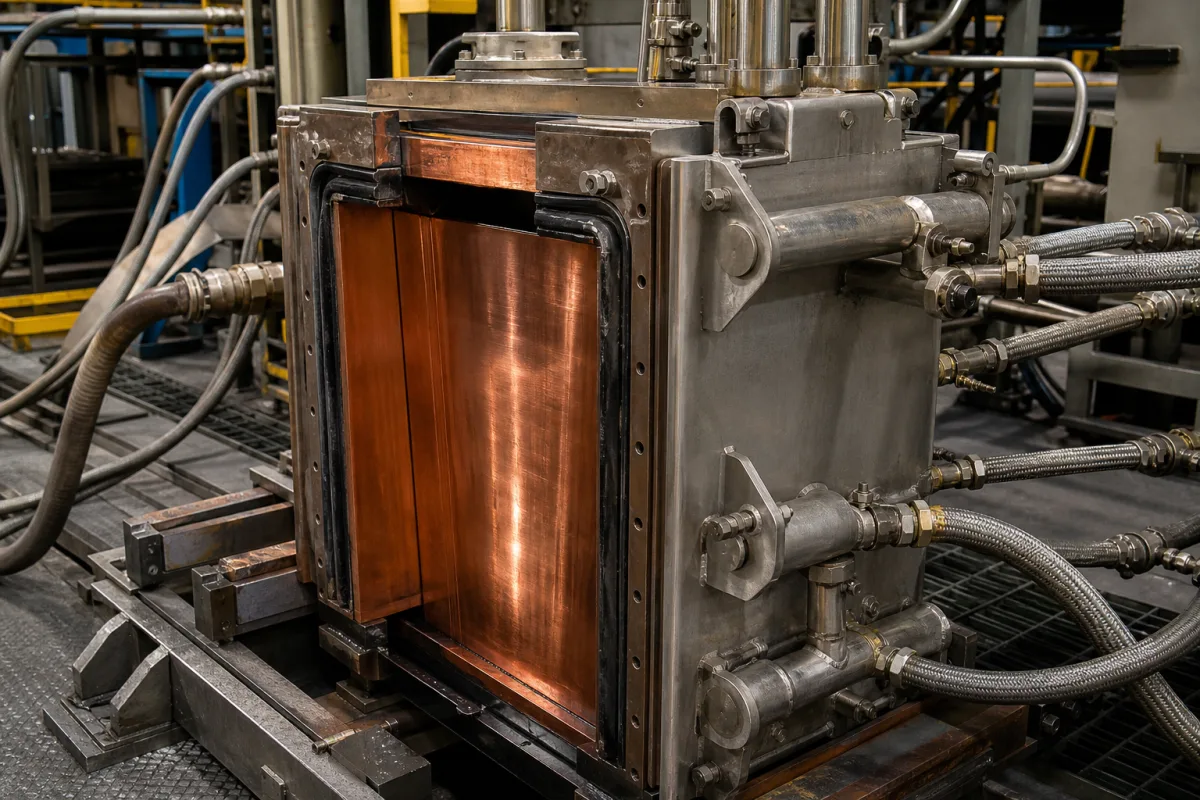
Technical details and manufacturing context for Water Jacket / Cooling System
| Parameter | Typical range | Notes & selection driver |
|---|---|---|
| Cooling Water Flow Rate | 80–120 L/min | Ensures uniform cooling; below 80 L/min may cause hot spots. |
| Water Inlet Temperature | 20–35 °C | Higher temperatures reduce cooling efficiency. |
| Water Outlet Temperature | 40–60 °C | Maximum outlet temperature to prevent boiling. |
| Operating Pressure | 1.0–1.6 MPa | |
| Pressure Drop | 0.05–0.15 MPa | Higher pressure drop may require larger pump. |
| Cooling Capacity | 150–300 kW | Matches casting heat load. |
| Material | H13 | Hot-work tool steel for high thermal fatigue resistance.ASTM A681 |
| Wall Thickness | 10–20 mm | Thinner walls improve heat transfer but reduce strength. |
| Surface Roughness | Ra 0.8–1.6 µm | Smoother surfaces reduce scale buildup.ISO 4287 |
| Leakage Rate | ≤0.01 mL/min | Exceeds Class A requirement. |
| Weight | 150–250 kg | Affects handling and installation. |
| Dimensions (L×W×H) | 800×400×300 mm | Customizable to mold design. |
Ranges are indicative industry figures for RFQ preparation, not a supplier commitment. Confirm every value and standard with the legal manufacturer before ordering.
Commonly used trade names and technical identifiers for Water Jacket / Cooling System.
This component is essential for the following industrial systems and equipment:
| pressure: | Up to 10 bar (maximum operating pressure) |
| flow rate: | 10 to 100 L/min (typical for standard casting molds) |
| temperature: | 5°C to 95°C (inlet water temperature range) |
| slurry concentration: | Not applicable (clean water systems only) |
Indicative industry ranges for design and RFQ preparation. Confirm the exact figures and applicable standard with the manufacturer before specifying.
Quoted from the published standard.
5 companies list this product among what they make. Company figures are quoted from each company's own website; every card states where the relationship came from.
Manufacturer listings support early research and capability understanding. They are not certification, ranking, or transaction guarantees.
A practical evidence checklist for RFQ preparation and supplier evaluation.
CNFX does not score or rank suppliers. Buyers must verify all claims and documents with the legal manufacturer before ordering.
The water jacket regulates the mold temperature by circulating cooling water through internal channels. This prevents overheating, ensures proper solidification of molten metal, and reduces the risk of defects in the final product.
Reference parameters include a cooling water flow rate of 80–120 L/min, inlet temperature of 20–35 °C, outlet temperature of 40–60 °C, operating pressure of 1.0–1.6 MPa, and cooling capacity of 150–300 kW. These values must be verified for the specific model and application.
Common materials include copper alloy and stainless steel. Additionally, hot-work tool steel grade H13 (ASTM A681) is specified for components requiring high thermal fatigue resistance. Material selection depends on the application and must be confirmed with the supplier.
Regular maintenance includes monitoring flow rate, temperature, and pressure, checking for scale buildup, leaks, and wear. The surface roughness (Ra 0.8–1.6 µm) helps reduce scale buildup. Any deviation from specified parameters should be investigated to prevent mold damage or product defects.
Editorial classification, named public sources where available, and source-reviewed manufacturer records.
Ask for use case, specification boundaries, supplier type, and RFQ preparation information for this product.
Compare manufacturer profiles with relevant product and process capability.