Industry-Verified Manufacturing Data (2026)

Automated Fermentation Control System

Based on aggregated insights from multiple verified factory profiles within the CNFX directory, the standard Automated Fermentation Control System used in the Beverage Manufacturing sector typically supports operational capacities ranging from standard industrial configurations to heavy-duty production requirements.

Technical Definition & Core Assembly

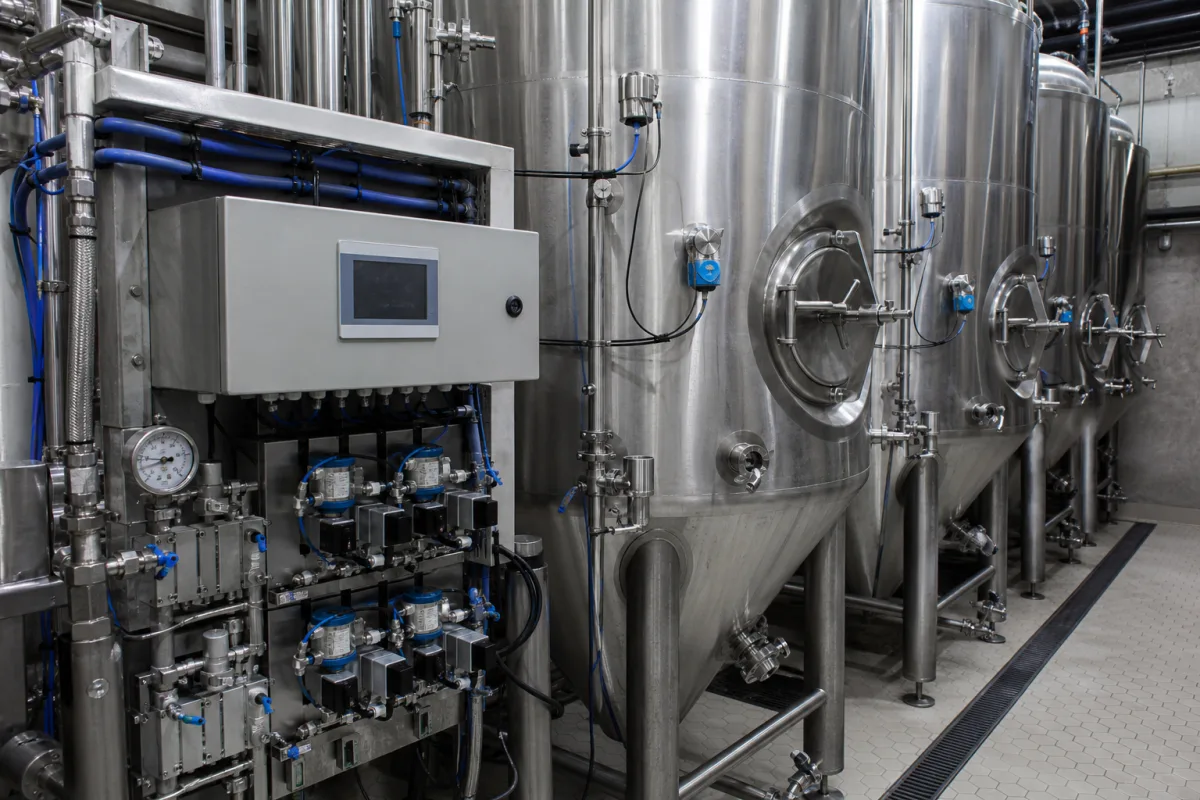
A canonical Automated Fermentation Control System is characterized by the integration of Temperature Control Module and Pressure Regulation Unit. In industrial production environments, manufacturers listed on CNFX commonly emphasize Stainless Steel 316L construction to support stable, high-cycle operation across diverse manufacturing scenarios.

Integrated industrial system for precise control of alcoholic fermentation processes.

Product Specifications

Technical details and manufacturing context for Automated Fermentation Control System

Definition
A comprehensive industrial automation system designed specifically for alcoholic beverage manufacturing that monitors and regulates fermentation parameters in real-time. This system integrates temperature control, pressure management, pH monitoring, and agitation systems to ensure consistent product quality and optimal fermentation efficiency. It serves as a critical component in breweries, wineries, and distilleries by automating what was traditionally a manual, variable process. The system enables B2B manufacturers to achieve batch-to-batch consistency while reducing labor costs and minimizing product loss due to fermentation failures.
Working Principle
Utilizes networked sensors to monitor fermentation parameters, with automated actuators adjusting temperature, pressure, and agitation based on pre-programmed fermentation curves and real-time feedback loops.
Common Materials
Stainless Steel 316L, Food-Grade Plastics, Titanium Alloy, Ceramic Coatings
Technical Parameters
  • Operational temperature control range (°C) Standard Spec
  • Maximum volume of fermentation vessel supported (liters) Standard Spec
Components / BOM
Engineering Reasoning
0.8-1.2 bar absolute pressure, 18-32°C temperature, 3.5-4.2 pH
Pressure exceeding 1.5 bar absolute causes vessel rupture, temperature below 15°C halts yeast metabolism, temperature above 35°C denatures enzymes
Design Rationale: Vessel rupture occurs when internal pressure exceeds yield strength of 316L stainless steel (205 MPa at 20°C). Thermal failure follows Arrhenius equation where reaction rate doubles per 10°C increase until enzyme denaturation at 35°C.
Risk Mitigation (FMEA)
Trigger PID controller integral windup during rapid temperature setpoint changes
Mode: Overshoot exceeding 35°C for >15 minutes causing irreversible enzyme denaturation
Strategy: Implement anti-windup circuitry with 0.1°C deadband and rate limiting of 2°C/minute setpoint changes
Trigger Dissolved oxygen sensor biofilm accumulation exceeding 50μm thickness
Mode: Signal attenuation causing false low oxygen readings triggering unnecessary aeration
Strategy: Install ultrasonic cleaning system operating at 40kHz with 30-minute intervals and automated calibration against Clark electrode reference

Industry Taxonomies & Aliases

Commonly used trade names and technical identifiers for Automated Fermentation Control System.

Industrial Ecosystem & Supply Chain DNA

Complementary Systems
Downstream Applications
Specialized Tooling

Application Fit & Sizing Matrix

Operational Limits
pressure: 0-2 bar (max operating pressure)
flow rate: 0.5-20 L/min (per pump channel)
temperature: 5-40°C (operating range), 0-50°C (storage)
slurry concentration: Up to 40% solids by weight
Media Compatibility
✓ Stainless steel 316L wetted parts ✓ Food-grade PTFE seals ✓ Ethanol/water mixtures up to 20% ABV
Unsuitable: Chlorinated solvents or highly acidic media (pH < 2.5)
Sizing Data Required
  • Maximum batch volume (liters)
  • Required fermentation temperature profile (°C vs time)
  • Target alcohol concentration (% ABV)

Reliability & Engineering Risk Analysis

Failure Mode & Root Cause
Sensor drift or failure
Cause: Biofouling from fermentation media, exposure to corrosive gases (CO2, ethanol), or calibration drift due to temperature fluctuations affecting pH, dissolved oxygen, and temperature sensors.
Control valve sticking or leakage
Cause: Accumulation of solids or microbial growth in valve seats and actuators, combined with cyclic thermal stress from sterilization cycles (SIP/CIP), leading to seal degradation or actuator failure.
Maintenance Indicators
  • Erratic or non-responsive control behavior (e.g., pH or temperature oscillating outside setpoints despite corrective actions)
  • Unusual audible alarms (e.g., continuous beeping from the PLC/HMI) or visible leaks/condensation around valves, sensors, or fittings
Engineering Tips
  • Implement a rigorous calibration schedule for all critical sensors (pH, DO, temperature) using traceable standards, and install protective barriers (e.g., sanitary membranes or purge systems) to reduce biofouling and corrosion.
  • Adopt predictive maintenance techniques, such as vibration analysis on agitator motors and trend monitoring of valve response times, to detect early degradation before functional failure occurs.

Compliance & Manufacturing Standards

Reference Standards
ISO 9001:2015 - Quality Management Systems IEC 61508 - Functional Safety of Electrical/Electronic/Programmable Electronic Safety-related Systems CE Marking - EU Machinery Directive 2006/42/EC
Manufacturing Precision
  • Temperature Control: +/-0.5°C
  • Pressure Sensor Accuracy: +/-0.25% of full scale
Quality Inspection
  • Sterility Validation Test (per ISO 14644 for cleanroom standards)
  • Functional Safety Test (SIL verification per IEC 61508)

Factories Producing Automated Fermentation Control System

Verified manufacturers with capability to produce this product in China

✓ 96% Supplier Capability Match Found

S Sourcing Manager from Australia Feb 13, 2026
★★★★★
"The technical documentation for this Automated Fermentation Control System is very thorough, especially regarding Temperature Control Accuracy (±°C)."
Technical Specifications Verified
P Procurement Specialist from Singapore Feb 10, 2026
★★★★☆
"Reliable performance in harsh Beverage Manufacturing environments. No issues with the Automated Fermentation Control System so far. (Delivery took slightly longer than expected, but technical support was excellent.)"
Technical Specifications Verified
T Technical Director from Germany Feb 07, 2026
★★★★★
"Testing the Automated Fermentation Control System now; the Temperature Control Accuracy (±°C) results are within 1% of the laboratory datasheet."
Technical Specifications Verified
Verification Protocol

“Feedback is collected from verified sourcing managers during RFQ (Request for Quote) and factory evaluation processes on CNFX. These reports represent historical performance data and technical audit summaries from our B2B manufacturing network.”

14 sourcing managers are analyzing this specification now. Last inquiry for Automated Fermentation Control System from Vietnam (1h ago).

Supply Chain Commonly Integrated Components

Precision Metering Pump Assembly

A precision fluid handling component designed to accurately measure and dispense specific volumes of liquid ingredients within an automated beverage blending system.

Explore Specs →
Sanitary Flow Meter

A precision instrument designed to measure the volumetric or mass flow rate of liquids in hygienic processing environments, featuring smooth surfaces and cleanable designs to prevent contamination.

Explore Specs →
Ingredient Inlet Valve Manifold

A multi-port valve assembly that controls and directs the flow of liquid ingredients into an automated beverage blending system.

Explore Specs →
In-line Mixer/Static Mixer

A stationary mixing device installed directly in a pipeline that blends beverage ingredients through geometric flow manipulation without moving parts.

Explore Specs →

Frequently Asked Questions

What materials are used in the Automated Fermentation Control System to ensure food safety?

The system uses Stainless Steel 316L, food-grade plastics, titanium alloy, and ceramic coatings - all certified for food and beverage manufacturing to prevent contamination and ensure product purity.

How does the system maintain precise temperature control during fermentation?

The Temperature Control Module provides ±°C accuracy with rapid system response time in seconds, ensuring optimal yeast activity and consistent fermentation results for various alcoholic beverages.

Can this system handle multiple fermentation vessels simultaneously?

Yes, the system supports multiple vessel connections with individual control of each vessel's agitation speed, pressure, temperature, and pH monitoring through the centralized Control Interface Panel.

Can I contact factories directly on CNFX?

CNFX is an open directory, not a transaction platform. Each factory profile provides direct contact information and production details to help you initiate direct inquiries with Chinese suppliers.

Get Quote for Automated Fermentation Control System

Request technical pricing, lead times, or customized specifications for Automated Fermentation Control System directly from verified manufacturing units.

Your business information is encrypted and only shared with verified Automated Fermentation Control System suppliers.

Thank you! Your message has been sent. We'll respond within 1–3 business days.

Need to Manufacture Automated Fermentation Control System?

Connect with verified factories specializing in this product category

Add Your Factory Contact Us
Previous Product
Automated CIP/SIP System for Beverage Production
Next Product
Automated Kegging and Barrel Filling System