Industry-Verified Manufacturing Data (2026)

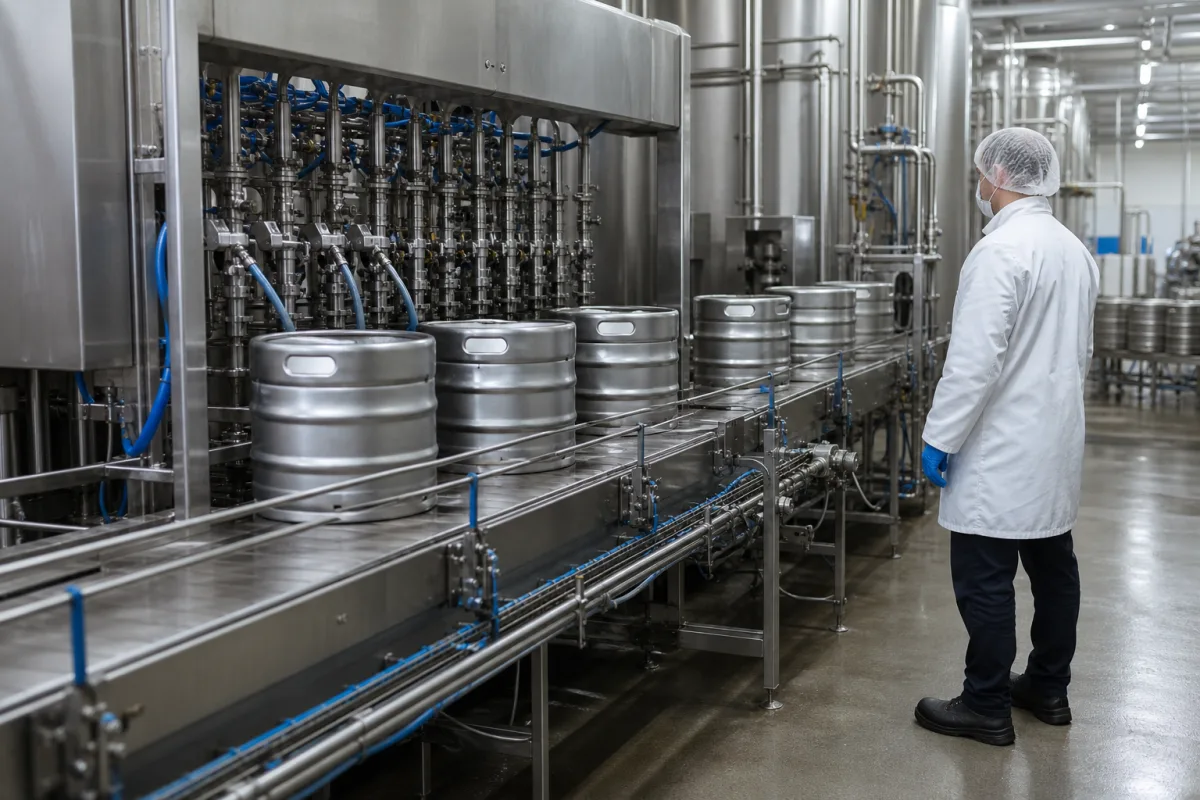
Automated Kegging and Barrel Filling System

Based on aggregated insights from multiple verified factory profiles within the CNFX directory, the standard Automated Kegging and Barrel Filling System used in the Beverage Manufacturing sector typically supports operational capacities ranging from standard industrial configurations to heavy-duty production requirements.

Technical Definition & Core Assembly

A canonical Automated Kegging and Barrel Filling System is characterized by the integration of Automated Conveyor System and CIP Cleaning Module. In industrial production environments, manufacturers listed on CNFX commonly emphasize Stainless Steel 316L construction to support stable, high-cycle operation across diverse manufacturing scenarios.

Integrated industrial system for automated filling, sealing, and handling of kegs and barrels

Product Specifications

Technical details and manufacturing context for Automated Kegging and Barrel Filling System

Definition
A complete industrial production line designed for the high-volume filling of alcoholic beverages into reusable kegs and barrels. This system integrates multiple modules including automated cleaning, precise volumetric filling, gas purging, pressure testing, and final sealing operations. It ensures consistent product quality, minimizes oxygen exposure, and optimizes production throughput for breweries, wineries, and distilleries. The coordinated solution handles various container sizes and materials while maintaining strict sanitary standards.
Working Principle
Empty containers are conveyed through sequential stations where they undergo automated cleaning, are filled with beverage via precision flow meters, purged with inert gas, pressure-tested for leaks, and finally sealed with appropriate closures before palletization.
Common Materials
Stainless Steel 316L, Food-Grade Elastomers, Polycarbonate Safety Guards
Technical Parameters
  • Volumetric precision of liquid dispensed into each container (%) Standard Spec
  • Maximum number of kegs/barrels processed per hour (units/hour) Standard Spec
Components / BOM
Engineering Reasoning
0.5-6.0 bar filling pressure, 0.1-0.3 m/s conveyor speed, 18-25°C ambient temperature
Seal failure at 8.5 bar internal pressure, motor overload at 0.4 m/s conveyor speed, sensor drift beyond ±0.5% accuracy
Design Rationale: Hooke's Law elastic limit exceeded in sealing gaskets at 8.5 bar, Joule heating in drive motors exceeding 85°C at 0.4 m/s, piezoelectric crystal depolarization in pressure sensors beyond ±0.5% accuracy threshold
Risk Mitigation (FMEA)
Trigger Hydraulic fluid contamination exceeding ISO 4406 18/16/13 cleanliness level
Mode: Proportional valve spool sticking causing 15% flow deviation
Strategy: Integrate 3 μm absolute filtration with differential pressure monitoring at 0.8 bar threshold
Trigger Encoder signal loss for 200 ms duration due to EMI at 85 dBμV/m
Mode: Servo motor position error accumulation exceeding ±0.2 mm tolerance
Strategy: Shielded twisted pair cabling with ferrite chokes at 100 MHz resonance frequency

Industry Taxonomies & Aliases

Commonly used trade names and technical identifiers for Automated Kegging and Barrel Filling System.

Industrial Ecosystem & Supply Chain DNA

Complementary Systems
Downstream Applications
Specialized Tooling

Application Fit & Sizing Matrix

Operational Limits
pressure: Up to 6 bar (filling pressure), 10 bar (system max)
flow rate: Up to 150 L/min per filling head
temperature: 5°C to 40°C (operating), -10°C to 60°C (storage)
viscosity range: 1 to 500 cP
container size range: 20L to 200L (kegs/barrels)
slurry concentration: Up to 30% solids by weight (non-abrasive)
Media Compatibility
✓ Beer and carbonated beverages ✓ Wine and spirits ✓ Food-grade liquids (oils, syrups, dairy)
Unsuitable: Highly corrosive chemicals (e.g., strong acids, chlorinated solvents)
Sizing Data Required
  • Required throughput (kegs/hour)
  • Container size(s) and types (keg/barrel dimensions)
  • Product viscosity and carbonation level

Reliability & Engineering Risk Analysis

Failure Mode & Root Cause
Seal degradation and leakage
Cause: Chemical attack from cleaning agents (e.g., caustic solutions) and product residues (e.g., beer proteins, sugars) causing elastomer swelling, hardening, or cracking over time, compounded by mechanical wear from repeated actuation cycles.
Valve or actuator sticking/failure
Cause: Accumulation of particulates (e.g., hop debris, yeast, mineral scale) or dried product residues in moving parts, leading to increased friction, misalignment, or solenoid/ pneumatic actuator malfunction, often exacerbated by inadequate cleaning or moisture ingress.
Maintenance Indicators
  • Audible hissing or irregular pneumatic sounds from valves/actuators indicating air leaks or sticking components.
  • Visible product drips or pooling around seals, fittings, or valve bodies, especially after cleaning cycles or during idle periods.
Engineering Tips
  • Implement a preventive maintenance schedule for seal inspection and replacement based on cycle counts and exposure to cleaning chemicals, using chemically compatible materials (e.g., EPDM, PTFE) rated for both product and sanitizers.
  • Install inline filters on pneumatic and product lines to trap particulates, and ensure cleaning protocols include thorough flushing and drying to prevent residue buildup in valves and actuators.

Compliance & Manufacturing Standards

Reference Standards
ISO 9001:2015 - Quality Management Systems CE Marking - Machinery Directive 2006/42/EC ASME BPE-2022 - Bioprocessing Equipment
Manufacturing Precision
  • Filling Volume Accuracy: +/- 0.5% of target volume
  • Sealing Surface Flatness: 0.08mm across mating surfaces
Quality Inspection
  • Pressure Decay Leak Test - 1.5x operating pressure for 30 minutes
  • Cleanliness Verification - ATP bioluminescence testing for microbial contamination

Factories Producing Automated Kegging and Barrel Filling System

Verified manufacturers with capability to produce this product in China

✓ 95% Supplier Capability Match Found

P Project Engineer from Brazil Jan 06, 2026
★★★★★
"The technical documentation for this Automated Kegging and Barrel Filling System is very thorough, especially regarding Maximum Throughput (kegs/hour)."
Technical Specifications Verified
S Sourcing Manager from Canada Jan 03, 2026
★★★★★
"Reliable performance in harsh Beverage Manufacturing environments. No issues with the Automated Kegging and Barrel Filling System so far."
Technical Specifications Verified
P Procurement Specialist from United States Dec 31, 2025
★★★★★
"Testing the Automated Kegging and Barrel Filling System now; the Maximum Throughput (kegs/hour) results are within 1% of the laboratory datasheet."
Technical Specifications Verified
Verification Protocol

“Feedback is collected from verified sourcing managers during RFQ (Request for Quote) and factory evaluation processes on CNFX. These reports represent historical performance data and technical audit summaries from our B2B manufacturing network.”

17 sourcing managers are analyzing this specification now. Last inquiry for Automated Kegging and Barrel Filling System from Vietnam (48m ago).

Supply Chain Commonly Integrated Components

Precision Metering Pump Assembly

A precision fluid handling component designed to accurately measure and dispense specific volumes of liquid ingredients within an automated beverage blending system.

Explore Specs →
Sanitary Flow Meter

A precision instrument designed to measure the volumetric or mass flow rate of liquids in hygienic processing environments, featuring smooth surfaces and cleanable designs to prevent contamination.

Explore Specs →
Ingredient Inlet Valve Manifold

A multi-port valve assembly that controls and directs the flow of liquid ingredients into an automated beverage blending system.

Explore Specs →
In-line Mixer/Static Mixer

A stationary mixing device installed directly in a pipeline that blends beverage ingredients through geometric flow manipulation without moving parts.

Explore Specs →

Frequently Asked Questions

What materials are used in this automated kegging system?

The system is constructed with Stainless Steel 316L for durability, food-grade elastomers for seals, and polycarbonate safety guards for operator protection.

What is the maximum throughput of this keg filling system?

The system has a maximum throughput of [kegs/hour] (exact number depends on configuration), with precision filling accuracy of ± [mL] and handles container sizes from [L] to [L].

Does the system include cleaning and quality control features?

Yes, it features an integrated CIP cleaning module, CO2 purging with [ppm O2] efficiency, and pressure testing up to [bar] range to ensure product quality and safety.

Can I contact factories directly on CNFX?

CNFX is an open directory, not a transaction platform. Each factory profile provides direct contact information and production details to help you initiate direct inquiries with Chinese suppliers.

Get Quote for Automated Kegging and Barrel Filling System

Request technical pricing, lead times, or customized specifications for Automated Kegging and Barrel Filling System directly from verified manufacturing units.

Your business information is encrypted and only shared with verified Automated Kegging and Barrel Filling System suppliers.

Thank you! Your message has been sent. We'll respond within 1–3 business days.

Need to Manufacture Automated Kegging and Barrel Filling System?

Connect with verified factories specializing in this product category

Add Your Factory Contact Us
Previous Product
Automated Fermentation Control System
Next Product
Automated Wort Clarification Separator