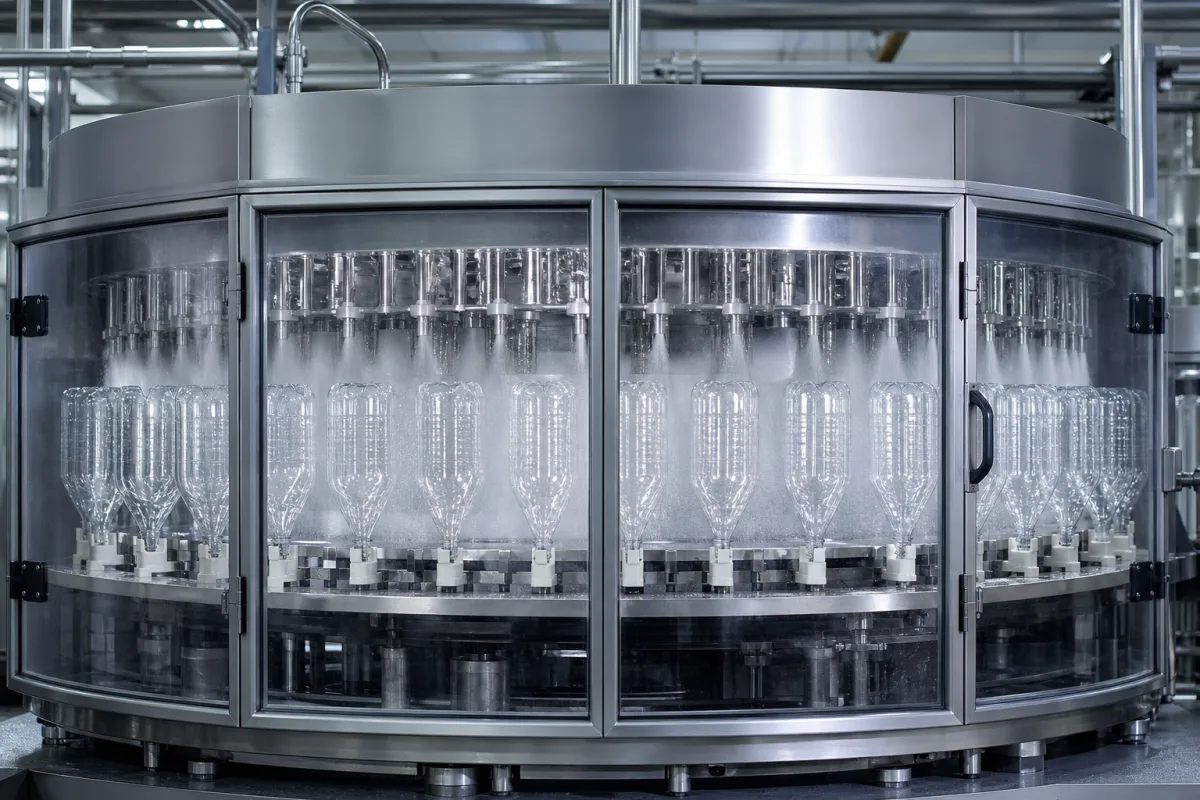
Hydrogen peroxide bottle sterilizer for aseptic PET filling
Aseptic PET lines · Hydrogen peroxide dose, hot sterile air activation, 0.5 ppm residue limit, preform versus bottle sterilization
A hydrogen peroxide bottle sterilizer is the station in an aseptic cold-fill line that applies H2O2 mist or gas to empty PET bottles (or their preforms), activates it with heat, and blows it out with sterile hot air before the bottles reach the filler. Ask three things first: what dose and gas concentration the machine delivers per bottle, how it proves the residue in filled product stays under the FDA limit, and whether it sterilizes bottles, preforms or both.
Hydrogen peroxide (mist, vapour or gas) sterilizers for empty PET bottles and preforms in aseptic beverage filling, including the H2O2 evaporator, dosing nozzles and hot sterile-air activation and purge. Water and ionized-air rinsers that clean bottles with a sanitizer rinse or air jets, without a validated sterilization step, are covered on the High-speed rotary bottle rinsing machine page. Household baby-bottle sterilizers, peracetic acid rinsers and sterilization of the filler isolator are outside this page.
CNFX editorial research · Sources checked October 12, 2026 · 3 sources
FDA's 21 CFR 178.1005 defines the sterilant as an aqueous solution of not more than 35% hydrogen peroxide by weight, meeting Food Chemicals Codex and USP specifications, and permits it, alone or with other processes, to give polymeric food-contact surfaces commercial sterility at least equivalent to thermal processing of metal containers under part 113. Polyethylene terephthalate complying with § 177.1630 is on the list of surfaces it may treat. [1]
Dai Nippon Printing's patent application EP 2 772 447 gives working doses for 500 mL bottles. Where only the bottle was sterilized, it states that 50–100 µL of hydrogen peroxide per 500 mL bottle, or a gas concentration of 5–10 mg/L, was needed. With the preform preheated and pre-sterilized, it reports commercially acceptable aseptic filling at 10–50 µL per 500 mL bottle, or 1–5 mg/L of gas. For the preform pre-sterilization it prefers a condensed film of 0.001–0.01 µL/cm² (35 weight % basis). [2]
Editorial calculation: moving from 50–100 µL to 10–50 µL per 500 mL bottle halves the dose at the top of the range and cuts it by 80% at the bottom; at 24,000 bottles per hour, every 10 µL per bottle is 240 mL of peroxide per hour. The line output is an assumed example. [2]
Give the supplier bottle volumes and neck finishes, PET grade and bottle weight, line output, product (low-acid or high-acid), the target log reduction and test organism, the H2O2 grade you will buy, and how residue will be sampled.
02
Activate with hot sterile air and prove the residue
FDA treats a sterilization process as non-compliant if more than 0.5 part per million of hydrogen peroxide can be determined in distilled water packaged under production conditions, with the assay performed immediately after packaging. [1]
EP 2 772 447 inverts the bottle and blows aseptic air through the downward-facing mouth, preferably heated above 70 °C so that it activates the peroxide, with a nozzle discharge temperature of 50–150 °C (75–120 °C preferred). In its example, 500 mL and 2 L bottles received heated aseptic air at 200 L/min for 3 seconds, and distilled water filled into them afterwards held less than 0.5 ppm hydrogen peroxide. [2]
The same document scores rinse time against five criteria: 0–3 seconds rated poor for residue and sterilization, 3–10 seconds acceptable on all counts, and over 10 seconds best for residue and sterilization but poor for bottle shrinkage and cost. Its pass bands are residue of 0.1–0.5 ppm (under 0.1 ppm best), a Bacillus subtilis spore reduction of 6–7 log (over 7 best) and bottle shrinkage of 0.2–1% (under 0.2% best). [2]
Editorial calculation: 200 L/min for 3 seconds is 10 L of air per bottle, equal to 20 volumes of a 500 mL bottle but only 5 volumes of a 2 L bottle, so a sterilizer that handles both sizes needs its rinse validated on the larger one. [2]
03
Choose bottle, preform or two-step sterilization
Dai Nippon Printing describes conventional aseptic PET lines as relying on large bottle sterilizers, long water-rinsing tunnels and multiple H2O2 evaporators. Its two-step system sprays H2O2 mist on the inner and outer surfaces of preforms on one wheel, removes residual peroxide with sterile hot air on a second wheel, heats the preforms to around 100–120 °C, and then sterilizes the blown bottles in a compact bottle sterilizer without water rinsing. [3]
DNP states that the approach reduces installation footprint by approximately 30%, cuts H2O2 use and associated energy by approximately 40%, and reduces the number of H2O2 evaporators from six to three. [3]
EP 2 772 447 preheats PET preforms to 40–80 °C (50–75 °C preferred) while keeping the mouth below 50 °C to avoid deformation; it states that sterilizing performance deteriorates below 40 °C and that bottles shrink after moulding above 80 °C. The preform body is then heated to 90–130 °C for blow moulding. [2]
04
Peroxide evaporator, mist or gas nozzles, preform pre-sterilizer, hot-air rinse and sterile air
Peroxide strength, dose, hot-air rinse, log reduction and residue limit for a PET bottle sterilizer
Ask for sterilization efficiency as a log reduction with the test organism, and for residue results against the FDA limit of 0.5 ppm in packaged distilled water. [2][1]
Explore company information and manufacturing capabilities, then discuss the scope of your project with a relevant supplier.
Share this page
Compiled and source-reviewed by the CNFX editorial team.
Each manufacturer above links to the page on that company's own website where the product is listed, with the date we checked it. How we source and review
· Page last updated 13 October 2026
Buyer questions
How much hydrogen peroxide may remain in the bottle?
FDA's 21 CFR 178.1005 treats the process as non-compliant if more than 0.5 ppm H2O2 can be determined in distilled water packaged under production conditions, assayed immediately after packaging. [1]
What gas concentration does a bottle sterilizer use?
EP 2 772 447 reports 5–10 mg/L when only the bottle is sterilized and 1–5 mg/L when the preform is preheated and pre-sterilized. [2]
Can the water rinse after sterilization be omitted?
Dai Nippon Printing states its two-step preform and bottle sterilization needs no bottle water rinsing. [3]
Sources and what still needs a direct check
Sources checked 2026-10-12. FDA's regulation sets the sterilant and residue limits. Dai Nippon Printing (DNP) is a packaging and aseptic-filling system maker: its patent application gives doses and air-rinse settings from its own trials, and its web page describes its two-step system.