Industry-Verified Manufacturing Data (2026)

Drying/Evaporation Tunnel

Based on aggregated insights from multiple verified factory profiles within the CNFX directory, the standard Drying/Evaporation Tunnel used in the Beverage Manufacturing sector typically supports operational capacities ranging from standard industrial configurations to heavy-duty production requirements.

Technical Definition & Core Assembly

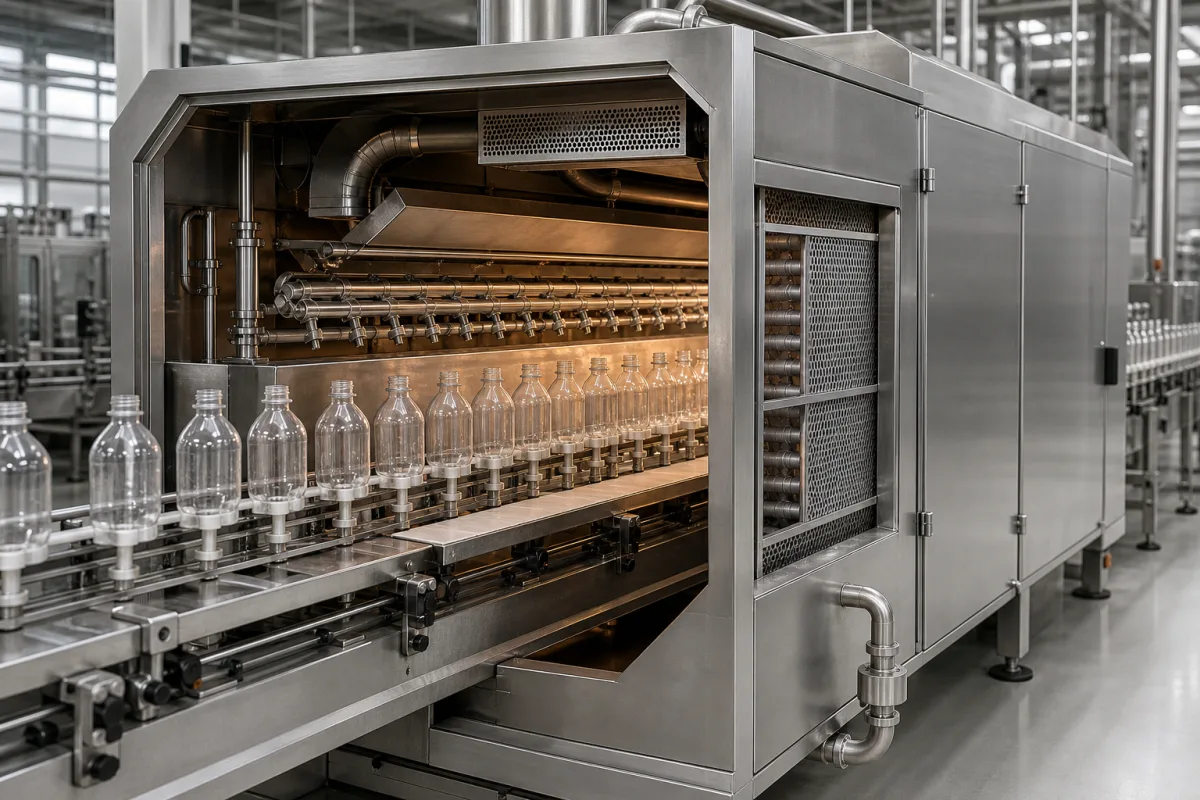
A canonical Drying/Evaporation Tunnel is characterized by the integration of Insulated Tunnel Casing and Heating Elements. In industrial production environments, manufacturers listed on CNFX commonly emphasize Stainless Steel (AISI 304/316) construction to support stable, high-cycle operation across diverse manufacturing scenarios.

A heated chamber within a bottle sterilizer that removes residual moisture or evaporates sterilizing agents from bottle surfaces after rinsing.
Product Specifications

Technical details and manufacturing context for Drying/Evaporation Tunnel

Definition
The Drying/Evaporation Tunnel is a critical component of a Bottle Sterilizer (e.g., Hydrogen Peroxide Rinser). Following the chemical rinsing or sterilization stage, bottles enter this tunnel. Its primary function is to apply controlled heat to evaporate any remaining liquid sterilant (like hydrogen peroxide) and moisture from the interior and exterior surfaces of the bottles, ensuring they are completely dry, sterile, and ready for filling. It ensures no chemical residues remain that could contaminate the product.
Working Principle
Bottles are conveyed through an enclosed, temperature-controlled tunnel. Heated air is circulated within the chamber, often using fans and heating elements (electric or steam). The heat energy transfers to the bottle surfaces, increasing the temperature of any residual liquid (water or sterilant solution) until it reaches its evaporation point, converting it to vapor, which is then typically exhausted from the system. The dwell time (conveyor speed) and temperature are precisely controlled to ensure complete drying without damaging the bottles.
Common Materials
Stainless Steel (AISI 304/316)
Technical Parameters
  • Length of the tunnel, determining processing capacity and dwell time. (mm) Standard Spec
Components / BOM
  • Insulated Tunnel Casing
    Forms the enclosed chamber to contain heat and protect the internal components. Provides structural support.
    Material: Stainless Steel with thermal insulation
  • Heating Elements
    Generate the heat required to raise the air temperature within the tunnel to evaporate moisture/sterilant.
    Material: Electric resistance coils or Steam Heat Exchangers (Stainless Steel)
  • Air Circulation Fans
    Circulate heated air uniformly throughout the tunnel to ensure consistent drying across all bottle surfaces.
    Material: Stainless Steel
  • Temperature Sensors & Controllers
    Monitor and regulate the internal temperature of the tunnel to maintain the set operating parameters.
    Material: Various (Sensor probes: Stainless Steel)
  • Conveyor System (within tunnel)
    Transports bottles through the tunnel at a controlled speed, determining the dwell time for drying.
    Material: Stainless Steel chain/belt
  • Vapor Exhaust Port
    Vent to remove moisture-laden air and evaporated sterilant from the tunnel chamber.
    Material: Stainless Steel ducting
Engineering Reasoning
80-120°C with 0.5-2.0 m/s air velocity
Material yield strength exceeded at 150°C with 0.1 MPa thermal stress or moisture content >0.5% by weight
Design Rationale: Thermal expansion mismatch between 304 stainless steel (17.3 μm/m·K) and heating elements (13.0 μm/m·K) causing stress concentration at welds
Risk Mitigation (FMEA)
Trigger PID controller integral windup causing 180°C overshoot
Mode: Polymer bottle deformation exceeding 2% dimensional change
Strategy: Cascade control with secondary RTD sensors and anti-windup algorithm (Kp=2.5, Ti=120s, Td=30s)
Trigger Laminar airflow disruption from 15° angular misalignment of inlet vanes
Mode: Moisture gradient >10% across tunnel cross-section
Strategy: Laser-aligned vane installation with 0.5° tolerance and computational fluid dynamics validation

Industry Taxonomies & Aliases

Commonly used trade names and technical identifiers for Drying/Evaporation Tunnel.

Applied To / Applications

This component is essential for the following industrial systems and equipment:

Industrial Ecosystem & Supply Chain DNA

Complementary Systems
Downstream Applications
Specialized Tooling

Application Fit & Sizing Matrix

Operational Limits
pressure: Atmospheric to 0.5 bar gauge (slight positive pressure for containment)
flow rate: 10-100 bottles/min (depending on tunnel length and conveyor speed)
temperature: 80-150°C (typical sterilization drying range)
slurry concentration: Not applicable (handles residual moisture/agent evaporation only)
Media Compatibility
✓ Glass bottles ✓ Plastic (PET/HDPE) bottles ✓ Stainless steel components
Unsuitable: Chlorine-based sterilizing agents (corrosive to heating elements and sensors)
Sizing Data Required
  • Bottle dimensions and throughput (units/hour)
  • Required residual moisture content (%)
  • Available floor space and utility connections (power, exhaust)

Reliability & Engineering Risk Analysis

Failure Mode & Root Cause
Thermal stress cracking
Cause: Rapid temperature cycling or uneven heating/cooling causing material fatigue and fracture in metal components
Corrosion-induced structural weakening
Cause: Exposure to moisture, chemicals, or acidic condensates leading to material degradation and loss of structural integrity
Maintenance Indicators
  • Unusual temperature fluctuations or hot spots detected by thermal imaging
  • Abnormal vibration patterns or audible knocking from fan/motor assemblies
Engineering Tips
  • Implement predictive maintenance with infrared thermography to detect early thermal anomalies before failure
  • Establish regular cleaning protocols for heat exchangers and ductwork to prevent corrosion and maintain optimal heat transfer efficiency

Compliance & Manufacturing Standards

Reference Standards
ISO 9001:2015 - Quality Management Systems ANSI/ASHRAE 15 - Safety Standard for Refrigeration Systems DIN EN 378 - Refrigerating systems and heat pumps - Safety and environmental requirements
Manufacturing Precision
  • Temperature Uniformity: +/- 2°C across tunnel length
  • Belt Tracking Alignment: +/- 1.5mm from centerline
Quality Inspection
  • Leak Testing (Pressure Decay or Helium Mass Spectrometry)
  • Thermal Performance Mapping (Temperature Profiling with Data Loggers)

Factories Producing Drying/Evaporation Tunnel

Verified manufacturers with capability to produce this product in China

✓ 94% Supplier Capability Match Found

P Project Engineer from United Arab Emirates Jan 05, 2026
★★★★★
"Impressive build quality. Especially the technical reliability is very stable during long-term operation."
Technical Specifications Verified
S Sourcing Manager from Australia Jan 02, 2026
★★★★★
"As a professional in the Beverage Manufacturing sector, I confirm this Drying/Evaporation Tunnel meets all ISO standards."
Technical Specifications Verified
P Procurement Specialist from Singapore Dec 30, 2025
★★★★★
"Standard OEM quality for Beverage Manufacturing applications. The Drying/Evaporation Tunnel arrived with full certification."
Technical Specifications Verified
Verification Protocol

“Feedback is collected from verified sourcing managers during RFQ (Request for Quote) and factory evaluation processes on CNFX. These reports represent historical performance data and technical audit summaries from our B2B manufacturing network.”

18 sourcing managers are analyzing this specification now. Last inquiry for Drying/Evaporation Tunnel from Brazil (32m ago).

Supply Chain Compatible Machinery & Devices

Automated Beverage Batch Blending System

Automated system for precise multi-ingredient beverage batch preparation.

Explore Specs →
Automated Beverage Container Sterilization System

Automated system for sterilizing beverage containers before filling.

Explore Specs →
Automated Beverage Labeling and Coding System

Integrated system for applying labels and printing codes on beverage containers.

Explore Specs →
Automated Beverage Ingredient Dispensing System

Automated system for precise dispensing of beverage ingredients into production lines.

Explore Specs →

Frequently Asked Questions

What is the primary function of a drying/evaporation tunnel in beverage manufacturing?

The drying/evaporation tunnel removes residual moisture and evaporates sterilizing agents from bottle surfaces after the rinsing process, ensuring bottles are completely dry and ready for filling.

Why is stainless steel (AISI 304/316) used for this equipment?

Stainless steel AISI 304/316 provides excellent corrosion resistance, hygiene, and durability required in beverage manufacturing environments where equipment is exposed to moisture, heat, and cleaning chemicals.

How does the temperature control system work in the drying tunnel?

Temperature sensors monitor the tunnel environment, while controllers adjust heating elements to maintain optimal drying temperatures. Air circulation fans ensure even heat distribution for consistent evaporation.

Can I contact factories directly on CNFX?

CNFX is an open directory, not a transaction platform. Each factory profile provides direct contact information and production details to help you initiate direct inquiries with Chinese suppliers.

Get Quote for Drying/Evaporation Tunnel

Request technical pricing, lead times, or customized specifications for Drying/Evaporation Tunnel directly from verified manufacturing units.

Your business information is encrypted and only shared with verified Drying/Evaporation Tunnel suppliers.

Thank you! Your message has been sent. We'll respond within 1–3 business days.

Need to Manufacture Drying/Evaporation Tunnel?

Connect with verified factories specializing in this product category

Add Your Factory Contact Us
Previous Product
Drainage Tray
Next Product
Food-Grade Ethanol Solution