Industry-Verified Manufacturing Data (2026)

Sterile Air Purge

Based on aggregated insights from multiple verified factory profiles within the CNFX directory, the standard Sterile Air Purge used in the Food Manufacturing sector typically supports operational capacities ranging from standard industrial configurations to heavy-duty production requirements.

Technical Definition & Core Assembly

A canonical Sterile Air Purge is characterized by the integration of HEPA Filter Housing and Air Distribution Manifold. In industrial production environments, manufacturers listed on CNFX commonly emphasize Stainless steel 316L construction to support stable, high-cycle operation across diverse manufacturing scenarios.

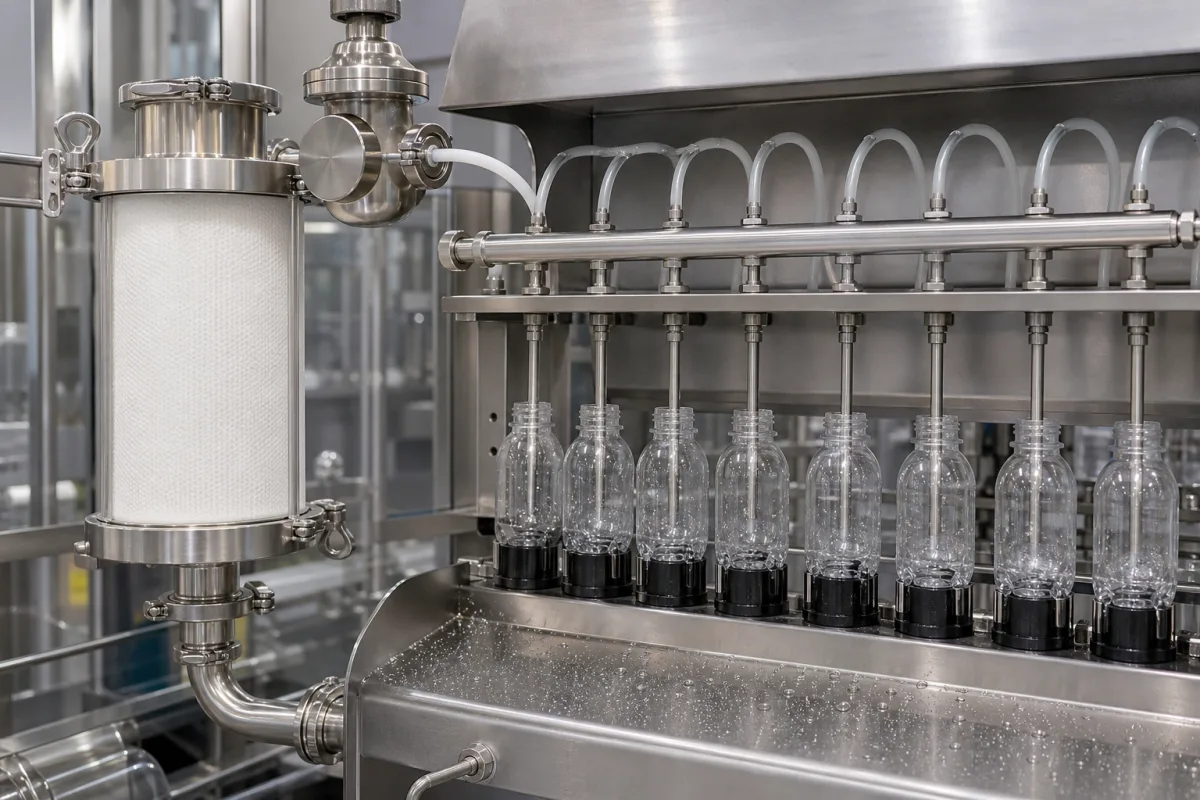
A component that removes residual sterilant and moisture from bottles using filtered sterile air after chemical sterilization.
Product Specifications

Technical details and manufacturing context for Sterile Air Purge

Definition
The Sterile Air Purge is a critical subsystem within bottle sterilizers (such as hydrogen peroxide rinsers) that follows the chemical sterilization stage. It uses HEPA-filtered sterile air to forcibly displace residual hydrogen peroxide solution, vapor, and moisture from bottle interiors and exteriors, ensuring complete drying and preventing chemical carryover into subsequent filling operations. This process maintains sterility while preparing containers for aseptic filling.
Working Principle
Sterile air is generated by passing compressed air through high-efficiency particulate air (HEPA) filters (typically 0.2-0.3 μm) to remove microorganisms. This filtered air is then directed through nozzles into the sterilization chamber at controlled pressure and flow rates. The air stream creates turbulent flow within bottles, evaporating residual liquid sterilant and carrying vapors out through exhaust systems. The purge cycle is timed and monitored to achieve specified dryness levels.
Common Materials
Stainless steel 316L, PTFE (seals/gaskets), HEPA filter media, Silicone tubing
Technical Parameters
  • Sterile air flow rate required for effective purge (m³/min) Per Request
Components / BOM
  • HEPA Filter Housing
    Contains and seals HEPA filter elements for sterile air generation
    Material: Stainless steel 316L
  • Air Distribution Manifold
    Distributes sterile air evenly to multiple purge nozzles
    Material: Stainless steel 316L
  • Purge Nozzles
    Direct sterile air stream into bottle openings for effective cleaning
    Material: Stainless steel 316L
  • Pressure Regulator
    Maintains consistent air pressure during purge cycle
    Material: Stainless steel with PTFE seals
Engineering Reasoning
0.5-2.0 bar differential pressure, 0.2-0.5 m³/min flow rate, 0.3 μm HEPA filter rating
Filter differential pressure exceeding 2.5 bar, moisture content >100 ppm in output air, particle count >100 particles/m³ at 0.3 μm
Design Rationale: Filter media saturation causing laminar flow disruption and pressure drop exceeding structural limits, moisture condensation leading to microbial growth in downstream components
Risk Mitigation (FMEA)
Trigger HEPA filter media degradation due to chemical sterilant exposure
Mode: Particle breakthrough exceeding ISO Class 5 cleanroom standards
Strategy: Chemical-resistant PTFE membrane filters with 99.999% efficiency at 0.3 μm
Trigger Dew point control failure in compressed air supply
Mode: Liquid water formation in sterile air stream
Strategy: Redundant desiccant dryers with -40°C dew point monitoring and automatic regeneration

Industry Taxonomies & Aliases

Commonly used trade names and technical identifiers for Sterile Air Purge.

Applied To / Applications

This component is essential for the following industrial systems and equipment:

Industrial Ecosystem & Supply Chain DNA

Complementary Systems
Downstream Applications
Specialized Tooling

Application Fit & Sizing Matrix

Operational Limits
pressure: 0.5 to 2.0 bar (7 to 29 psi)
flow rate: 10 to 100 L/min (0.35 to 3.5 CFM)
temperature: Ambient to 60°C (140°F)
moisture removal capacity: Up to 95% relative humidity reduction
sterilant residual tolerance: Up to 1000 ppm initial concentration
Media Compatibility
✓ Pharmaceutical grade glass bottles ✓ PET plastic containers ✓ Stainless steel vessels
Unsuitable: High-viscosity liquid-filled containers requiring agitation
Sizing Data Required
  • Bottle volume and geometry (mL or dimensions)
  • Required purge cycle time (seconds)
  • Initial sterilant concentration and target residual level (ppm)

Reliability & Engineering Risk Analysis

Failure Mode & Root Cause
Filter Media Degradation
Cause: Excessive moisture or oil contamination in the air supply, leading to microbial growth, clogging, or chemical breakdown of filter materials, compromising sterility.
Seal Failure or Leakage
Cause: Improper installation, thermal cycling, or material incompatibility causing gasket or O-ring deterioration, resulting in loss of purge pressure and potential contamination ingress.
Maintenance Indicators
  • Audible hissing or whistling from purge lines or connections, indicating air leaks.
  • Visible moisture or particulate accumulation in downstream sight glasses or at purge outlets, suggesting filter failure or contamination.
Engineering Tips
  • Implement a routine air quality monitoring program, including dew point and particle count checks, to ensure supply air meets sterility specifications before entering the purge system.
  • Use dual redundant filters with differential pressure gauges and establish a preventive replacement schedule based on pressure drop trends, not just time intervals.

Compliance & Manufacturing Standards

Reference Standards
ISO 8573-1:2010 (Compressed air purity classes) ANSI/ISA-7.0.01-1996 (Quality standard for instrument air) DIN EN 285:2015 (Sterilization - Steam sterilizers)
Manufacturing Precision
  • Flow rate: +/-5% of specified value
  • Particle retention: 99.97% at 0.3 microns
Quality Inspection
  • HEPA filter integrity test (DOP/PAO challenge)
  • Sterility validation (Biological indicator testing)

Factories Producing Sterile Air Purge

Verified manufacturers with capability to produce this product in China

✓ 95% Supplier Capability Match Found

S Sourcing Manager from Brazil Jan 04, 2026
★★★★★
"Found 56+ suppliers for Sterile Air Purge on CNFX, but this spec remains the most cost-effective."
Technical Specifications Verified
P Procurement Specialist from Canada Jan 01, 2026
★★★★☆
"The technical documentation for this Sterile Air Purge is very thorough, especially regarding technical reliability. (Delivery took slightly longer than expected, but technical support was excellent.)"
Technical Specifications Verified
T Technical Director from United States Dec 29, 2025
★★★★★
"Reliable performance in harsh Food Manufacturing environments. No issues with the Sterile Air Purge so far."
Technical Specifications Verified
Verification Protocol

“Feedback is collected from verified sourcing managers during RFQ (Request for Quote) and factory evaluation processes on CNFX. These reports represent historical performance data and technical audit summaries from our B2B manufacturing network.”

7 sourcing managers are analyzing this specification now. Last inquiry for Sterile Air Purge from Vietnam (1h ago).

Supply Chain Compatible Machinery & Devices

Automated Food Moisture Analyzer

Automated system for precise moisture content measurement in food products

Explore Specs →
Automated Food Color Consistency Analyzer

Automated inline system for real-time color measurement and consistency control in food processing.

Explore Specs →
Control Panel

A centralized interface for monitoring and controlling industrial equipment and processes

Explore Specs →
Industrial Vacuum Tumbler

Industrial machine for massaging and marinating meat under vacuum to enhance texture and flavor.

Explore Specs →

Frequently Asked Questions

How does the sterile air purge system ensure food safety compliance?

The system uses HEPA-filtered sterile air to remove residual chemical sterilants and moisture from bottles, preventing contamination and meeting food manufacturing hygiene standards. Constructed with 316L stainless steel and PTFE seals for cleanability and corrosion resistance.

What maintenance is required for the HEPA filter in this system?

HEPA filters should be monitored via pressure differential gauges and replaced according to manufacturer specifications or when pressure drop indicates reduced efficiency. Regular integrity testing ensures sterile air quality for food safety applications.

Can this system be integrated with existing sterilization lines?

Yes, the modular design with standard fittings and adjustable pressure regulation allows integration with most chemical sterilization systems. Customizable purge nozzle configurations accommodate various bottle sizes and production line speeds.

Can I contact factories directly on CNFX?

CNFX is an open directory, not a transaction platform. Each factory profile provides direct contact information and production details to help you initiate direct inquiries with Chinese suppliers.

Get Quote for Sterile Air Purge

Request technical pricing, lead times, or customized specifications for Sterile Air Purge directly from verified manufacturing units.

Your business information is encrypted and only shared with verified Sterile Air Purge suppliers.

Thank you! Your message has been sent. We'll respond within 1–3 business days.

Need to Manufacture Sterile Air Purge?

Connect with verified factories specializing in this product category

Add Your Factory Contact Us
Previous Product
Sterile Air Filter
Next Product
Sterile Air/Hood Enclosure