Industry-Verified Manufacturing Data (2026)

Capping Station

Based on aggregated insights from multiple verified factory profiles within the CNFX directory, the standard Capping Station used in the Beverage Manufacturing sector typically supports operational capacities ranging from standard industrial configurations to heavy-duty production requirements.

Technical Definition & Core Assembly

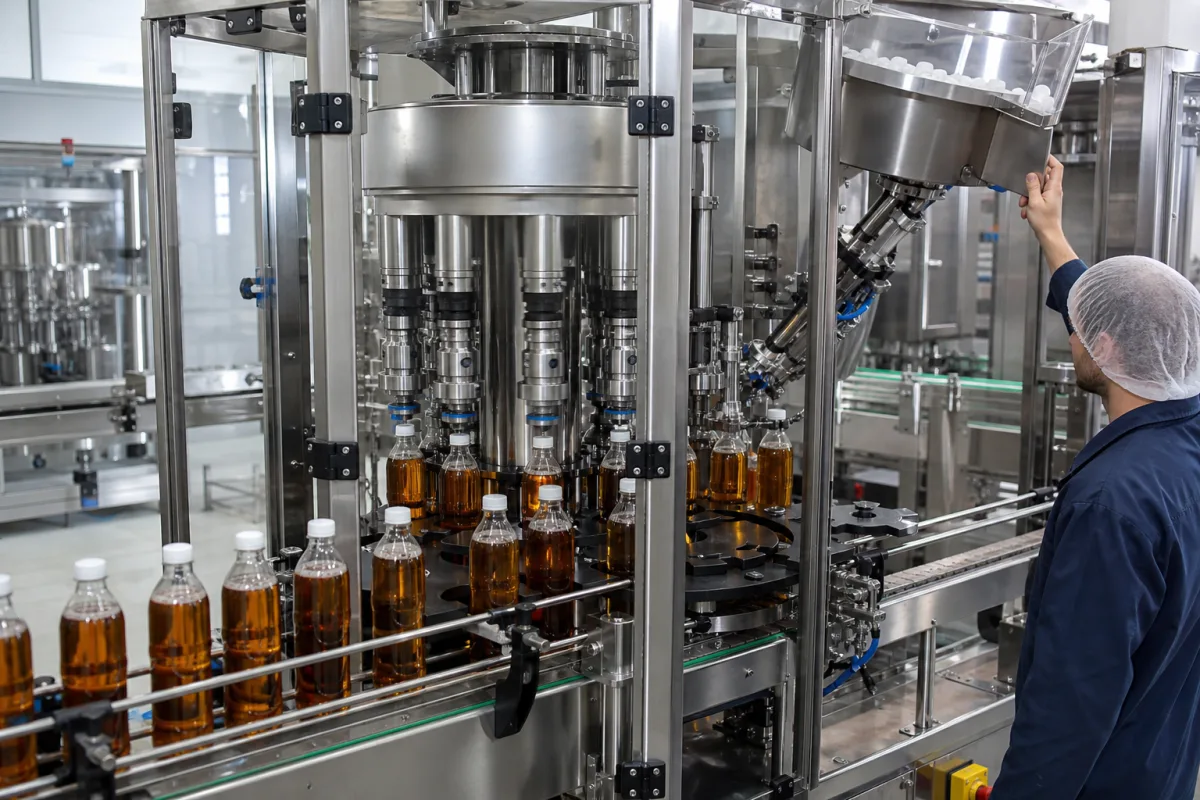
A canonical Capping Station is characterized by the integration of Capping Head and Cap Chute/Elevator. In industrial production environments, manufacturers listed on CNFX commonly emphasize Stainless Steel (AISI 304/316L) construction to support stable, high-cycle operation across diverse manufacturing scenarios.

A specialized component within an aseptic hot-fill beverage bottling line responsible for applying and sealing caps onto filled bottles under sterile conditions.

Product Specifications

Technical details and manufacturing context for Capping Station

Definition
The Capping Station is a critical component of an Aseptic Hot-Fill Beverage Bottling Line. It is positioned downstream from the filling station and is responsible for securely applying pre-sterilized caps to bottles that have been filled with hot beverage product. Its primary function is to create a hermetic seal that maintains product sterility, prevents contamination, preserves carbonation (if applicable), and ensures shelf stability by preventing oxygen ingress and microbial growth. The station operates within a controlled aseptic environment, often incorporating features like laminar airflow or sterile air curtains to maintain sterility during the capping process.
Working Principle
The station receives filled bottles and pre-sterilized caps (e.g., screw caps, crown caps, sports caps). Using a capping head (which may be rotary, spindle, or chuck-type), it picks up a cap, aligns it with the bottle neck, and applies it with precise torque and downward pressure. For hot-fill applications, capping often occurs while the product is still hot (typically above 85°C/185°F), creating a vacuum seal upon cooling. The process is synchronized with the conveyor line speed and is controlled by a PLC for consistent application force and seal integrity.
Common Materials
Stainless Steel (AISI 304/316L), Food-Grade Plastics, Ceramic
Technical Parameters
  • Maximum capping speed/capacity (bottles/min) Standard Spec
Components / BOM
  • Capping Head
    The mechanism that grips, aligns, and applies the cap to the bottle with controlled torque.
    Material: Stainless Steel, Food-Grade Polymer
  • Cap Chute/Elevator
    Feeds pre-sterilized caps from a hopper or supply system to the capping head.
    Material: Stainless Steel
  • Torque Control Unit
    Precisely regulates the rotational force applied by the capping head to ensure consistent seal tightness.
    Material: Stainless Steel, Alloy
  • Bottle Positioning Starwheel
    Accurately positions and guides bottles into the capping station from the conveyor.
    Material: Acetal (POM), Stainless Steel
  • Sterile Air/Hood Enclosure
    Provides a localized aseptic environment (e.g., via HEPA-filtered laminar airflow) around the capping area to prevent contamination.
    Material: Stainless Steel, Polycarbonate
Engineering Reasoning
0.8-1.2 bar sterile air pressure, 120-180°C cap sterilization temperature, 0.5-2.0 m/s conveyor speed
Cap torque below 8 N·m or above 15 N·m, sterilization temperature below 115°C for >5 seconds, particulate contamination >ISO Class 5 air quality
Design Rationale: Cap torque failure due to tribological wear on capping chuck surfaces (coefficient of friction μ<0.15), thermal degradation of sealing polymers above 190°C glass transition temperature, laminar flow breakdown at Reynolds number Re>2300 in sterile air supply
Risk Mitigation (FMEA)
Trigger Cap feeder jam due to dimensional tolerance stack-up exceeding ±0.2 mm
Mode: Incomplete cap seating causing 0.3-0.5 mm headspace gap
Strategy: Cap sorting mechanism with 3-point optical inspection at 50μm resolution
Trigger Stepper motor position error accumulation exceeding 0.5° angular displacement
Mode: Torque application misalignment generating asymmetric sealing force distribution
Strategy: Closed-loop servo control with 0.1° resolution rotary encoder feedback

Industry Taxonomies & Aliases

Commonly used trade names and technical identifiers for Capping Station.

Industrial Ecosystem & Supply Chain DNA

Complementary Systems
Downstream Applications
Specialized Tooling

Application Fit & Sizing Matrix

Operational Limits
pressure: 0-2 bar (capping torque application)
other spec: Bottle throughput: 100-1000 bottles/min, Cap size range: 18-38mm diameter, Sterile air purity: Class 100 (ISO 5) or better
temperature: Ambient to 95°C (sterilization range)
Media Compatibility
✓ Carbonated beverages (soda, sparkling water) ✓ Still beverages (juice, tea, water) ✓ High-acid products (sports drinks, energy drinks)
Unsuitable: Highly viscous or particulate-containing media (pulp-heavy juices, smoothies with solids)
Sizing Data Required
  • Bottle neck finish dimensions (thread type, diameter)
  • Required production rate (bottles per minute)
  • Cap material and design (plastic, metal, tamper-evident features)

Reliability & Engineering Risk Analysis

Failure Mode & Root Cause
Seal degradation
Cause: Chemical attack from product residues or cleaning agents, compounded by thermal cycling and mechanical wear from repeated capping cycles.
Misalignment-induced mechanical failure
Cause: Wear in guide rails, bushings, or actuator linkages due to improper installation, lack of lubrication, or foreign object debris, leading to off-center capping forces and premature component fatigue.
Maintenance Indicators
  • Audible grinding or knocking sounds during the capping cycle, indicating mechanical binding or severe misalignment.
  • Visible product leakage or inconsistent cap torque, often accompanied by visible seal damage or residue buildup on capping heads.
Engineering Tips
  • Implement a routine cleaning and inspection protocol for seals and contact surfaces, using compatible solvents and verifying seal integrity to prevent chemical degradation and buildup.
  • Establish a preventive maintenance schedule for alignment checks and lubrication of guide components, using laser alignment tools and manufacturer-specified lubricants to minimize wear and ensure consistent operation.

Compliance & Manufacturing Standards

Reference Standards
ISO 9001:2015 - Quality management systems ANSI B46.1 - Surface texture (Surface roughness, waviness, and lay) CE Marking - Conformity with EU health, safety, and environmental protection directives
Manufacturing Precision
  • Bore diameter: +/-0.01mm
  • Parallelism of sealing surfaces: 0.05mm
Quality Inspection
  • Pressure decay leak test
  • Dimensional verification with coordinate measuring machine (CMM)

Factories Producing Capping Station

Verified manufacturers with capability to produce this product in China

✓ 97% Supplier Capability Match Found

S Sourcing Manager from Canada Feb 13, 2026
★★★★★
"Great transparency on the Capping Station components. Essential for our Beverage Manufacturing supply chain."
Technical Specifications Verified
P Procurement Specialist from United States Feb 10, 2026
★★★★☆
"The Capping Station we sourced perfectly fits our Beverage Manufacturing production line requirements. (Delivery took slightly longer than expected, but technical support was excellent.)"
Technical Specifications Verified
T Technical Director from United Arab Emirates Feb 07, 2026
★★★★★
"Found 56+ suppliers for Capping Station on CNFX, but this spec remains the most cost-effective."
Technical Specifications Verified
Verification Protocol

“Feedback is collected from verified sourcing managers during RFQ (Request for Quote) and factory evaluation processes on CNFX. These reports represent historical performance data and technical audit summaries from our B2B manufacturing network.”

9 sourcing managers are analyzing this specification now. Last inquiry for Capping Station from Vietnam (50m ago).

Supply Chain Compatible Machinery & Devices

Automated Beverage Batch Blending System

Automated system for precise multi-ingredient beverage batch preparation.

Explore Specs →
Automated Beverage Container Sterilization System

Automated system for sterilizing beverage containers before filling.

Explore Specs →
Automated Beverage Labeling and Coding System

Integrated system for applying labels and printing codes on beverage containers.

Explore Specs →
Automated Beverage Ingredient Dispensing System

Automated system for precise dispensing of beverage ingredients into production lines.

Explore Specs →

Frequently Asked Questions

What makes this capping station suitable for aseptic beverage production?

This capping station features a sterile air/hood enclosure, food-grade materials (AISI 304/316L stainless steel), and precise torque control to maintain sterile conditions during hot-fill bottling, preventing contamination.

How does the torque control unit improve capping quality?

The torque control unit ensures consistent cap application with precise sealing force, preventing under-tightening (leaks) or over-tightening (damage), crucial for maintaining product integrity and shelf life in beverage manufacturing.

Can this capping station handle different bottle sizes and cap types?

Yes, with adjustable components like the bottle positioning starwheel and customizable capping heads, it accommodates various bottle sizes and cap styles (e.g., screw caps, snap caps) common in beverage production lines.

Can I contact factories directly on CNFX?

CNFX is an open directory, not a transaction platform. Each factory profile provides direct contact information and production details to help you initiate direct inquiries with Chinese suppliers.

Get Quote for Capping Station

Request technical pricing, lead times, or customized specifications for Capping Station directly from verified manufacturing units.

Your business information is encrypted and only shared with verified Capping Station suppliers.

Thank you! Your message has been sent. We'll respond within 1–3 business days.

Need to Manufacture Capping Station?

Connect with verified factories specializing in this product category

Add Your Factory Contact Us
Previous Product
Bottle Transport Conveyor
Next Product
Carbonation Vessel