CIP spray ball system for beer fermenters and bright tanks: flow per metre of circumference, caustic strength and time, and the CO2 vacuum hazard
Spray-ball cleaning in place of beer fermenters and bright beer tanks: the supply flow per metre of tank circumference, the caustic strength and contact time that met ATP limits in microbrewery trials, ambient against hot caustic, rinse volumes, and the CO2 left in a fermenter that can pull the tank into vacuum
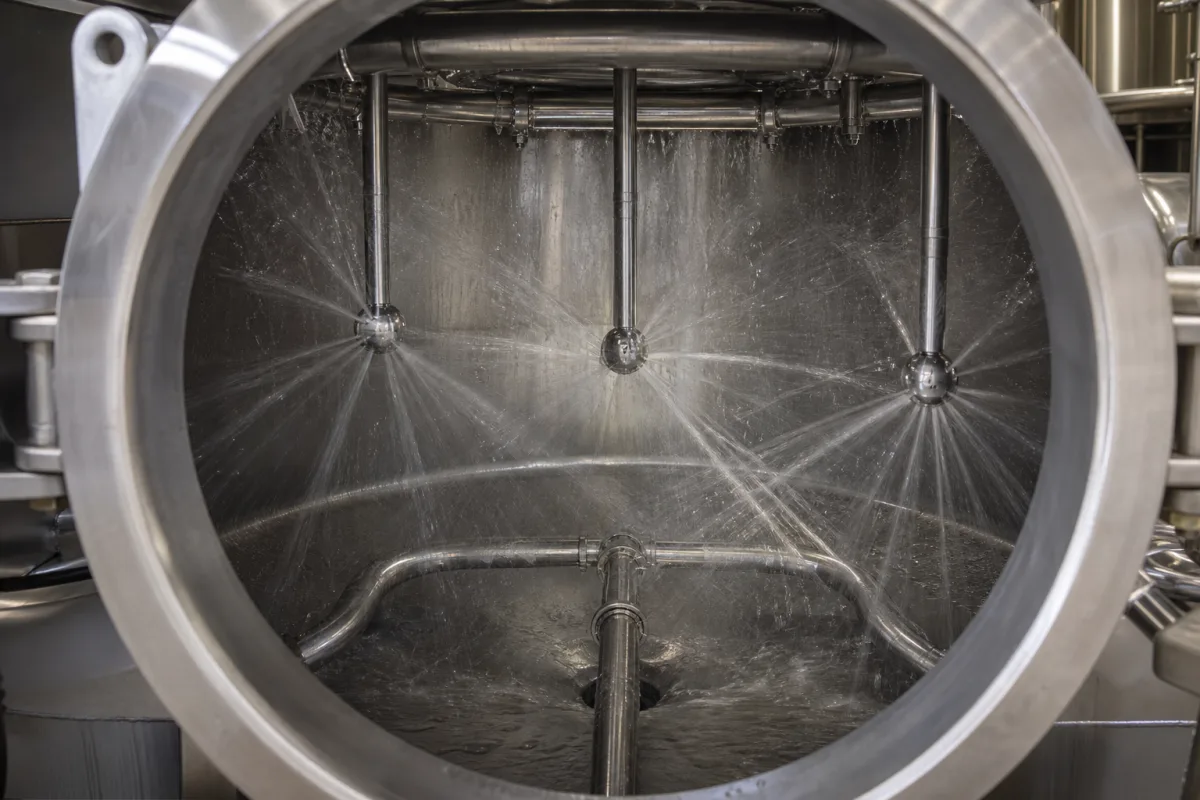
A brewery fermenter is cleaned without opening it: CIP solution is pumped up to one or more spray balls in the top of the vessel, sprayed over the walls and drained from the cone. What makes this different from cleaning a water or dairy tank is the soil and the gas: a ring of yeast and foam residue dried onto the wall above the beer line, and a headspace full of carbon dioxide when the beer has just been transferred out. The vessel pictured, with three static spray balls hanging from a top header, is a multi-ball arrangement of this kind.
Spray-ball CIP of beer fermenters and bright beer (conditioning or carbonation) tanks: supply flow per metre of tank circumference, caustic concentration and contact time, ambient against heated caustic, rinse volume, ATP verification, peracetic acid sanitising, and the vacuum hazard when caustic meets a CO2-filled tank. Spray ball types, spray patterns and riboflavin coverage testing are covered on the Spray ball page; supply sizing and steam compatibility in CIP/SIP circuits on the Spray device for automated CIP/SIP page; falling-film and jet cleaning mechanisms on the Spray Balls/Nozzles page; the CIP skid on the CIP (clean-in-place) system page. Brewhouse vessels and pipelines are outside this page.
CNFX editorial research · Sources checked October 13, 2026 · 4 sources
Caustic through the spray ball: 1.5–3 % v/v, 20–40 minutes and no need to heat
Laing, Bull, Joyce and O'Malley of Newcastle University tested caustic CIP in North East England microbreweries with 100 to 3,200 L brew kits, on fermenters of 450 L and 900 L, judging a vessel clean below 10 RLU on ATP swabs and usable below 30 RLU. Their paper also cites a supply of 1.5–3.5 m³/h per metre of tank circumference through the spray ball, from Boulton and Quain, to give the shear needed to move biofilm and debris. [1]
Heating did not help in those trials: 40–60 °C caustic gave no better cleanliness than ambient water at 10–20 °C over the 35-minute cycle, and the authors note that above 60 °C an open-top vessel gives off steam and caustic vapour. They estimate 18.9 MJ, or 5.25 kWh, to heat 100 L from 15 to 60 °C. A single 100 L rinse removed caustic residue from vessels up to 1,200 L, with 150 L suggested up to 1,800 L and 200 L up to 3,200 L, followed by peracetic acid at 1 % v/v of a 5 % product for at least 10 minutes. [1]
The spray ball itself was a factor: in one brewery the caustic flow through the spray ball was low and cleanliness suffered, and the authors recommend enough spray-ball pressure to reach all areas of the fermenter with reasonable shear, while noting that high flow can drip from open-top fermenters. [1]
Kylee Goode's University of Birmingham EngD thesis found two soils in fermenters: a yeast film above the beer line from foaming, which is aged and needs part water and part chemical removal, and a soil below the beer from emptying, which water removes. A visually clean surface was reached at 20, 30, 50 and 70 °C with detergent equivalent to 1 and 0.1 wt % NaOH, against the 2 % NaOH at 70 °C then used in the brewery studied; fermenter CIP there cost £106k a year, and switching to a warm pre-rinse followed by ambient caustic was costed at a £69k saving. [2]
Editorial calculation: at 1.5–3.5 m³/h per metre of circumference, a fermenter 1.2 m in diameter (3.77 m round) needs about 5.7 to 13.2 m³/h at the spray balls, shared between the balls fitted.
Caustic dilution (of ~32 % liquor)
Result in the fermenter trials
0.5 % v/v
Did not reach tolerance at any temperature or duration tested [1]
1.0 % v/v
Inadequate for consistent cleanliness in fermenters of at least 450 L [1]
1.5 % v/v
Reached tolerance after 30–40 min; at least 40 min at ambient temperature recommended [1]
2.0 % v/v
25–35 min; at least 2 % v/v for 35 min preferred [1]
3.0 % v/v
20–30 min; no significant cleaning benefit over 2 % [1]
Ask for the spray-ball supply flow and pressure at your vessel diameter, the caustic strength and time the supplier validated, and how many balls are needed to reach the yeast ring above the beer line.
02
Caustic in a CO2-filled tank: why a fermenter can implode during CIP
Laing and co-authors warn that CO2 and caustic react, and that the resulting vacuum could collapse a vessel left fully sealed; they found 1.0 % v/v caustic enough for bright beer tanks at low temperature in as little as 10 minutes, but only if the tank had no added microorganisms such as bottling yeast and had been purged of CO2 first. [1]
Paul Mueller Company describes the same case after transfer: the fermenter is left full of carbon dioxide, caustic sprayed into it reacts with the gas and lowers the pressure inside, and without adequate vacuum relief the tank can implode. Mueller advises opening the racking valve during CIP and making sure the vacuum relief valve is large enough for the tank and not seized from poor maintenance. [3]
Mueller lists two further causes of vacuum failure in brewery tanks: overfilling a brite tank and rinsing with cold water too soon after a hot CIP cycle, when steam in the tank condenses and the pressure drops. [4]
Editorial calculation: in the reaction 2 NaOH + CO2 → Na2CO3 + H2O, each kilogram of sodium hydroxide can take up 44/80 × 1 kg ≈ 0.55 kg of CO2, about 0.3 m³ of gas at 20 °C and atmospheric pressure, so a few kilograms of caustic in the CIP charge can absorb a cubic metre or more of headspace gas.
Ask how the tank is vented or purged of CO2 before caustic, the size and test interval of the vacuum relief valve, and whether an acid-only cycle is offered for tanks kept under CO2.
03
Information for a fermenter CIP spray ball system
Paste it into your enquiry below or into an email to a maker, then replace every bracket.
Vessels: [fermenters and bright tanks; volumes; diameters; open or closed top]
Spray balls: [number per vessel; supply flow and pressure; position relative to the yeast ring]
Cycle: [caustic strength and time; temperature; rinse volume; acid sanitiser]
Verification: [ATP or other test and acceptance limit]
Safety: [CO2 purge or venting before caustic; vacuum relief valve size]
Explore company information and manufacturing capabilities, then discuss the scope of your project with a relevant supplier.
Share this page
Compiled and source-reviewed by the CNFX editorial team.
Each manufacturer above links to the page on that company's own website where the product is listed, with the date we checked it. How we source and review
· Page last updated 13 October 2026
Buyer questions
What caustic strength cleans a beer fermenter?
Newcastle University trials found at least 1.5 % v/v for 40 min, preferably 2 % v/v for 35 min, of ~32 % caustic liquor; 0.5 % never met the ATP limit. [1]
Does fermenter CIP caustic need to be hot?
In the same trials 40–60 °C caustic cleaned no better than 10–20 °C water over 35 min; Goode's thesis reached visually clean surfaces from 20 to 70 °C. [1][2]
Why can a fermenter implode during CIP?
CO2 left after transfer reacts with caustic and creates a vacuum; Paul Mueller advises opening the racking valve and keeping the vacuum relief valve sized and working. [3][1]
How much spray-ball flow does a fermenter need?
Laing et al. cite 1.5–3.5 m³/h per metre of tank circumference to give enough shear at the wall. [1]
Sources and what still needs a direct check
Sources checked 2026-10-13. Caustic strength, time, temperature, rinse and flow figures come from a Newcastle University paper in the Journal of Brewing and Distilling and a University of Birmingham EngD thesis; the CO2 and hot-rinse vacuum hazards from Paul Mueller Company's brewery articles.