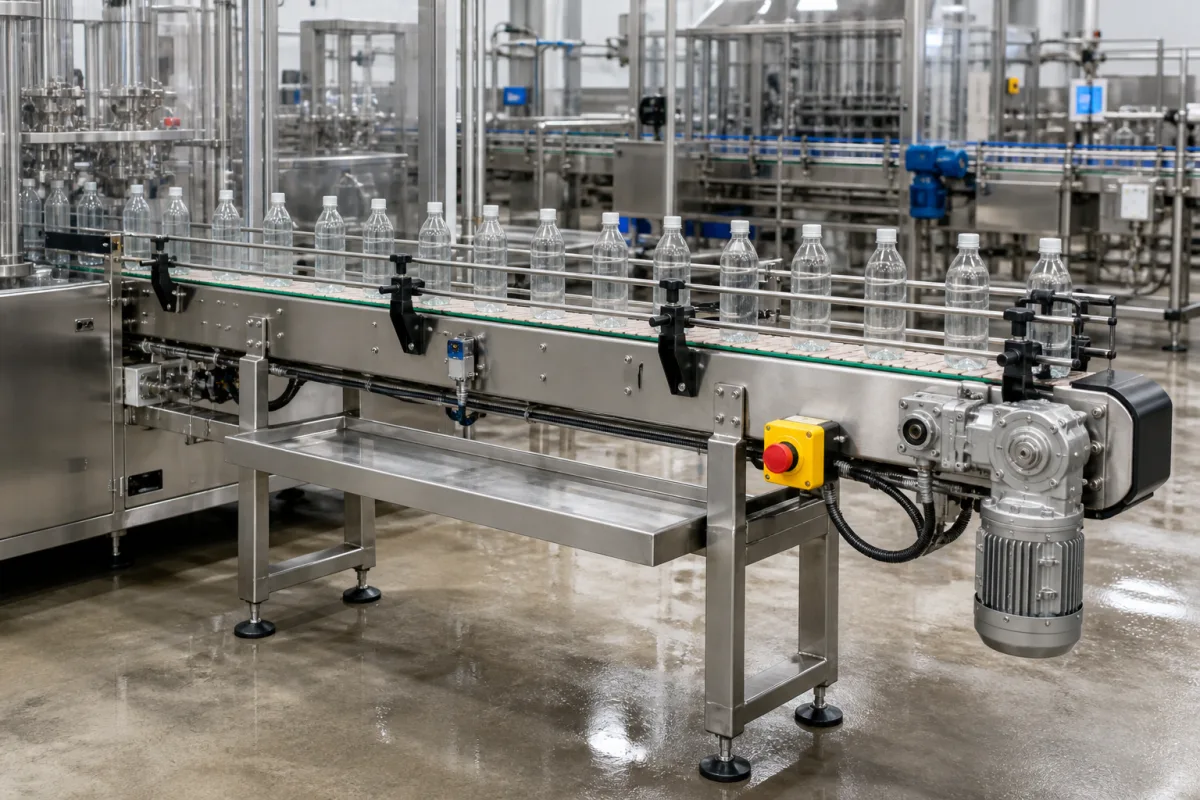
Conveyor module for beverage containers: a single-file TableTop chain conveyor with guide rails that carries bottles between machines
Single-file container conveyors for beverage lines · Steel and plastic TableTop slat chains, flatness and working load, dry-running chain materials, line speed from throughput and bottle spacing, and adjustable guide rails for format changes
This page covers single-file container conveyors in beverage filling and packaging lines: a steel or plastic TableTop (slat) chain running on wear strips between guide rails, driven by a gearmotor, carrying bottles or cans from one machine to the next, such as to a labeller or coder. Ask three things first: which chain material and width suit your containers and whether the line runs dry or lubricated, what chain speed your throughput and container spacing require, and how guide rails are reset when the container format changes.
Single-file container conveyors for beverage filling and packaging lines, including TableTop slat chains in steel or plastic, wear strips, guide rails, drives and speed steps between machines. Modular straight, curve and drive sections for unit-load conveyors are covered on the Conveyor section page, plastic flexible-chain conveyors for small-part assembly on the Automated small-part assembly conveyor page, and conveyor systems as a whole on the Conveyor systems page. Multi-lane mass conveyors, case and pack conveyors and roller conveyors for logistics are outside this page.
CNFX editorial research · Sources checked October 12, 2026 · 3 sources
Steel TableTop chain: flatness that keeps bottles upright and working load before permanent stretch
Regal Rexnord's TableTop and MatTop catalogue states that poor flatness as a product moves from one link to the next causes products to tip, and gives flatness figures of 0.08 mm for its X-Line chains, 0.15 mm for standard chains and 0.10 mm for SSC ferritic stainless steel. It states that the breaking load does not decide whether a chain suits an application; the maximum working load before permanent deformation does, and its chain calculation takes conveyor length, chain speed, accumulation level, lubrication, product type and weight into account. [1]
Regal Rexnord adds that polished hinge eyes improve running on high-speed side transfers such as pressure-less combiners, by smoothing contact with the wear strips and preventing the chain from pulsating, and that hardened pins reduce chain elongation. [1]
Steel chain material
Stated use
Mean surface finish Ra
SSA austenitic chrome-nickel stainless (similar to 18/8)
Good chemical resistance; austenitic stainless pins. [1]
Give the supplier the containers (material, diameter, height, filled weight), throughput, the machines to link and their infeed heights, accumulation length and whether containers accumulate under pressure, wet or dry running, wash-down and cleaning chemicals, and the format range the guide rails must cover.
02
Plastic slat chain materials for dry-running PET, glass and can lines
Regal Rexnord lists plastic TableTop chain materials by how they run without external lubrication, and notes that metric widths, following the standard 85 mm pitch between strands of slatband chain, have become the standard of the European beverage industry. [1]
Material
Stated use
Limit stated
LF low-friction acetal
High output at moderate to high speeds; wear reduced up to 15% over plain acetal. [1]
—
HP internally lubricated acetal
Dry running or reduced lubrication at high speed; wear reduced up to 40% over plain acetal. [1]
—
PSX polymer alloy
High-speed glass bottles, PET bottles and cans with minimal or no lubrication; long wear life, minimal dust. [1]
Glass handling where shards wear other plastics; up to five times the wear life of acetal. [1]
—
03
Chain speed from throughput and bottle spacing, and guide rails that move for a new format
US patent 4,308,944 on single-track bottle flows in bottling plants gives the feeding chain speed as the throughput in bottles per second multiplied by the spacing between bottles, and states that at 50,000 bottles per hour with a spacing of 0.1 m the speed is about 1.4 m/s. It transfers a spaced flow by a guide rail onto a parallel conveyor where the bottles close up, then onto slower take-off sections, and reports a noise level about 10 dB(A) lower than a conventional layout of the same length. [2]
Editorial calculation: 50,000 / 3,600 ≈ 13.9 bottles per second × 0.1 m ≈ 1.39 m/s, or about 83 m/min, matching the patent's figure. [2]
US patent 6,244,429 describes guide rails in sections whose spacing is changed by a reversible motorised actuator and motion converter, so that the conveyor path can be reset automatically for containers of different sizes and shapes. [3] Editorial note: ask whether guide rails are set by hand, by tool-less clamps or by actuators, how long a format change takes, and whether settings are stored per container.
04
Send the containers, throughput and line layout together
Paste it into your enquiry below or into an email to a maker, then replace every bracket.
Containers: [type; diameter; height; filled weight]
Throughput: [containers per hour; spacing]
Layout: [machines linked; lengths; curves; transfers]
Chain: [steel or plastic; width; wet or dry]
Guide rails: [format range; manual or motorised]
Hygiene: [wash-down; chemicals; materials]
Explore company information and manufacturing capabilities, then discuss the scope of your project with a relevant supplier.
Share this page
Compiled and source-reviewed by the CNFX editorial team.
Each manufacturer above links to the page on that company's own website where the product is listed, with the date we checked it. How we source and review
· Page last updated 13 October 2026
Buyer questions
How fast must a single-file bottle conveyor run?
Chain speed equals throughput in bottles per second times bottle spacing; a 1982 patent gives about 1.4 m/s for 50,000 bottles per hour at 0.1 m spacing. [2]
Which slat chain material runs dry on PET lines?
Regal Rexnord lists DRY-PT for PET without external lubrication (not for glass or cans), and PSX and HP for dry or reduced-lubrication high-speed running. [1]
Why does slat chain flatness matter?
Regal Rexnord states that poor flatness from link to link makes products tip; it gives 0.08 mm for X-Line, 0.10 mm for SSC and 0.15 mm for standard steel chains. [1]
Sources and what still needs a direct check
Sources checked 2026-10-12. Regal Rexnord describes its own TableTop chains; two US patents describe bottle flow speed and adjustable guide rails.