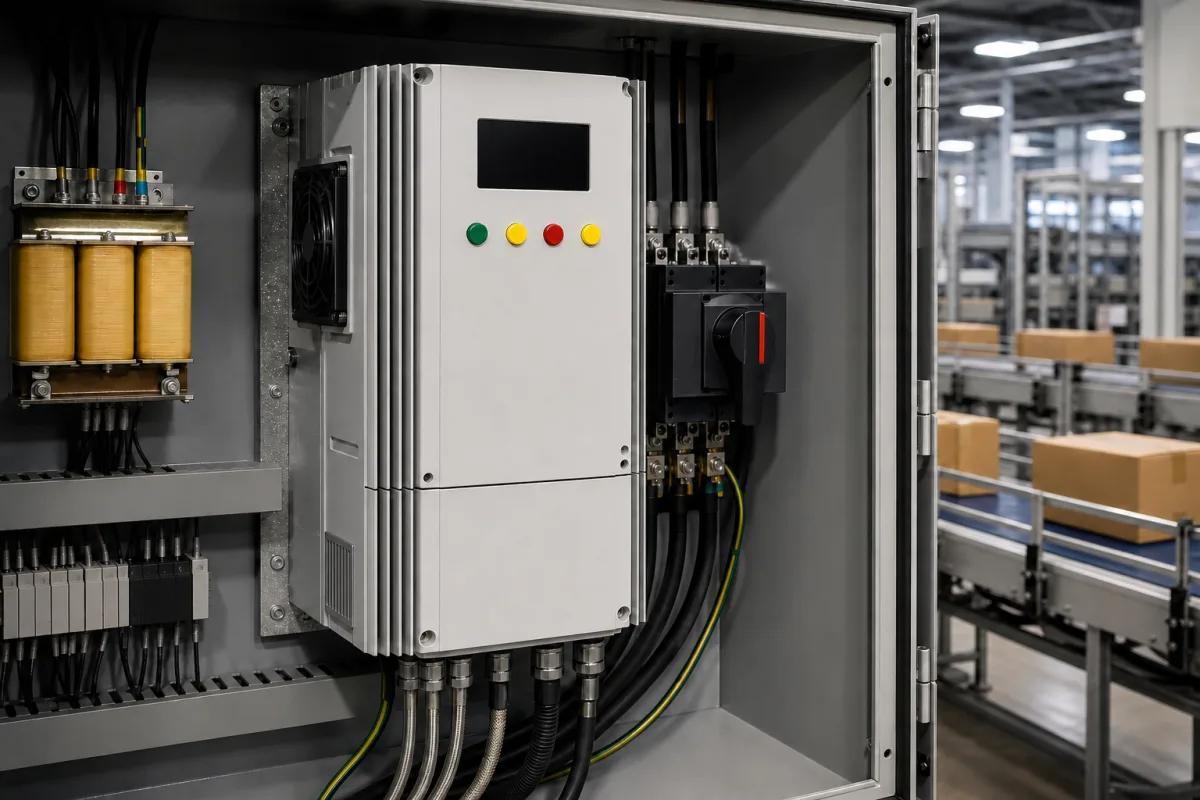
Conveyor motor speed controller (AC speed control unit, DC SCR control and cabinet drive package)
Conveyor motor speed control · Speed control units for small AC gearmotors, DC SCR controls and cabinet drives with line reactors
A conveyor motor speed controller is the control that sets how fast a belt, roller or chain conveyor runs by controlling what reaches the drive motor. On light conveyors it can be a small speed control unit matched to an AC speed-control gearmotor or a DC SCR control for a brush DC gearmotor; on larger lines it is an inverter drive mounted in a control cabinet with a line reactor and a disconnect. Ask three things first: which motor type and power the conveyor uses, what speed range and control signal the line needs, and what the cabinet must add around the controller.
Speed controllers selected for conveyor drives: plug-in or panel speed control units for fractional-kilowatt AC speed-control motors, DC SCR speed controls for brush DC gearmotors, and inverter drive packages in conveyor control cabinets with their line reactors and disconnects. General-purpose low-voltage PWM AC drives for pumps, fans, compressors and machines, with their load types, part-load efficiency and motor protection, are covered on the Variable frequency drive page. Servo drives, pneumatic flow speed controllers and fan dimmer switches are outside this page.
CNFX editorial research · Sources checked October 12, 2026 · 4 sources
The controller follows the motor. For small AC speed-control gearmotors, Yueqing Winston Electric lists its SS-22 speed control unit for motors of 6, 15, 25, 40, 60, 90 and 120 W on a 220 V AC 50/60 Hz supply (±10%), with a speed range of 90–1400 r/min at 50 Hz and 90–2800 r/min at 60 Hz, an operating temperature of –10 °C to +50 °C and a body of 57 × 40 × 78 mm; forward or reverse running is chosen by how the CW, CCW and COM terminals are connected. [1]
Editorial calculation: scaling 1400 r/min by 60/50 gives 1680 r/min, not 2800 r/min, so the listed 60 Hz upper speed should be confirmed with the supplier for the motor you will use. [1]
For brush DC gearmotors, Dart Controls lists its 125DV200E as a cast aluminium NEMA 4X enclosed DC SCR control for motors up to 2 HP, taking 120 or 240 V AC in and giving 0–90 or 0–180 V DC out, for a range of 1/4 to 2 HP. Variants add forward/stop/reverse, run/jog, or an auto/manual follower that takes a voltage or 4–20 mA signal, so a line controller can set conveyor speed. [3] Editorial calculation: 2 HP × 0.746 = 1.49 kW and 1/4 HP = 0.19 kW.
Give the supplier the conveyor type, load and speed range, the motor type (AC speed-control, three-phase induction or brush DC), its power, voltage and gear ratio, the supply voltage, the control signal (potentiometer, 0–10 V, 4–20 mA or fieldbus), reversing and jog needs, starting and stopping ramps, the enclosure rating and ambient temperature, and whether the controller is to be supplied loose or built into a cabinet.
02
Fit out an inverter drive cabinet for a conveyor line
Where conveyors are driven by three-phase motors, the controller is an inverter. Winston lists its WST700 series for 400 V or 230 V input (±15%) at 47–63 Hz, with output frequency 0–400 Hz, V/F or sensorless vector control, and overload capacity of 150% of rated current for 60 s and 180% for 10 s. [2]
Cabinet builds add a line reactor ahead of the drive. MTE states that its RL line/load reactors reduce nuisance tripping, lower harmonic distortion and minimise long-lead effects, and lists them for 4- or 6-pulse rectifiers in currents from 1 A to 1,500 A, impedances of 1.5%, 3% and 5%, 208–690 V, 50/60 Hz, an ambient range of –40 °C to 50 °C and altitude to 1,000 m without derating. Overload is rated at 200% for 30 minutes and 300% for 1 minute, and the continuous service factor is 150% of rating for reactors up to 750 A and 125% above. [4]
Editorial calculation: the drive's 180% for 10 s is below the reactor's 300% for 1 minute, so on the published figures the reactor's short-time rating, relative to its own rated current, is higher than the drive's. [2][4] Ask the cabinet builder which impedance was chosen and why.
03
Compare the three controller types
The published examples differ in motor, power and control. Figures are as listed by each maker.
Controller
Motor
Figures stated
Speed control unit (Winston SS-22)
AC speed-control gearmotor, 6–120 W
220 V AC ±10%; 90–1400 r/min at 50 Hz; –10 to +50 °C [1]
DC SCR control (Dart 125DV200E)
Brush DC motor, 1/4–2 HP
120/240 V AC in; 0–90/180 V DC out; NEMA 4X; 4–20 mA follower option [3]
Inverter drive (Winston WST700)
Three-phase induction motor
400/230 V ±15%; 0–400 Hz; V/F or SVC; 150% 60 s, 180% 10 s [2]
1 company lists this product among what they make. Company figures are quoted from each
company's own website; every card states where the relationship came from.
YUEQING WINSTON ELECTRIC CO.,LTD
Manufacturing site to be confirmed for the order
Lists an SS-22 motor speed control unit for 6–120 W AC motors, frequency inverters, and AC and DC reactors.
Explore company information and manufacturing capabilities, then discuss the scope of your project with a relevant supplier.
Share this page
Compiled and source-reviewed by the CNFX editorial team.
Each manufacturer above links to the page on that company's own website where the product is listed, with the date we checked it. How we source and review
· Page last updated 13 October 2026
Buyer questions
What speed range does a small AC conveyor speed controller give?
Winston lists its SS-22 unit for 6–120 W motors with 90–1400 r/min at 50 Hz; it lists 90–2800 r/min at 60 Hz, which should be confirmed. [1]
Can a DC conveyor motor follow a 4–20 mA signal?
Dart lists an auto/manual follower option for its 125DV200E DC SCR control that accepts a voltage or 4–20 mA signal, for 1/4–2 HP motors. [3]
What impedance should a drive line reactor have?
MTE offers its RL reactors in 1.5%, 3% and 5% impedance for 1–1,500 A; ask the cabinet builder which value suits your supply and drive. [4]
Sources and what still needs a direct check
Sources checked 2026-10-12. Yueqing Winston Electric, Dart Controls and MTE describe their own speed controls, drives and reactors.