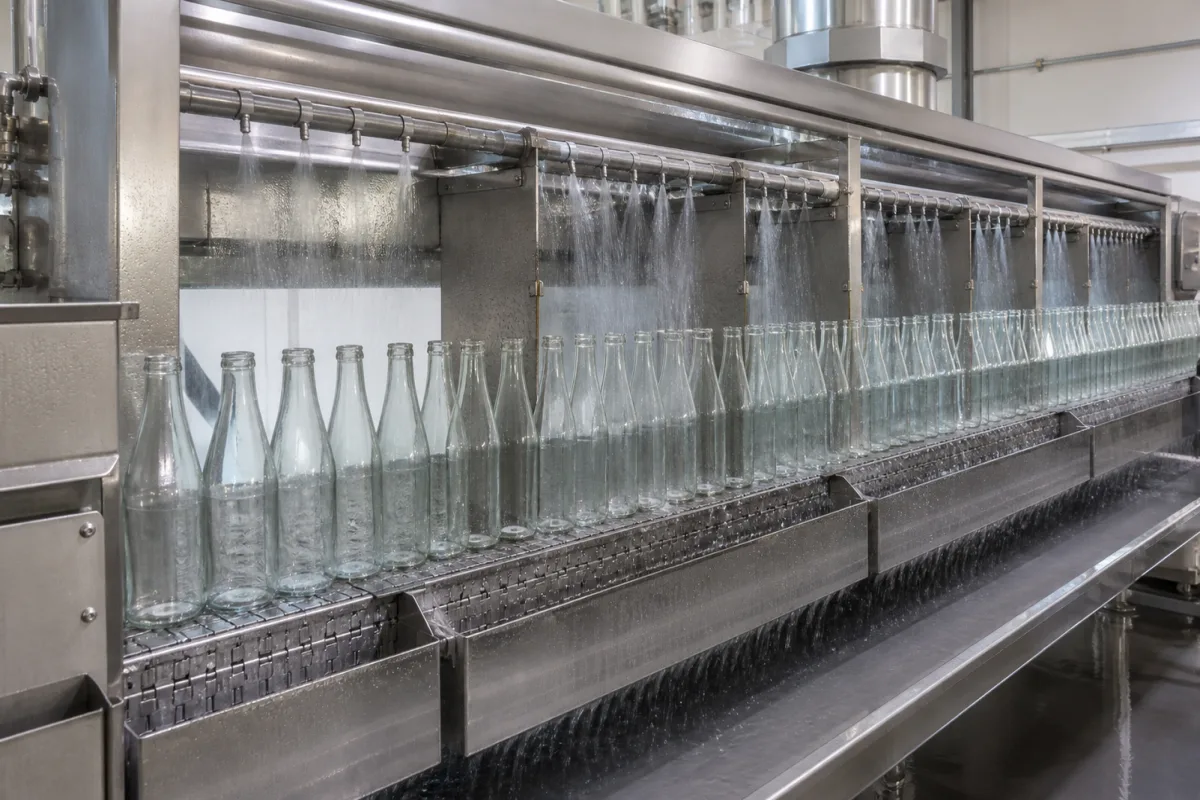
Cooling section of a tunnel pasteurizer (pre-cooling and final cooling zones)
Tunnel pasteurizers · The pre-cooling and final cooling zones after the hold: spray temperatures, residence time, water pairing with the heating zones, exit temperature and biocide in water below 50 °C
After the holding zone, a tunnel pasteurizer cools its containers in stages: a pre-cooling spray, then one or more cooling sprays that bring the containers to the discharge temperature. The water from these zones is warmed by the containers and is sent back to pre-heat incoming ones, so the cooling section sets both the exit temperature and the heat returned to the entry zones. Its water is also cool enough for bacteria to grow.
The pre-cooling and final cooling zones of tunnel pasteurizers for beverages in glass bottles, cans and PET: spray headers and nozzles, collection tanks, recirculation pumps, the piping that returns cooling-zone water to the heating zones, heat exchangers or chilled water for the last zone, and water treatment. Whole tunnel pasteurizers, with PU targets, heating and holding zones and machine comparisons, are covered on the Beverage pasteurization and cooling tunnel page. Flash pasteurizer plate coolers and retort cooling are outside this page. The hot spray side of tunnels that pasteurize sealed food trays and pouches is on the Hot-water spray heating zone for in-pack pasteurizing of sealed food trays and pouches page.
CNFX editorial research · Sources checked October 12, 2026 · 3 sources
Measured pre-cooling and cooling zones in a 150 bottle/min tunnel
Di Giuseppe and Gambelli (University of Perugia) instrumented an industrial tunnel pasteurizer for viscous bottled products running at up to 150 bottles a minute, 250 mm/min and 36 min in total. After heating and holding at 88 °C to keep the coldest point at or above 72 °C for at least 12 min, bottles pass a 600 mm pre-cooling chamber at 54 °C (±6 °C) for 2.4 min, then a 2650 mm cooling chamber at 30 °C (±10 °C) for 10.6 min. Water leaving pre-cooling is recirculated to pre-heating. [1]
The water took up 2.04 MJ in pre-cooling and 66.01 MJ in cooling while the bottles gave up 2.31 MJ and 30.04 MJ, which the authors express as a cooling-phase efficiency of 47.54%, against 37.29% for heating. The bottle and product together had a measured heat capacity of 847 J/K. [1]
In one tested variant the pre-cooling setpoint was lowered to 50 °C and final cooling raised to 35 °C, with pre-heating raised to 70 °C; the product then stayed above 72 °C for about 20 min, well beyond the 12 min required. [1]
Editorial calculation: 847 J/K × 22.3 K ≈ 18.9 kJ per bottle, matching the table; 150 bottles/min × 10.6 min = 1,590 bottles in the cooling zone; and 34,332 l/h × 10.6 ÷ 60 ≈ 6,065 l. [1]
Zone
Spray water flow
Water through the zone during one residence
Water ΔT
Bottles in zone
Bottle ΔT
Heat per bottle
Pre-cooling, 54 °C
11,039 l/h
442 l
1.1 °C
360
−7.6 °C
6.4 kJ
Cooling, 30 °C
34,332 l/h
6,065 l
2.6 °C
1,590
−22.3 °C
18.9 kJ
Give the supplier the container type and fill, line speed in containers per minute, the temperature leaving the holding zone, the required exit temperature, and the temperature of the cooling water or chilled water available for the last zone.
02
Pairing each cooling zone with the heating zone of nearest temperature
KHS's European patent EP 1529448 describes the cooling section of known tunnel pasteurizers as a series of zones in which containers are cooled by stepwise decreasing spray temperatures to the desired exit temperature. Water from each cooling zone is fed to the heating zone whose intended temperature is closest to it. [2]
In its example the first warm-up zone sprays at 18 °C and the exit cooling zone at about 17 °C; the second warm-up zone is just above 24 °C and the cooling zone feeding it about 23 °C. [2]
The patent's proposal is to take warmer pasteurizer water through a heat exchanger against the cold beverage before filling, for example beverage at 2 °C, and return the cooled water to the cooling zones. It states this lowers the exit temperature to only a few degrees above the storage or filling temperature, or, where that further cooling is not needed, shortens the treatment and so the tunnel. [2]
03
Chlorine level, pH and cleaning for water below 50 °C
Rexnord's guide for plastic conveyor chain in pasteurizers states that chemicals need not be dosed where water is above 50 °C, because biomass cannot reproduce there, and, starting from a clean system, gives 0.5 to 1.0 mg/L of chlorine as its range: above 1.0 mg/L the risk of chain damage rises sharply, and 0.5 mg/L is the lower end it gives for controlling biomass. [3]
The guide says ozone, chlorine dioxide and hydrogen peroxide, at oxidizing potentials of about 2.0 V, should never be used in pasteurizers with plastic chain, against 1.4 V for chlorine and close to 1 V for bromine. Each 10 °C rise multiplies the oxidizing reaction rate 2 to 3 times. It recommends pH close to 7, boilouts with a diffused hot-water spray at 65–75 °C plus a biodispersant rather than hot water and strong oxidizer together, and cleaning frequency set by regular biological sampling. Spray dead zones above the nozzle bed defeat any chemical programme. [3]
Editorial note: in the Perugia tunnel the 30 °C cooling chamber, and the warm-up zone it feeds, run well below the 50 °C threshold Rexnord gives. [1][3]
Ask the supplier how cooling-zone water is dosed and monitored (oxidant, set point, pH), what chain material is used, and how nozzles are arranged to reach the area above the nozzle bed.
04
Send the container, temperature and water data together
Paste it into your enquiry below or into an email to a maker, then replace every bracket.
Containers: [glass, can or PET; size; fill; containers per minute]
Temperatures: [leaving hold; pre-cooling setpoint; exit temperature required]
Zones: [number of cooling zones; length; residence time]
Water: [flow per zone; pairing with heating zones; chilled or tower water for last zone]
Treatment: [oxidant and mg/L; pH; chain material]
Cleaning: [boilout method; access to nozzle bed]
Explore company information and manufacturing capabilities, then discuss the scope of your project with a relevant supplier.
Share this page
Compiled and source-reviewed by the CNFX editorial team.
Each manufacturer above links to the page on that company's own website where the product is listed, with the date we checked it. How we source and review
· Page last updated 13 October 2026
Buyer questions
What temperatures do tunnel pasteurizer cooling zones run at?
In a 2026 Perugia study, pre-cooling ran at 54 °C for 2.4 min and cooling at 30 °C for 10.6 min; a KHS patent example has its exit cooling zone at about 17 °C. [1][2]
Where does the cooling-zone water go?
It is sent to the heating zones to pre-heat incoming containers; KHS pairs each cooling zone with the heating zone of nearest temperature. [2][1]
How much chlorine does pasteurizer cooling water need?
Rexnord gives 0.5–1.0 mg/L from a clean start, dosed where water is below 50 °C, with chain damage risk rising above 1.0 mg/L. [3]
Sources and what still needs a direct check
Sources checked 2026-10-12. The Perugia paper measured one industrial tunnel with an instrumented bottle; the KHS patent gives example zone temperatures for its proposed design; Rexnord writes as a maker of pasteurizer conveyor chain.