Industry-Verified Manufacturing Data (2026)

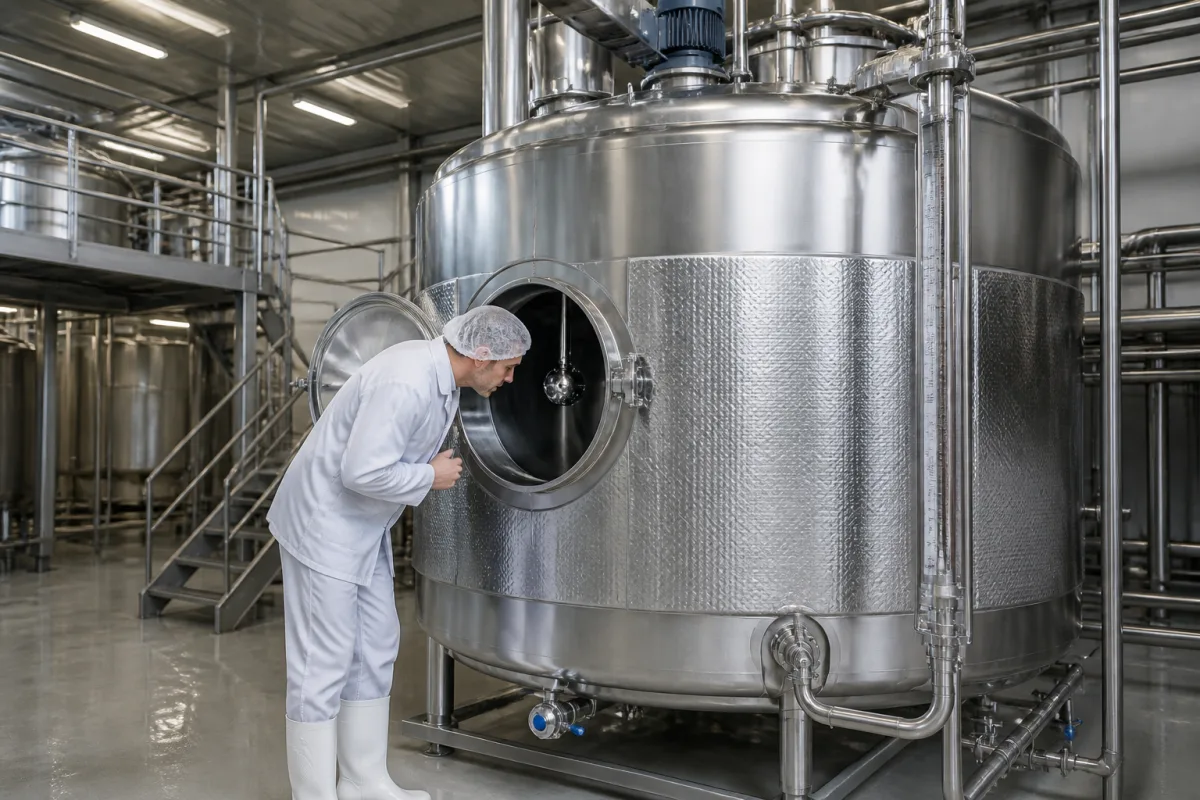
Ingredient Storage Tank

Based on aggregated insights from multiple verified factory profiles within the CNFX directory, the standard Ingredient Storage Tank used in the Beverage Manufacturing sector typically supports operational capacities ranging from standard industrial configurations to heavy-duty production requirements.

Technical Definition & Core Assembly

A canonical Ingredient Storage Tank is characterized by the integration of Tank Body and Level Sensor. In industrial production environments, manufacturers listed on CNFX commonly emphasize Stainless Steel 304/316 construction to support stable, high-cycle operation across diverse manufacturing scenarios.

A container designed to store liquid or powder beverage ingredients in an automated dispensing system

Product Specifications

Technical details and manufacturing context for Ingredient Storage Tank

Definition
The Ingredient Storage Tank is a critical component within the Automated Beverage Ingredient Dispensing System that securely holds and preserves various beverage ingredients (such as syrups, concentrates, flavorings, or powders) before they are precisely measured and dispensed into the beverage production stream. It ensures ingredient integrity, prevents contamination, and maintains proper storage conditions.
Working Principle
The tank provides a sealed or controlled environment for ingredient storage, typically featuring level sensors to monitor ingredient quantity. Ingredients are stored under appropriate conditions (temperature, pressure, agitation if needed) and are supplied to downstream dispensing mechanisms through outlet valves or pumps when required by the system.
Common Materials
Stainless Steel 304/316, Food-grade Plastic
Technical Parameters
  • Storage capacity of the ingredient tank (liters) Per Request
Components / BOM
  • Tank Body
    Main container that holds the beverage ingredient
    Material: Stainless steel or food-grade plastic
  • Level Sensor
    Monitors ingredient quantity and provides feedback to control system
    Material: Stainless steel with electronic components
  • Outlet Valve
    Controls the flow of ingredient from tank to dispensing system
    Material: Stainless steel with food-grade seals
  • Inlet Port
    Connection point for refilling the tank with ingredients
    Material: Stainless steel with quick-connect fittings
  • Insulation Jacket
    Maintains consistent temperature for temperature-sensitive ingredients
    Material: Polyurethane foam with protective coating
  • Agitator
    Mixes ingredients to prevent settling or separation
    Material: Stainless steel with motor
Engineering Reasoning
0.1-2.0 bar (gauge pressure), -10°C to 40°C ambient temperature, 0-95% relative humidity (non-condensing)
Material yield strength: 235 MPa for SS304, burst pressure: 6.0 bar (4x design pressure), maximum deflection: 3 mm per meter of tank height
Design Rationale: Stress corrosion cracking due to chloride ion concentration exceeding 25 ppm at temperatures above 60°C, causing intergranular fracture in austenitic stainless steel
Risk Mitigation (FMEA)
Trigger Thermal cycling between -5°C and 45°C at 3 cycles/hour
Mode: Weld fatigue cracking at nozzle-to-shell junction (ASME Section VIII Div.1 UW-16)
Strategy: Integral reinforcement pads with 2:1 elliptical transition geometry and post-weld heat treatment at 1050°C for 1 hour per inch of thickness
Trigger Electrochemical potential difference of 0.5V between dissimilar metals (tank shell and agitator shaft)
Mode: Galvanic corrosion at mounting flange interface, material loss rate: 0.8 mm/year in 3% NaCl solution
Strategy: Dielectric isolation using PTFE gaskets with 10 kΩ minimum resistance and cathodic protection with zinc sacrificial anodes at -1.05V vs. SCE

Industry Taxonomies & Aliases

Commonly used trade names and technical identifiers for Ingredient Storage Tank.

Applied To / Applications

This component is essential for the following industrial systems and equipment:

Industrial Ecosystem & Supply Chain DNA

Complementary Systems
Downstream Applications
Specialized Tooling

Application Fit & Sizing Matrix

Operational Limits
pressure: 0 to 2 bar (gauge)
flow rate: 0-100 L/min (liquid), 0-50 kg/min (powder)
temperature: -10°C to 80°C
slurry concentration: Up to 60% solids by weight
Media Compatibility
✓ Food-grade syrups and concentrates ✓ Powdered milk and creamer ✓ Carbonated beverage bases
Unsuitable: Highly corrosive acidic solutions (pH < 2.5)
Sizing Data Required
  • Required storage volume (liters or kg)
  • Ingredient viscosity and flow characteristics
  • Required turnover rate (refill frequency per day)

Reliability & Engineering Risk Analysis

Failure Mode & Root Cause
Corrosion
Cause: Chemical attack from stored ingredients, moisture ingress, or improper material selection leading to wall thinning and eventual leaks.
Structural fatigue
Cause: Cyclic loading from filling/emptying cycles, thermal expansion/contraction, or vibration from connected equipment causing crack initiation and propagation.
Maintenance Indicators
  • Visible corrosion spots, weeping, or discoloration on tank walls or welds
  • Unusual audible creaking, popping, or stress noises during filling/emptying cycles
Engineering Tips
  • Implement regular ultrasonic thickness testing and corrosion mapping to monitor wall integrity and schedule proactive repairs
  • Install proper ventilation/desiccant systems to control internal humidity and prevent condensation, and ensure thermal insulation is maintained to minimize thermal cycling stress

Compliance & Manufacturing Standards

Reference Standards
ISO 28300: Petroleum, petrochemical and natural gas industries - Shell-and-tube heat exchangers ASME BPVC Section VIII: Rules for Construction of Pressure Vessels DIN 28018: Vertical cylindrical steel tanks for the storage of liquids above ground - Dimensions
Manufacturing Precision
  • Wall thickness: +/-5% of nominal thickness
  • Vertical alignment: 1 mm per meter of height
Quality Inspection
  • Hydrostatic Pressure Test
  • Ultrasonic Thickness Testing

Factories Producing Ingredient Storage Tank

Verified manufacturers with capability to produce this product in China

✓ 97% Supplier Capability Match Found

P Project Engineer from Canada Feb 18, 2026
★★★★★
"Testing the Ingredient Storage Tank now; the Capacity (liters) results are within 1% of the laboratory datasheet."
Technical Specifications Verified
S Sourcing Manager from United States Feb 15, 2026
★★★★★
"Impressive build quality. Especially the Capacity (liters) is very stable during long-term operation."
Technical Specifications Verified
P Procurement Specialist from United Arab Emirates Feb 12, 2026
★★★★★
"As a professional in the Beverage Manufacturing sector, I confirm this Ingredient Storage Tank meets all ISO standards."
Technical Specifications Verified
Verification Protocol

“Feedback is collected from verified sourcing managers during RFQ (Request for Quote) and factory evaluation processes on CNFX. These reports represent historical performance data and technical audit summaries from our B2B manufacturing network.”

5 sourcing managers are analyzing this specification now. Last inquiry for Ingredient Storage Tank from USA (46m ago).

Supply Chain Compatible Machinery & Devices

Automated Beverage Container Sterilization System

Automated system for sterilizing beverage containers before filling.

Explore Specs →
Automated Beverage Labeling and Coding System

Integrated system for applying labels and printing codes on beverage containers.

Explore Specs →
Automated Beverage Ingredient Dispensing System

Automated system for precise dispensing of beverage ingredients into production lines.

Explore Specs →
Automated Beverage Container Deoxygenation System

Automated system for removing oxygen from beverage containers before filling.

Explore Specs →

Frequently Asked Questions

What materials are available for this ingredient storage tank?

Available in Stainless Steel 304/316 for durability and corrosion resistance, or food-grade plastic for lightweight and cost-effective options, both suitable for beverage ingredients.

What components are included in the tank's bill of materials?

The BOM includes tank body, agitator for mixing, inlet/outlet ports, insulation jacket for temperature control, level sensor for monitoring, and outlet valve for dispensing.

How does this tank integrate with automated dispensing systems?

Designed with standard port sizes, level sensors, and outlet valves for seamless integration into automated beverage manufacturing lines, ensuring precise ingredient handling and dispensing.

Can I contact factories directly on CNFX?

CNFX is an open directory, not a transaction platform. Each factory profile provides direct contact information and production details to help you initiate direct inquiries with Chinese suppliers.

Get Quote for Ingredient Storage Tank

Request technical pricing, lead times, or customized specifications for Ingredient Storage Tank directly from verified manufacturing units.

Your business information is encrypted and only shared with verified Ingredient Storage Tank suppliers.

Thank you! Your message has been sent. We'll respond within 1–3 business days.

Need to Manufacture Ingredient Storage Tank?

Connect with verified factories specializing in this product category

Add Your Factory Contact Us
Previous Product
Ingredient Inlet Valve Manifold
Next Product
Integrated Beverage Mixing and Homogenization System