Industry-Verified Manufacturing Data (2026)

Outlet Valve

Based on aggregated insights from multiple verified factory profiles within the CNFX directory, the standard Outlet Valve used in the Food Manufacturing sector typically supports operational capacities ranging from standard industrial configurations to heavy-duty production requirements.

Technical Definition & Core Assembly

A canonical Outlet Valve is characterized by the integration of Valve Body and Seat. In industrial production environments, manufacturers listed on CNFX commonly emphasize Stainless Steel 316L construction to support stable, high-cycle operation across diverse manufacturing scenarios.

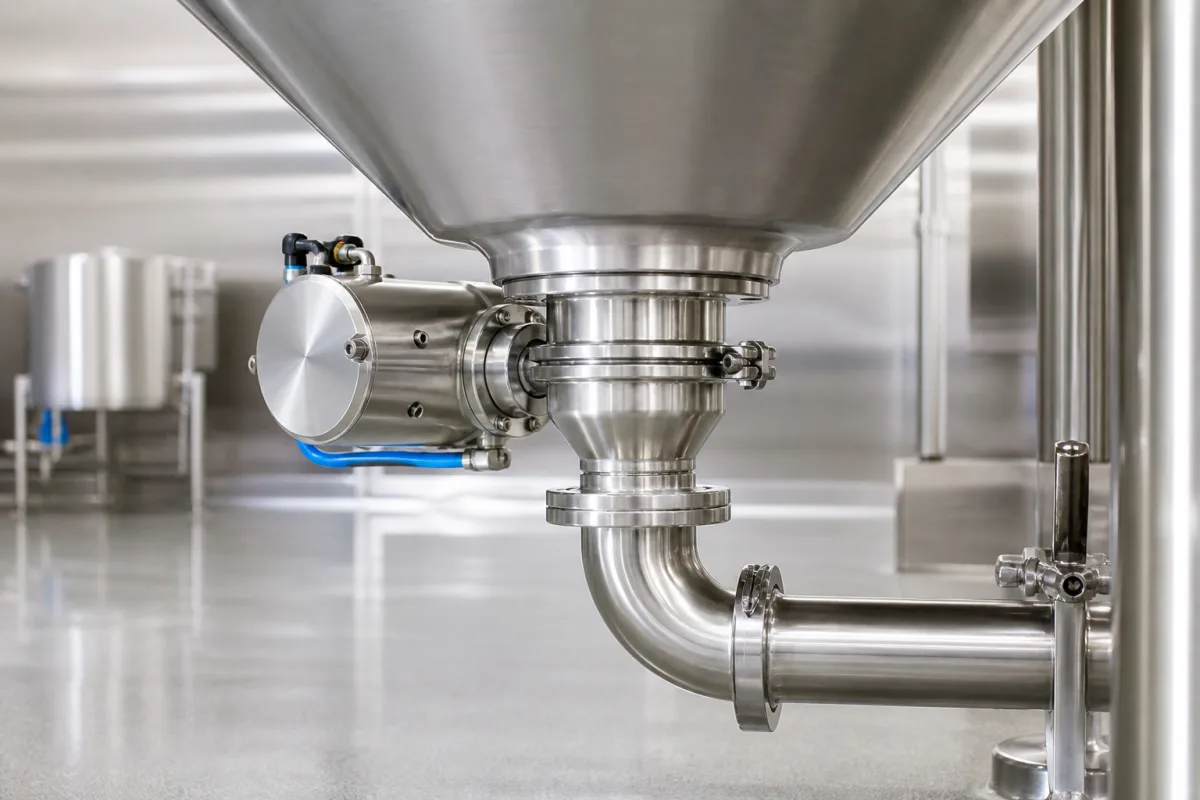
A valve installed at the outlet of an ingredient storage tank to control the flow of materials.
Product Specifications

Technical details and manufacturing context for Outlet Valve

Definition
The outlet valve is a critical component of an ingredient storage tank that regulates the discharge of stored materials. It provides precise control over flow rates, enables complete shut-off when needed, and ensures safe and efficient material transfer to downstream processes. In food manufacturing applications, it must maintain hygiene standards and prevent contamination.
Working Principle
The outlet valve operates by using a mechanical mechanism (such as a gate, ball, or butterfly design) to open or close the flow path. When opened, it allows ingredients to exit the storage tank under controlled conditions. When closed, it creates a tight seal to prevent leakage and maintain tank integrity.
Common Materials
Stainless Steel 316L
Technical Parameters
  • Valve size matching the outlet pipe diameter (mm) Per Request
Components / BOM
  • Valve Body
    Main housing that contains the flow path and connects to piping
    Material: Stainless Steel
  • Seat
    Provides sealing surface for the closure element
    Material: Food-grade elastomer
  • Stem
    Transmits rotational or linear motion to the closure element
    Material: Stainless Steel
  • Actuator
    Mechanism for opening and closing the valve (manual or automated)
    Material: Stainless Steel/Aluminum
Engineering Reasoning
0-25 bar differential pressure, -40°C to 150°C fluid temperature
35 bar differential pressure causes permanent seat deformation, 180°C causes elastomer seal degradation
Design Rationale: Cavitation-induced erosion at 0.8 vapor pressure ratio, thermal expansion mismatch between 316L stainless steel body and PTFE seals at ΔT>130°C
Risk Mitigation (FMEA)
Trigger Particulate contamination exceeding 50μm in process fluid
Mode: Seat scoring leading to 15% leakage at rated pressure
Strategy: Install 10μm duplex filter with differential pressure monitoring upstream
Trigger Actuator torque exceeding 120% of rated value due to control system fault
Mode: Stem shear at 450 N·m torque, resulting in complete flow blockage
Strategy: Implement torque-limiting coupling with mechanical shear pin rated at 110% maximum operating torque

Industry Taxonomies & Aliases

Commonly used trade names and technical identifiers for Outlet Valve.

Applied To / Applications

This component is essential for the following industrial systems and equipment:

Industrial Ecosystem & Supply Chain DNA

Complementary Systems
Downstream Applications
Specialized Tooling

Application Fit & Sizing Matrix

Operational Limits
pressure: 0 to 10 bar (g)
flow rate: Up to 50 m³/h
temperature: -20°C to 150°C
slurry concentration: Up to 40% solids by weight
Media Compatibility
✓ Food-grade liquids (e.g., syrups, oils) ✓ Pharmaceutical powders ✓ Chemical slurries (e.g., lime, gypsum)
Unsuitable: Highly corrosive acids (e.g., hydrochloric acid, sulfuric acid) at elevated temperatures
Sizing Data Required
  • Required flow rate (m³/h)
  • Media viscosity and density
  • Required pressure drop across valve

Reliability & Engineering Risk Analysis

Failure Mode & Root Cause
Cavitation
Cause: Rapid pressure drop across valve causing vapor bubble formation and implosion, leading to pitting and material degradation.
Corrosion and Erosion
Cause: Chemical attack from process media combined with high-velocity flow, thinning valve components and compromising sealing surfaces.
Maintenance Indicators
  • Audible hissing or whistling indicating internal leakage past the valve seat
  • Visible external weeping or dripping from valve body or stem seal area
Engineering Tips
  • Implement regular valve stroking exercises to prevent seat sticking and maintain proper sealing surfaces
  • Install pressure gauges upstream and downstream to monitor pressure differentials and detect abnormal conditions before damage occurs

Compliance & Manufacturing Standards

Reference Standards
ISO 5208: Industrial valves - Pressure testing of valves ANSI/ASME B16.34: Valves - Flanged, Threaded, and Welding End DIN EN 12266-1: Industrial valves - Testing of metallic valves
Manufacturing Precision
  • Bore diameter: +/-0.05mm
  • Surface flatness: 0.08mm
Quality Inspection
  • Hydrostatic pressure test
  • Leakage test with helium or nitrogen

Factories Producing Outlet Valve

Verified manufacturers with capability to produce this product in China

✓ 92% Supplier Capability Match Found

S Sourcing Manager from United States Feb 09, 2026
★★★★★
"Standard OEM quality for Food Manufacturing applications. The Outlet Valve arrived with full certification."
Technical Specifications Verified
P Procurement Specialist from United Arab Emirates Feb 06, 2026
★★★★☆
"Great transparency on the Outlet Valve components. Essential for our Food Manufacturing supply chain. (Delivery took slightly longer than expected, but technical support was excellent.)"
Technical Specifications Verified
T Technical Director from Australia Feb 03, 2026
★★★★★
"The Outlet Valve we sourced perfectly fits our Food Manufacturing production line requirements."
Technical Specifications Verified
Verification Protocol

“Feedback is collected from verified sourcing managers during RFQ (Request for Quote) and factory evaluation processes on CNFX. These reports represent historical performance data and technical audit summaries from our B2B manufacturing network.”

16 sourcing managers are analyzing this specification now. Last inquiry for Outlet Valve from Poland (17m ago).

Supply Chain Compatible Machinery & Devices

Automated Food Moisture Analyzer

Automated system for precise moisture content measurement in food products

Explore Specs →
Automated Food Color Consistency Analyzer

Automated inline system for real-time color measurement and consistency control in food processing.

Explore Specs →
Control Panel

A centralized interface for monitoring and controlling industrial equipment and processes

Explore Specs →
Industrial Vacuum Tumbler

Industrial machine for massaging and marinating meat under vacuum to enhance texture and flavor.

Explore Specs →

Frequently Asked Questions

Why is Stainless Steel 316L used for this outlet valve in food manufacturing?

Stainless Steel 316L offers superior corrosion resistance, especially against chlorides and acids common in food processing, ensuring hygiene, durability, and compliance with food safety standards like FDA and EHEDG.

How does the outlet valve control ingredient flow from storage tanks?

The valve, installed at the tank outlet, uses an actuator to adjust the stem and seat position, precisely regulating material flow. This ensures consistent dosing, prevents spills, and maintains process efficiency in food production lines.

What maintenance is required for the valve's BOM components?

Regular inspection of the actuator, seat, stem, and valve body is recommended. Clean with food-safe sanitizers, check for wear or corrosion, and replace seals as needed to prevent contamination and ensure optimal performance.

Can I contact factories directly on CNFX?

CNFX is an open directory, not a transaction platform. Each factory profile provides direct contact information and production details to help you initiate direct inquiries with Chinese suppliers.

Get Quote for Outlet Valve

Request technical pricing, lead times, or customized specifications for Outlet Valve directly from verified manufacturing units.

Your business information is encrypted and only shared with verified Outlet Valve suppliers.

Thank you! Your message has been sent. We'll respond within 1–3 business days.

Need to Manufacture Outlet Valve?

Connect with verified factories specializing in this product category

Add Your Factory Contact Us
Previous Product
Oilseed Pre-Conditioning Steam Jacket
Next Product
Overflow Vortex Finder