Editorial Technical Reference

Sparging System

This page explains how Sparging System is classified within Beverage Manufacturing. Technical values and manufacturer relationships are research references; confirm the current specification and supplier evidence for each order.

Technical Definition & Core Assembly

A system that introduces and distributes carbon dioxide gas into liquid within a carbonation vessel
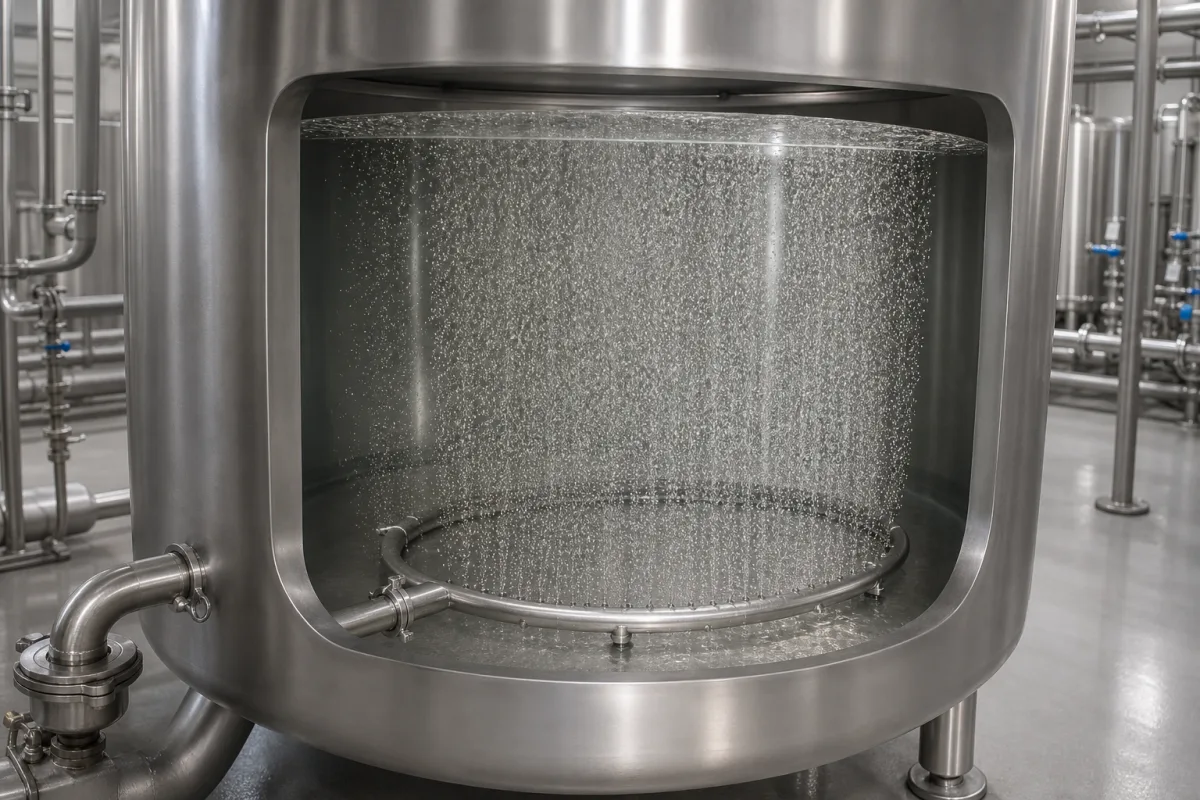
Representative product image. Confirm appearance and specifications with the manufacturer.

Product Specifications

Technical details and manufacturing context for Sparging System

Definition
The sparging system is a critical component of carbonation vessels that injects and disperses CO₂ gas into beverages or other liquids to achieve precise carbonation levels. It typically consists of gas injection nozzles, distribution manifolds, and control mechanisms that ensure uniform gas dispersion throughout the liquid volume. The system operates by forcing compressed CO₂ through specialized nozzles or diffusers that create fine bubbles, increasing the surface area for gas dissolution. Pressure and flow rates are maintained to optimize gas absorption efficiency. The system is designed for use in beverage manufacturing, where precise carbonation is essential for product quality. It is available in configurations with operating pressures from 1.0 to 1.6 MPa, flow rates from 5 to 50 m³/h, and gas purity requirements of 99.9% to 99.99% food-grade CO₂. Components are rated for temperatures from -10°C to 60°C. Materials of construction include stainless steel 316L for beverage contact parts and food-grade plastics for non-contact components. Connection sizes range from DN25 to DN80, with sanitary clamp or flange fittings per DIN 11851. The system requires a 24 V DC power supply (±10%) for control valves and sensors, and electrical enclosures are rated IP54 to IP65 per IEC 60529. Weight varies from 15 to 60 kg depending on configuration and size. All values are reference ranges and must be verified for the specific model and application. Standards such as ISO 14532, ASTM A240, and DIN 11851 are listed as procurement references, not as proof of certification. Buyers should confirm compliance with the legal manufacturer or supplier.
Working Principle
Compressed CO₂ gas is forced through specialized nozzles or diffusers that create fine bubbles. These bubbles rise through the liquid, increasing surface area for gas dissolution. The system maintains pressure and flow rates optimized for maximum gas absorption efficiency. The control mechanisms regulate gas flow to achieve uniform dispersion throughout the liquid volume, ensuring consistent carbonation levels.
Common Materials
Stainless Steel 316L, Food-grade plastics
Technical Parameters
ParameterTypical rangeNotes & selection driver
Operating Pressure1.0–1.6 MPa
Flow Rate5–50 m³/hDepends on vessel size and carbonation level
Gas Purity99.9–99.99 %Food-grade CO2 requiredISO 14532
Temperature Range-10–60 °COperating temperature for components
Material316LStainless steel for beverage contactASTM A240
Connection SizeDN25–DN80 mmSanitary clamp or flangeDIN 11851
Power Supply24 ±10% V DCFor control valves and sensors
Ingress ProtectionIP54–IP65For electrical enclosuresIEC 60529
Weight15–60 kgDepends on configuration and size

Ranges are indicative industry figures for RFQ preparation, not a supplier commitment. Confirm every value and standard with the legal manufacturer before ordering.

Components / BOM
  • Gas Distribution Manifold
    Evenly distributes CO₂ gas to multiple injection points
    Material: Stainless Steel 316L
  • Sparging Nozzles
    Creates fine CO₂ bubbles for efficient dissolution
    Material: Stainless Steel 316L
  • Flow Control Valve
    Regulates gas flow rate to the injection system
    Material: Stainless Steel 316L
  • Diffuser Optional
    Breaks CO₂ into fine bubbles over a porous surface instead of through drilled nozzles.

Applied To / Applications

This component is essential for the following industrial systems and equipment:

Industrial Ecosystem & Supply Chain Structure

Complementary Systems
Downstream Applications
Specialized Tooling

Application Fit & Sizing Matrix

Operational Limits
pressure: 0-10 bar (0-145 psi)
flow rate: 0.1-100 L/min gas flow
temperature: 0-100°C (32-212°F)
slurry concentration: Up to 30% solids by weight
Media Compatibility
✓ Carbonated beverages (soft drinks, beer) ✓ Pharmaceutical buffer solutions ✓ Food-grade liquids (juices, dairy)
Unsuitable: Highly corrosive acids (e.g., concentrated sulfuric acid)
Sizing Data Required
  • Required CO2 absorption rate (kg/hr)
  • Liquid volume and vessel dimensions
  • Desired carbonation level (volumes of CO2)

Reliability & Engineering Risk Analysis

Failure Mode & Root Cause
Clogging/Blockage
Cause: Accumulation of particulates, scaling, or biological growth within sparger pores or distribution lines, often due to inadequate filtration, poor fluid quality, or incompatible process media.
Corrosion/Erosion
Cause: Chemical attack from aggressive process fluids (e.g., acids, chlorides) or mechanical wear from high-velocity gas/liquid flow, exacerbated by material incompatibility or improper operating pressures.
Maintenance Indicators
  • Uneven or reduced gas bubble distribution across the sparger surface, indicating partial clogging or internal damage.
  • Abnormal pressure drop increase across the sparger or audible 'hissing' from leaks at connections, suggesting erosion, cracks, or seal failure.
Engineering Tips
  • Implement routine sparger backflushing or chemical cleaning protocols to prevent fouling, and install upstream filtration (e.g., 10-micron filters) to remove particulates from the gas/liquid supply.
  • Select corrosion-resistant materials (e.g., 316L stainless steel, Hastelloy, or PTFE-coated spargers) matched to process chemistry, and optimize gas flow rates to stay below erosional velocity thresholds.

Indicative industry ranges for design and RFQ preparation. Confirm the exact figures and applicable standard with the manufacturer before specifying.

Compliance & Manufacturing Standards

Applicable Standards
ASME BPE-2022 - Bioprocessing Equipment EN 13445-5:2021 - Unfired pressure vessels - Part 5: Inspection and testing

Quoted from the published standard.

Manufacturing Precision
  • Orifice diameter: +/-0.01mm
  • Surface roughness (Ra): 0.4μm max
Quality Inspection
  • Pressure decay leak test
  • Material composition verification via XRF analysis

Manufacturers of Sparging System

Manufacturer profiles associated with Sparging System.

Sourcing Sparging System from China?
Tell us your specification and target quantity — we will match it against manufacturer records and come back with the factories that fit.
Request manufacturers We manufacture this

Manufacturer listings support early research and capability understanding. They are not certification, ranking, or transaction guarantees.

Technical documentation
Request current drawings, revision history, and a signed specification sheet.
Manufacturing capability
Verify equipment lists, process limits, capacity, and representative production evidence.
Inspection readiness
Confirm test methods, calibrated equipment, sampling plans, and traceable reports.
Supplier transparency
Check the legal entity, factory address, ownership, certifications, and direct contacts.

CNFX does not score or rank suppliers. Buyers must verify all claims and documents with the legal manufacturer before ordering.

Supply Chain Compatible Machinery & Devices

Automated Beverage Container Integrity Testing System

Automated system for non-destructive testing of beverage container seals and structural integrity.

Explore Specs →
Automated Beverage Container Pressure Testing System

Automated system for testing beverage container pressure resistance and seal integrity.

Explore Specs →
Automated Beverage Container Leak Detection System

The Automated Beverage Container Leak Detection System is an industrial device designed for integration into bottling or canning lines.

Explore Specs →
Automated Beverage Container Depalletizing Machine

Industrial machine that automatically removes beverage containers from pallets for production line feeding

Explore Specs →

Frequently Asked Questions

What is the operating pressure range for this sparging system?

The reference operating pressure range is 1.0 to 1.6 MPa. However, the actual range must be confirmed for the specific model and application with the manufacturer or supplier.

What materials are used in the sparging system?

Beverage contact parts are made of stainless steel 316L (ASTM A240), and non-contact components may use food-grade plastics. Confirm material suitability for your specific liquid and cleaning agents.

What are the connection size options?

Connection sizes range from DN25 to DN80, with sanitary clamp or flange fittings per DIN 11851. The exact size depends on the vessel and required flow rate.

What gas purity is required?

Food-grade CO₂ with purity of 99.9% to 99.99% is required, as per ISO 14532. Always verify gas quality with your supplier to ensure product safety.

Data Basis

Editorial classification, named public sources where available, and source-reviewed manufacturer records.

Preliminary Technical Classification
This page supports structured research, RFQ preparation, and supplier evaluation. It does not replace buyer-led supplier qualification, standards review, or technical approval.
Buyer enquiry

Request manufacturing insight for Sparging System

Ask for use case, specification boundaries, supplier type, and RFQ preparation information for this product.

Where it goes
Straight to the CNFX editorial desk, and to the manufacturer if this product is linked to a claimed profile. Nothing is broadcast to a supplier list.
Your details stay here
We do not sell or rent enquiry data, and we do not add you to a mailing list. Used only to answer this request.
No commission, no middleman
CNFX is a directory. We take no cut of any order and never negotiate on a supplier's behalf.
What we don't claim
A listing is not an endorsement. Qualify every supplier and verify every figure yourself before ordering.

Your business information is used only to process this request.

Thank you! Your message has been sent. We'll respond within 1–3 business days.
Sorry, we couldn't send your message. Please try again, or email us at contact@cnfx.com.

Need to Manufacture Sparging System?

Compare manufacturer profiles with relevant product and process capability.

Previous Product
Sanitary Centrifugal Pump
Next Product
Syrup Preparation Vessel
Get QuotesChat