Industry-Verified Manufacturing Data (2026)

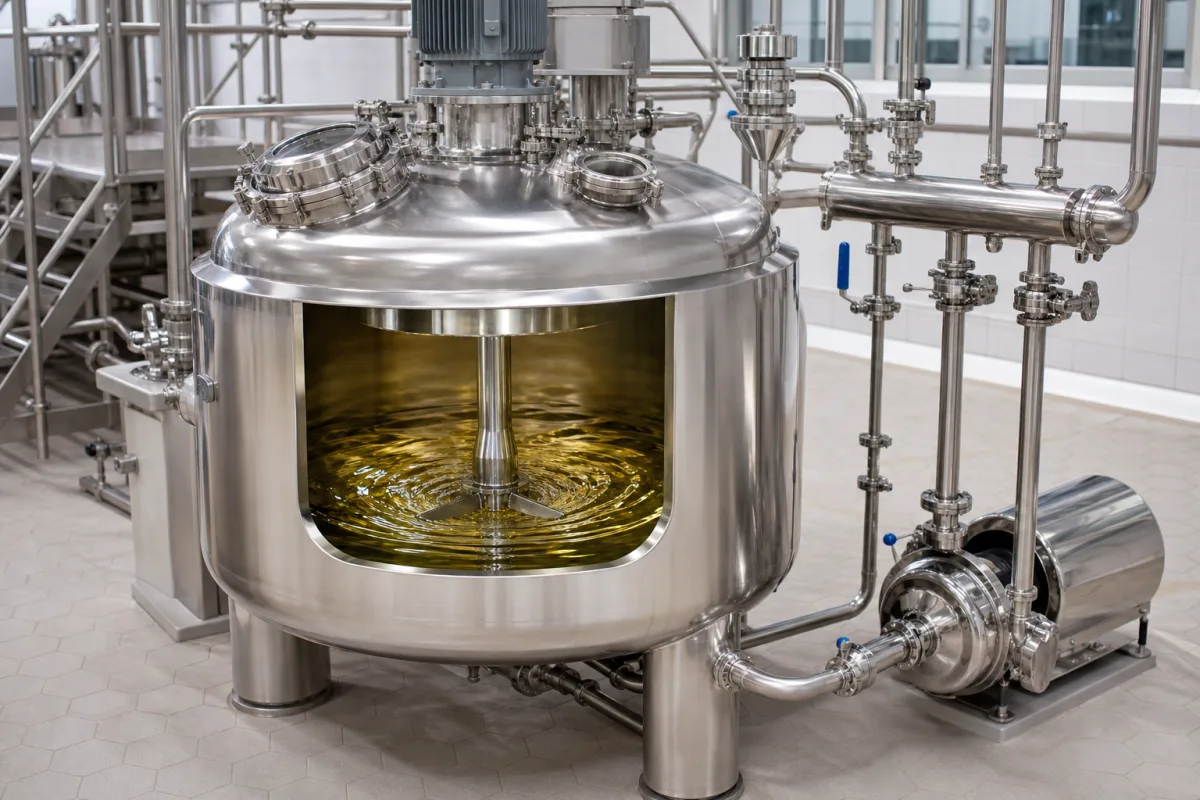
Syrup Preparation Vessel

Based on aggregated insights from multiple verified factory profiles within the CNFX directory, the standard Syrup Preparation Vessel used in the Beverage Manufacturing sector typically supports operational capacities ranging from standard industrial configurations to heavy-duty production requirements.

Technical Definition & Core Assembly

A canonical Syrup Preparation Vessel is characterized by the integration of Vessel Body/Cylinder and Agitator/Impeller. In industrial production environments, manufacturers listed on CNFX commonly emphasize Stainless Steel (e.g., 304 or 316L) construction to support stable, high-cycle operation across diverse manufacturing scenarios.

A specialized container designed for mixing, dissolving, and preparing beverage syrup concentrates from raw ingredients.
Product Specifications

Technical details and manufacturing context for Syrup Preparation Vessel

Definition
Within the Integrated Beverage Syrup Preparation and Dosing System, the Syrup Preparation Vessel serves as the primary mixing and holding tank where sugar, water, flavorings, and other ingredients are combined, heated (if required), and dissolved to create a homogeneous syrup concentrate. It is a critical component that ensures consistent syrup quality before the concentrate is transferred for dilution and dosing.
Working Principle
Ingredients are loaded into the vessel. The vessel may incorporate agitation (e.g., via an internal impeller) to mix components thoroughly. It may also include heating elements or a jacketed design to control temperature, aiding in the dissolution of sugars and other solids. The prepared syrup is held within the vessel until it is pumped to the next stage of the system.
Common Materials
Stainless Steel (e.g., 304 or 316L)
Technical Parameters
  • Working capacity of the vessel. (L) Per Request
Components / BOM
  • Vessel Body/Cylinder
    Main containment structure for the syrup.
    Material: Stainless Steel
  • Agitator/Impeller
    Provides mechanical mixing to dissolve ingredients and ensure homogeneity.
    Material: Stainless Steel
  • Heating Jacket/Element
    Transfers heat to the syrup contents to control temperature and aid dissolution.
    Material: Stainless Steel
  • Inlet/Outlet Ports
    Connections for adding ingredients and discharging prepared syrup.
    Material: Stainless Steel
Engineering Reasoning
0.1-2.0 bar (gauge pressure), 20-95°C, 0.5-3.0 m³ capacity
Yield stress of 316L stainless steel at 150°C: 170 MPa, Maximum allowable working pressure: 3.5 bar, Creep rupture limit: 1000 hours at 120°C under 2.8 bar
Design Rationale: Stress corrosion cracking due to chloride ion concentration exceeding 25 ppm at temperatures above 60°C, exacerbated by cyclic thermal loading from 20-95°C operational range
Risk Mitigation (FMEA)
Trigger Incomplete sugar dissolution creating localized concentration gradients exceeding 70% w/w
Mode: Crystallization-induced abrasion on agitator blades and vessel walls at 150+ RPM
Strategy: Integrated inline refractometer with PID-controlled heating jacket maintaining 80±2°C during dissolution phase
Trigger Galvanic corrosion cell formation between 316L stainless steel vessel and carbon steel support structure
Mode: Pitting corrosion at rate of 0.5 mm/year in presence of citric acid solutions below pH 3.5
Strategy: Dielectric isolation using PTFE gaskets and cathodic protection with sacrificial zinc anodes at -0.85V vs SCE

Industry Taxonomies & Aliases

Commonly used trade names and technical identifiers for Syrup Preparation Vessel.

Industrial Ecosystem & Supply Chain DNA

Complementary Systems
Downstream Applications
Specialized Tooling

Application Fit & Sizing Matrix

Operational Limits
pressure: 0 to 2 bar (0 to 29 psi) vacuum to positive pressure
flow rate: 0.5 to 5 m³/h (2.2 to 22 gpm) agitation-dependent
temperature: 5°C to 95°C (41°F to 203°F)
slurry concentration: Up to 70% solids by weight
Media Compatibility
✓ High-fructose corn syrup solutions ✓ Sugar-water mixtures with additives ✓ Flavor concentrate emulsions
Unsuitable: Highly abrasive particulate slurries (e.g., sand suspensions)
Sizing Data Required
  • Batch volume requirement (liters/gallons)
  • Viscosity of final syrup (cP)
  • Required mixing time per batch (minutes)

Reliability & Engineering Risk Analysis

Failure Mode & Root Cause
Corrosion and pitting
Cause: Exposure to acidic or sugary syrups, especially with temperature cycling, leading to localized material degradation, particularly in welds and crevices.
Agitator bearing or seal failure
Cause: Continuous operation under high viscosity loads, inadequate lubrication, or seal wear allowing product ingress, leading to overheating and mechanical breakdown.
Maintenance Indicators
  • Unusual vibration or noise from the agitator drive, indicating potential bearing wear or imbalance.
  • Visible syrup leakage around seals or welds, or discoloration/corrosion spots on the vessel interior during inspection.
Engineering Tips
  • Implement a regular cleaning and passivation schedule to remove syrup residues and maintain the stainless steel's protective oxide layer, especially after processing acidic batches.
  • Use condition monitoring (e.g., vibration analysis on agitator bearings) and schedule preventive maintenance during planned downtime to replace seals and lubricate bearings before failure occurs.

Compliance & Manufacturing Standards

Reference Standards
ISO 14159:2002 Safety of machinery - Hygiene requirements for the design of machinery ANSI/ASME BPE-2019 Bioprocessing Equipment DIN 11864-1 Food processing machinery - Stainless steel vessels - Part 1: Design and construction
Manufacturing Precision
  • Surface finish: Ra ≤ 0.8 μm for product contact surfaces
  • Volume capacity: ±1% of nominal capacity at operating temperature
Quality Inspection
  • Passivation test per ASTM A967 to verify corrosion resistance
  • Pressure test at 1.5 times maximum working pressure for 30 minutes

Factories Producing Syrup Preparation Vessel

Verified manufacturers with capability to produce this product in China

✓ 96% Supplier Capability Match Found

P Project Engineer from Australia Jan 13, 2026
★★★★★
"Found 47+ suppliers for Syrup Preparation Vessel on CNFX, but this spec remains the most cost-effective."
Technical Specifications Verified
S Sourcing Manager from Singapore Jan 10, 2026
★★★★★
"The technical documentation for this Syrup Preparation Vessel is very thorough, especially regarding technical reliability."
Technical Specifications Verified
P Procurement Specialist from Germany Jan 07, 2026
★★★★★
"Reliable performance in harsh Beverage Manufacturing environments. No issues with the Syrup Preparation Vessel so far."
Technical Specifications Verified
Verification Protocol

“Feedback is collected from verified sourcing managers during RFQ (Request for Quote) and factory evaluation processes on CNFX. These reports represent historical performance data and technical audit summaries from our B2B manufacturing network.”

10 sourcing managers are analyzing this specification now. Last inquiry for Syrup Preparation Vessel from Turkey (1h ago).

Supply Chain Compatible Machinery & Devices

Automated Beverage Container Sterilization System

Automated system for sterilizing beverage containers before filling.

Explore Specs →
Automated Beverage Labeling and Coding System

Integrated system for applying labels and printing codes on beverage containers.

Explore Specs →
Automated Beverage Ingredient Dispensing System

Automated system for precise dispensing of beverage ingredients into production lines.

Explore Specs →
Automated Beverage Container Deoxygenation System

Automated system for removing oxygen from beverage containers before filling.

Explore Specs →

Frequently Asked Questions

What are the benefits of using stainless steel in syrup preparation vessels?

Stainless steel (304 or 316L) offers corrosion resistance, easy cleaning, compliance with food safety standards, durability, and maintains syrup purity without contamination.

How does the heating system work in a syrup preparation vessel?

The vessel typically includes a heating jacket or element that provides controlled, uniform heating to dissolve ingredients efficiently, maintain consistent syrup viscosity, and prevent crystallization.

What maintenance is required for syrup preparation vessels?

Regular cleaning with food-grade sanitizers, inspection of agitator seals and heating elements, and checking for wear on ports and valves ensure optimal performance and hygiene.

Can I contact factories directly on CNFX?

CNFX is an open directory, not a transaction platform. Each factory profile provides direct contact information and production details to help you initiate direct inquiries with Chinese suppliers.

Get Quote for Syrup Preparation Vessel

Request technical pricing, lead times, or customized specifications for Syrup Preparation Vessel directly from verified manufacturing units.

Your business information is encrypted and only shared with verified Syrup Preparation Vessel suppliers.

Thank you! Your message has been sent. We'll respond within 1–3 business days.

Need to Manufacture Syrup Preparation Vessel?

Connect with verified factories specializing in this product category

Add Your Factory Contact Us
Previous Product
Sterile Chamber & Tunnel
Next Product
Temperature Control Panel