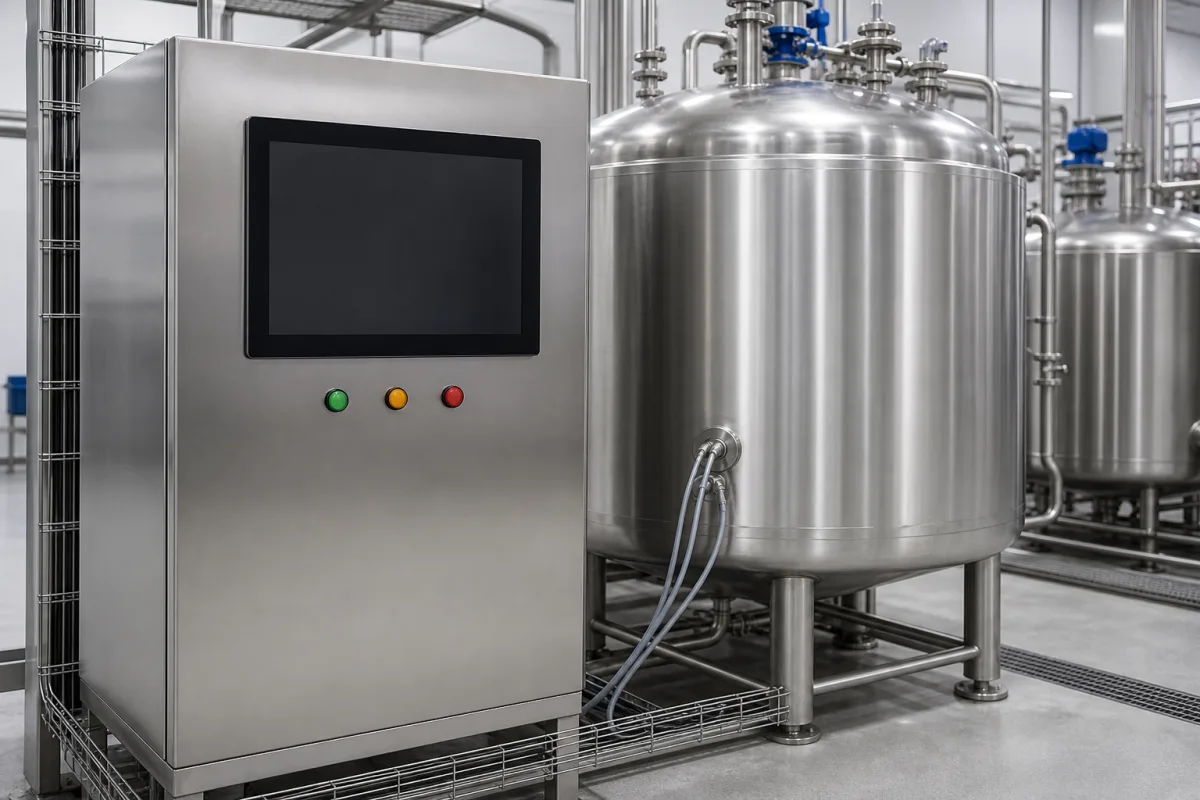
Temperature control panel for winery fermentation tanks: one controller per tank in a central stainless cabinet
Central temperature control cabinet for wine and cider cellars · one controller per tank in a stainless panel for 10, 20 or 30 tanks, a peak heat release near 1 W per litre of fermenting must, and jacket water at 12–16 °C or glycol for −2 to +2 °C cold stabilisation
In a cellar of stainless fermenters each tank has a cooling jacket, a valve on its supply and a probe in a thermowell. The controller that opens and closes that valve can hang on the tank or sit with all the others in one cabinet at the end of the row, where every set point and reading can be seen together and logged. What the panel has to handle is set by the fermentation it controls: the heat the must gives off at its peak, and whether the jackets carry water for fermentation or glycol for cold stabilisation.
Central and tank-side temperature control panels for wine, cider and similar fermentation and storage tanks: per-tank controllers, probes in thermowells, jacket valve outputs, pump relays, data logging and the jacket water or glycol they switch. Temperature control systems for brewery cylindroconical fermenters, with jacket zones and glycol loops, are covered on the Automated fermentation control system for brewery cylindroconical fermenters page; stand-alone panel and DIN-rail controllers on the Temperature controller page, and hot- and chilled-water modules for dairy vats on the Temperature control module page.
CNFX editorial research · Sources checked October 13, 2026 · 4 sources
One controller card per tank, 10 to 30 tanks per cabinet, and two relays for the heating and cooling pumps
Quantor's FermFlex-Box is a stainless control cabinet that controls tank temperatures from a central point in a wine cellar or brewery, with one controller card per tank, each fed by a cable sensor placed in that tank's thermowell. [1] The same maker's FermFix and FermFlex controllers do the same job at the tank instead. [2]
Quantor also sells a portable FermFlex-Mobile set with its own solenoid valve, filter, sensor and transformer that can be moved from tank to tank, which suits cellars that only control a few tanks at a time. [2]
Editorial note: the central cabinet puts the electronics away from the tank tops and their washdown, and the code lock matters where cellar staff and winemakers share the same set points; the price is a cable run from every thermowell and valve back to the cabinet.
Quantor published data
FermFlex-Box central cabinet
FermFix / FermFlex at the tank
Tanks per unit
10, 20 or 30 controllers, one per tank; more can be added up to the cabinet size [1]
Count the tanks now and planned, state whether each needs cooling only or cooling and heating, the valve type and voltage, the cable length to the furthest tank, and whether set points must be changed remotely and logged.
02
About 1 W per litre at the peak: what the must gives off and what the panel has to keep up with
Malavasi and co-authors at the University of Parma note that alcoholic fermentation releases approximately 106.3 kJ per mole of glucose in grape must, only partly absorbed by the must, and that the temperature rise this causes can affect yeast metabolism or even become lethal to the yeast. [3]
In the fermentation they describe, the highest heat release, about 1 W per litre, occurs in the first two days, when yeast activity is greatest, and is the peak over a week-long fermentation. They estimated heat release from must temperature measured over time, taking 0.1 °C as the thermocouple measurement uncertainty, and validated the method with a heater in 100 litres of water inside a fermenter at peak inputs of 100 W and 140 W. [3]
Editorial calculation: 106.3 kJ per mole of glucose divided by 180.16 g/mol is about 590 kJ per kg of glucose fermented. At about 1 W per litre, a 10,000-litre tank releases about 10 kW at its peak.
Editorial note: because the peak lasts days, not hours, the panel's job in that period is to keep the jacket valve open long enough, which depends on the jacket area and coolant temperature in the next section; a controller that cannot get enough coolant to the tank will show the set point being lost while the valve is open.
Give tank volumes, the must sugar content, the fermentation temperature set points for whites and reds, and the number of tanks that can ferment at the same time.
03
Water at 12–16 °C for fermentation, glycol for −2 to +2 °C cold stabilisation: the jacket area behind each controller
Winegrowers Supplies states that cooling a fermentation between 12 °C and 16 °C is more efficient with water alone, while cold stabilisation between −2 °C and +2 °C needs a glycol/water mixture. [4]
The same page says an internal cooling plate or coil needs only 72 % of the area of an external jacket, and that tank makers recommend an external jacket covering about 30 % of the tank surface. [4]
Editorial note: a panel that serves both fermentation and cold stabilisation switches two different coolants or one coolant at two temperatures; ask whether each tank's valve and controller is set up for the colder, more viscous glycol mixture as well as water.
Tank volume
Minimum external jacket area, ambient 22 °C, liquid 18 °C, glycol/water at 7 °C
State the jacket area or plate type on each tank, the coolant (water or glycol/water) and its supply temperature, and the cellar ambient temperature in harvest.
04
What to send for a winery temperature control panel
Paste it into your enquiry below or into an email to a maker, then replace every bracket.
Tanks: [number; volumes; now and planned]
Control: [cooling only or heating and cooling; set point ranges]
Coolant: [water or glycol; supply temperature; pumps]
Valves: [type; voltage; one per tank or per zone]
Panel: [central cabinet or at the tank; enclosure rating; cable lengths]
Data: [remote set points; logging; access lock]
Explore company information and manufacturing capabilities, then discuss the scope of your project with a relevant supplier.
Share this page
Compiled and source-reviewed by the CNFX editorial team.
Each manufacturer above links to the page on that company's own website where the product is listed, with the date we checked it. How we source and review
· Page last updated 13 October 2026
Buyer questions
How many tanks can one central control cabinet run?
Quantor's FermFlex-Box is built for 10, 20 or 30 tanks, with one controller per tank and 24 V AC, 2.5 A valve outputs. [1]
How much heat does a wine fermentation give off?
University of Parma researchers cite about 106.3 kJ per mole of glucose and describe a peak of about 1 W per litre in the first two days of the fermentation they studied. [3]
Do winery tank jackets need glycol?
Winegrowers Supplies says water alone is more efficient for fermentation at 12–16 °C, while cold stabilisation at −2 to +2 °C needs a glycol/water mixture. [4]
Sources and what still needs a direct check
Sources checked 2026-10-13. Cabinet and controller data come from Quantor's FermFlex-Box and FermFix/FermFlex pages; fermentation heat from Malavasi et al., International Journal of Heat and Technology (2023); jacket areas and coolant choice from Winegrowers Supplies.