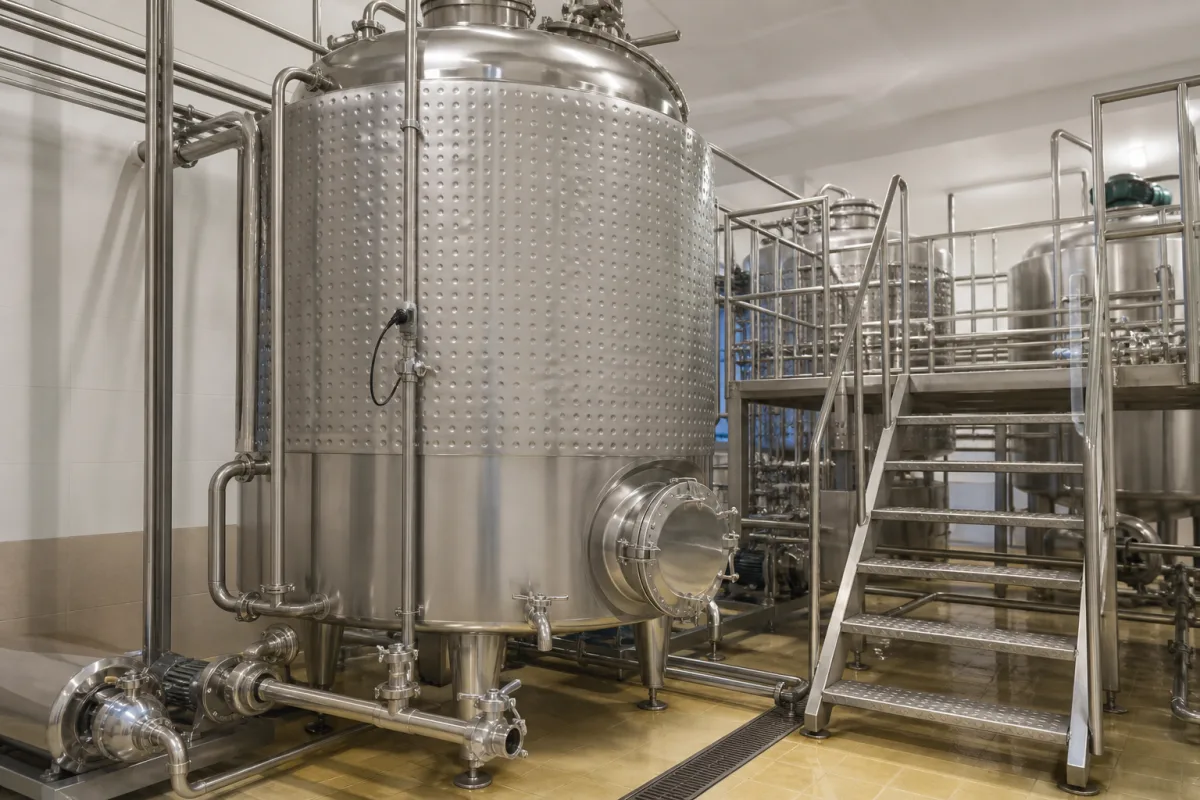
Hold prepared beverage syrup within its specified temperature conditions
A temperature-controlled syrup storage tank holds prepared beverage syrup before batching or dosing. Define the recipe’s temperature requirements and holding/withdrawal schedule, then size and coordinate the thermal circuit, insulation, agitation and measurement. Agree the temperature behavior across the working volume under the intended duty.
Prepared-beverage-syrup holding vessels with controlled heating/cooling or temperature maintenance before batching and dosing. General storage-tank families are covered on the Storage tank page; tanks buffering finished product at the filler on the Liquid storage tank ahead of the bottle filler page. Sugar dissolution, complete syrup-preparation lines, carbonators and aseptic-process validation are outside this holding-vessel scope.
CNFX editorial research · Sources checked October 19, 2026 · 3 sources
Separate prepared-syrup holding from dissolution and final-product buffering
Envitro’s syrup-tank range distinguishes sugar dissolution, mixing, heating/cooling jackets and ready-to-batch transfer. Identify which functions the proposed vessel must perform after the syrup has been prepared. A preparation system’s overall capability leaves the holding-vessel duty to be specified. [1]
Supply the syrup formulation or relevant physical-property envelope, including concentration, viscosity versus temperature and sensitivity to the intended heating/cooling and storage conditions. The process owner should define temperature limits and maximum hold conditions for each recipe.
Specify minimum and maximum working volume, incoming temperature, fill/withdrawal rates and interruptions. Decide whether the vessel only maintains temperature or must also heat/cool a batch within a stated time. Include ambient conditions and the utility conditions available at the tank.
02
Specify heat-transfer duty separately from insulation
Spirax Sarco describes indirect heat transfer through submerged coils or a vessel jacket. It explains that heat-transfer performance depends on fluid properties, viscosity, circulation and the thermal boundary layers. Select the heat-transfer arrangement for the actual syrup and operating conditions. [2]
iBottling’s hot/cold storage page describes jacketed beverage vessels, optional insulation and integration with syrup/preparation systems. Treat that as a supply-family description and obtain the proposed tank’s thermal calculation, layout and guaranteed conditions. [3]
Distinguish the circulating thermal-fluid jacket from the insulating layer. Define effective heat-transfer area and utility supply/return conditions, controls, heat losses and any agitation required by the thermal design. Agree product-side and jacket-side pressure/temperature limits independently.
Ask for the heating/cooling profile at the actual working volume and recipe, with operating limits at low fill. Include thermal expansion, drainability, utility isolation and service access in the approved equipment layout.
03
Define what the temperature-control guarantee measures
Specify the measured location and reference method before agreeing an accuracy figure. Sensor calibration, controller variation and temperature differences through the syrup volume are separate quantities.
Agree sensor position, immersion and calibration, along with the controller and thermal-valve response. Define the agitation speed/pattern and permitted operating levels for each recipe. Obtain the manufacturer’s approved monitoring and operating sequence.
For thermal acceptance, identify fill volume, initial temperature, ambient and utility conditions, syrup properties and withdrawal schedule. Record temperature at the agreed reference points through heat-up/cooldown and holding. Define permitted variation, spatial differences, recovery after a disturbance and test duration.
Approve the wetted materials, surface/connection details and cleaning process for the recipe and site. Holding temperature alone supplies no validation of cleaning, sterility or product shelf life.
04
Itemize the vessel and its thermal-control package
Use the equipment schedule and fields below to define the actual supplied assembly, its utility connections and its acceptance documents.
Require model-specific drawings and material/inspection records. Identify whether pumps, thermal-fluid equipment, instruments, valves, cleaning connections and control integration are included or supplied by others.
Insulation material/thickness, moisture protection, thermal losses and service access.
Temperature sensor / measurement
Location, range, calibration, hygienic connection and reference measurement for tests.
Agitation system
Selected impeller/drive, duty, minimum level and effect on temperature distribution.
Heating / cooling circuit
Jacket, coil or external circuit; utility conditions, controls and independently rated pressure boundary.
Tank control / line interface
Recipe selection, temperatures/alarms, level and transfer coordination, records and responsibilities.
05
Agree the thermal and installation fields for each recipe
Assign values to the offered configuration and the approved duty. Quote temperature maintenance separately from the time needed to change a batch’s temperature.
Tank field
Define and verify
Capacity
Gross and usable working volume, minimum level for agitation/thermal duty and required headspace.
Operating temperature range
Recipe holding range and separate product, jacket and cleaning/design limits.
Temperature control accuracy
Reference location, instrument uncertainty, control band, spatial uniformity and acceptance duration.
Operating pressure
Product and thermal-circuit design/operating pressures separately, including vent/vacuum conditions.
Material grade
Wetted body, fittings, agitator and seals matched to syrup and cleaning conditions.
Insulation thickness
Selected insulation/cladding construction and the thermal-loss/design basis.
Heating/cooling rate
Time-temperature profile at stated volume, properties, utility and agitation conditions.
Power supply
Loads and supplies for the chosen motor, controls and thermal equipment.
Ingress protection
Installed motors, sensors, controls and connections with washdown conditions identified.
Empty weight
Vessel and supplied attachments, separately from full working mass and support loads.
Footprint (diameter × height)
Installed envelope with nozzles, drive, cleaning/service and access clearances.
06
Share a syrup-holding and thermal acceptance brief
Paste it into your enquiry below or into an email to a maker, then replace every bracket.
Explore company information and manufacturing capabilities, then discuss the scope of your project with a relevant supplier.
Share this page
Compiled and source-reviewed by the CNFX editorial team.
Require a configuration-specific equipment list, vessel and thermal-circuit drawings, material records and the agreed thermal-test results. How we source and review
· Page last updated 19 October 2026
Buyer questions
Does a syrup preparation tank automatically define the holding duty?
Envitro lists different process functions. Specify the prepared-syrup holding requirements separately. [1]
Is insulation the heating or cooling jacket?
Spirax Sarco describes the jacket as a heat-transfer path. Specify insulation as a separate thermal-loss measure. [2]
Does a hot/cold tank family establish a temperature guarantee?
The iBottling page describes the equipment family. Obtain duty-specific thermal and control acceptance for the offered tank. [3]
Sources and what still needs a direct check
Sources checked 2026-10-19. Envitro and iBottling describe their own equipment families; their general offer language supplies no universal syrup holding temperature or accuracy. Spirax Sarco explains indirect heating and factors affecting heat transfer. Obtain design and measured acceptance evidence for the actual formulation and tank.