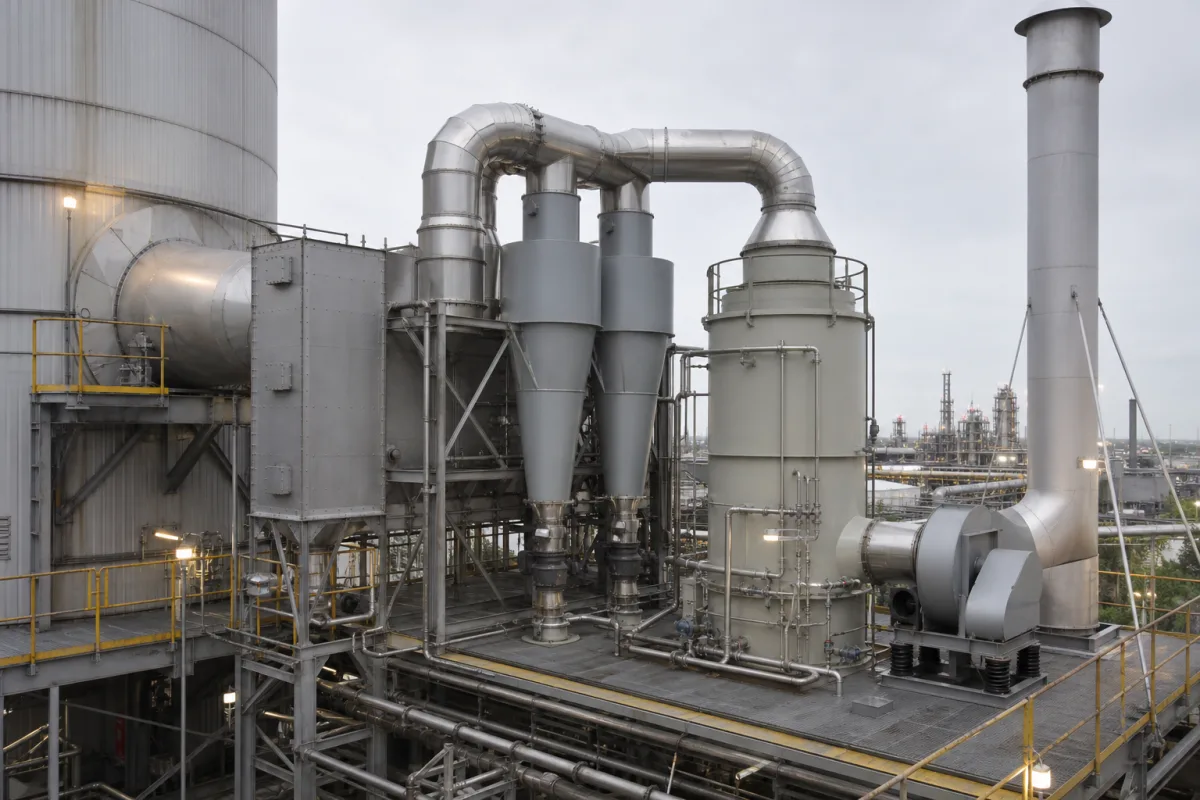
Prill tower air exhaust system (off-gas collection and urea dust and ammonia scrubbing for urea prilling towers)
Exhaust air from urea prilling towers · off-gas volume per tonne, urea dust and ammonia loads, submicron particles, wet scrubbing with recycled urea solution, scrubber pressure drop and water evaporation
A urea prilling tower is cooled by a very large upward air stream, and all of that air leaves near the top carrying fine urea dust and ammonia. The exhaust system collects it, scrubs it with water or recycled urea solution, sends the recovered urea back to the plant and discharges the cleaned air. It is sized on the off-gas volume, the dust and ammonia concentrations going in and the limit coming out, the share of submicron particles, the pressure the tower's draft can spare, and the water the scrubber will evaporate.
Off-gas collection and treatment for urea prilling towers: ducts or hoods at the tower top, wet dust scrubbers and Venturi eductors, acid scrubbing for ammonia, recirculation tanks and pumps, fans and stacks, and the return of recovered urea solution. The tower itself, its spray heads, cooling-air design and bottom bed are covered on the Prilling tower (prill tower for urea and ammonium nitrate) page; local exhaust ventilation for workshops and process machines is covered on the Industrial exhaust system page. Exhaust treatment for urea granulators, bagging-plant de-dusting and ammonium nitrate towers are outside this page except where compared.
CNFX editorial research · Sources checked October 12, 2026 · 4 sources
Off-gas volume and the urea dust and ammonia it carries
Stamicarbon gives an indicative off-gas flow of 500,000 Nm³/h for a urea prilling tower, and 900,000 Nm³/h for a larger tower producing 75 to 100 t/h of urea. Towers stand 60 to 80 m high, some up to 125 m. Emissions can be 0.5 to 2.5 kg of urea dust per tonne of prills (35 to 125 mg/Nm³) and about 0.5 to 2.7 kg of NH₃ per tonne (35 to 245 mg/Nm³); some existing towers have been reported above 200 mg/Nm³ of urea dust. [1]
Editorial calculation: 900,000 Nm³/h over 75 to 100 t/h is 9,000 to 12,000 Nm³ of off-gas per tonne of urea. At 500,000 Nm³/h, a dust concentration of 125 mg/Nm³ is 62.5 kg/h of urea leaving the tower; at 20 mg/Nm³ it is 10 kg/h. [1][2]
Snamprogetti's 1974 patent example gives a check on these orders of magnitude: a tower fed 62,500 kg/h of molten urea with 726,000 cooling air (stated as "Ncm³/hour", read here as Nm³/h) released 625 kg/h of urea powder with the air from the top. [3] Editorial calculation: that is 1% of the melt, about 11,600 Nm³ of air per tonne, and roughly 860 mg/Nm³ of dust before any treatment.
The dust is hard to catch because much of it is very fine: Stamicarbon reports a size peak between 0.1 and 1 µm aerodynamic diameter, with particles below 10 µm making up a cumulative mass of about 70 mg/Nm³, about half of total particulate matter, against about 25 mg/Nm³ in urea granulator off-gas. It notes that available capture technologies have low efficiency for submicron particles or a large pressure drop. [1]
Give the scrubber supplier the off-gas flow, temperature and humidity, the urea dust and NH₃ concentrations measured at the tower outlet, a particle-size analysis if one exists, and the outlet limits in the permit.
02
Wet scrubbing at the tower top: Venturi eductors, recycled urea solution and pressure drop
Snamprogetti's arrangement draws the air and urea powder from the tower top, adds water ahead of an ejector, and drives the ejector with urea solution recirculated from a collecting tank, from which the urea is recovered. In the example the circulating flow was 3,900 m³/h and the bleed was 2,505 kg/h of water carrying the 625 kg/h of urea. [3]
Editorial calculation: the bleed is 625 ÷ (2,505 + 625) ≈ 20% urea by weight, and the liquid-to-gas ratio in the ejector is 3,900 m³/h over 726,000 Nm³/h, about 5.4 L/Nm³. [3]
Stamicarbon's later design uses Venturi eductors in which the sprayed liquid propels the gas, and the patent puts the scrubber pressure drop below 250 Pa as a design statement rather than a measured value: it can be zero depending on the inlet and outlet ducting, and in some instances there is a net pressure gain of up to 500 Pa or more. Mounted at the top of a natural-draft tower, the eductors can sit horizontally and one above another to save height and footprint, with a casing of light materials such as FRP. [1] A second Stamicarbon design feeds the off-gas to a quench zone and then a scrub column with a Venturi stage and a split sump of two compartments. [2]
Water evaporates as the hot off-gas saturates. For air leaving the tower at 80 °C, Stamicarbon calculates saturation at 33 °C and 0.03 kg of water evaporated per Nm³ with pure water, falling to 0.02 kg/Nm³ (saturation at 37 °C) when the eductor liquid is recycled up to about 45% urea. [1] Editorial calculation: on 500,000 Nm³/h that is about 15 t/h of water with pure water and about 10 t/h with concentrated recycle, which the make-up and urea-recovery circuit must handle.
Ask for the pressure drop or gain across the scrubber at design flow, the recirculation and bleed flows, the urea concentration of the bleed sent back to the plant, and the weight the tower top must carry.
03
Outlet limits and what a plant reports from the prilling tower stack
Stamicarbon notes that limits for urea dust are stringent, such as below 20 mg/Nm³, below 10 mg/Nm³ or even below 5 mg/Nm³. [2]
In India, the environmental clearance for the Indo Gulf Fertilisers urea unit of Grasim Industries states that particulate emissions from the urea plant shall not exceed 50 mg/Nm³ and that the prilling tower is to be monitored to CPCB guidelines. For April to September 2019 the plant reported prilling tower SPM between 37 and 40 mg/Nm³ (average 38.73 mg/Nm³) and NH₃ between 39 and 43 ppm (average 41.04 ppm). [4] Editorial calculation: the average is about 77% of the 50 mg/Nm³ condition, but roughly eight times the 5 mg/Nm³ level Stamicarbon cites as a stringent limit.
The same clearance requires production to be interlocked with the pollution control devices, and a unit whose control system fails is not to be restarted until the controls are rectified. [4]
State which limit applies (dust in mg/Nm³, NH₃ in mg/Nm³ or ppm, reference conditions) and the monitoring method, so the guarantee is written against the same basis.
04
Data for a prill tower exhaust quotation
Paste it into your enquiry below or into an email to a maker, then replace every bracket.
Tower: [urea capacity t/h; height; natural or forced draft]
Off-gas: [flow Nm³/h; temperature; humidity]
Inlet load: [urea dust mg/Nm³; NH₃ mg/Nm³; particle size if measured]
Outlet limits: [dust; NH₃; reference conditions; monitoring method]
Scrubbing: [dust scrubbing; acid scrubbing for NH₃; Venturi eductors; quench]
Liquids: [make-up water; recirculation flow; bleed concentration returned to the plant]
Pressure: [allowable pressure drop; fan or natural draft]
Structure: [mounting at tower top or grade; weight limit; materials such as FRP or stainless]
Explore company information and manufacturing capabilities, then discuss the scope of your project with a relevant supplier.
Share this page
Compiled and source-reviewed by the CNFX editorial team.
Each manufacturer above links to the page on that company's own website where the product is listed, with the date we checked it. How we source and review
· Page last updated 13 October 2026
Buyer questions
How much air does a urea prilling tower exhaust?
Stamicarbon gives 500,000 Nm³/h as an indicative figure and 900,000 Nm³/h for a larger tower making 75 to 100 t/h of urea. [1][2]
Why is prill tower urea dust hard to remove?
Much of it is submicron: Stamicarbon reports a size peak between 0.1 and 1 µm, where available capture technologies are inefficient or have a large pressure drop. [1]
What happens to the urea caught by the scrubber?
It is recovered as urea solution; in Snamprogetti's example the bleed carried 625 kg/h of urea in 2,505 kg/h of water back for recovery. [3]
Sources and what still needs a direct check
Sources checked 2026-10-12. Stamicarbon and Snamprogetti are urea technology licensors whose patents state these off-gas and scrubbing figures; the stack readings are self-reported by the plant in its compliance report.