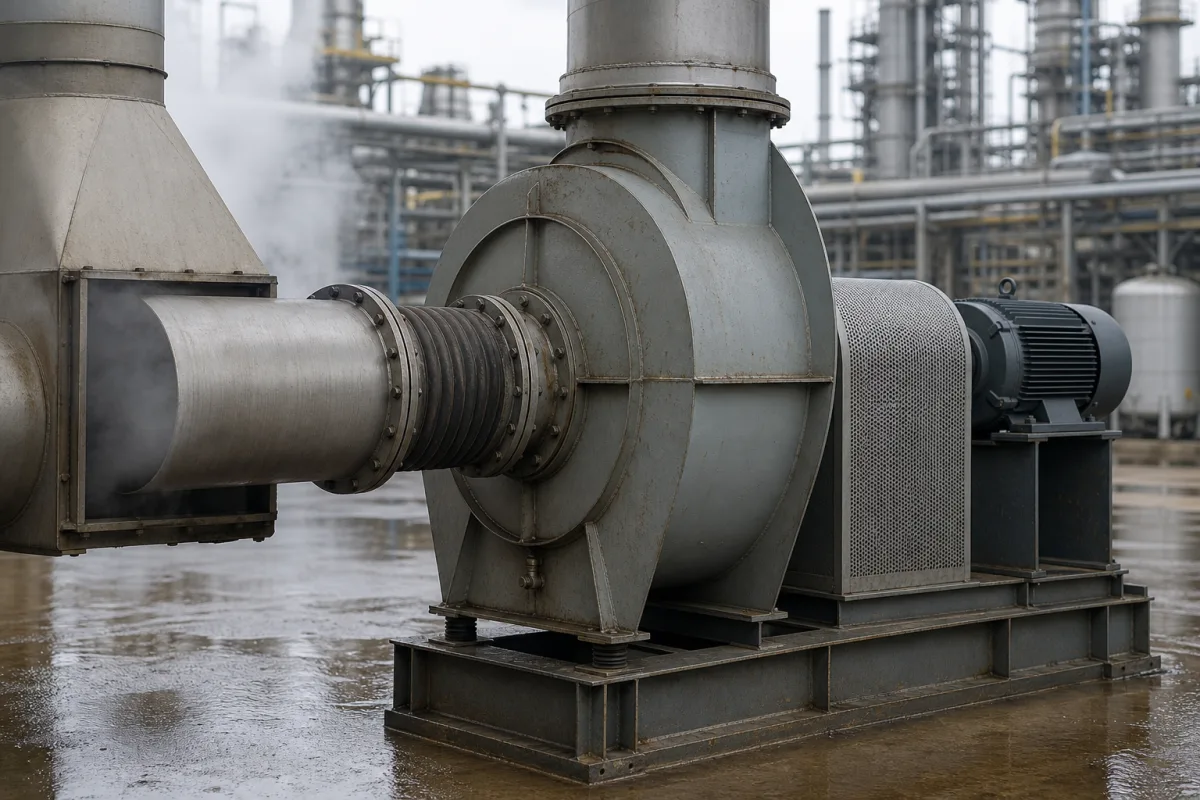
Exhaust fan for corrosive chemical fumes: fibreglass-reinforced plastic (FRP) centrifugal fume exhauster
Fibreglass (FRP) centrifugal exhausters for chemical fumes · vinyl ester resin and surfacing veil, chemical-by-chemical resistance, 200–250 °F limits and safe-speed derating, static grounding, drains and shaft seals
In a chemical plant the exhaust fan at the end of a fume hood, scrubber or tank vent handles air laden with acids, alkalis or solvent vapours, sometimes saturated with water. Painted carbon steel corrodes, and stainless steel costs more, so these fans are made with fibreglass-reinforced plastic airstream parts: a vinyl ester or polyester housing and wheel, a resin-rich surfacing veil and encapsulated stainless hardware. Check three things before the duty point: the fume against the maker's resistance guide, the gas temperature against the resin and speed limits, and whether the fumes are flammable.
Centrifugal exhaust fans with fibreglass-reinforced plastic housings and wheels for extracting corrosive gases, fumes and vapours from chemical processes, laboratories and scrubbers, and their resin, veil, hardware, grounding, drain and seal options. Selecting and testing industrial centrifugal fans by duty at gas conditions, fan laws, system effects and field tests is covered on the Centrifugal fan page, and burner combustion air blowers on the Combustion air blower page. Axial wall and roof ventilation fans, plastic (PP or PVC) fans and steel high-temperature fans are outside this page.
CNFX editorial research · Sources checked October 12, 2026 · 3 sources
Resin, surfacing veil and airstream hardware matched to the fume
In an FRP fume exhauster the resin chemistry, not the fan type, decides which fumes it can handle, so the resistance guide is read first.
Aerovent's Model RBF housings are solid FRP hand lay-up in a corrosion-grade, flame-retardant vinyl ester resin, with a glass veil on airstream surfaces as a resin-rich liner; the wheel is solid FRP with a steel hub encapsulated in the backplate, fixed to a 316 stainless stepped shaft by a 316 stainless retaining plate that is then encapsulated. Where chemicals attack glass or polyester resin, special plastics and reinforcement can be supplied. [1]
Hartzell's Series 41 guide specification calls for a one-piece resin-transfer-moulded wheel in Derakane 510-A vinyl ester with an encapsulated aluminium core insert, a housing of Hetron 693 polyester resin with 3% antimony trioxide for Class I flame spread below 25, at least 10 mil of chemical-, flame- and UV-resistant resin on all fibreglass surfaces, 304 stainless airstream hardware, and conformance to ASTM D4167-97. [2] Hartzell's current product page instead names Derakane 510B for housings and says airstream fasteners are encapsulated in at least 10 mil of resin and glass. [3] The two documents differ on the housing resin, so ask for the resin named on the order drawing.
Fume (Aerovent guide, standard FRP, max. 200 °F)
Saturated vapour
Dry vapour
Excess dry air
Hydrochloric acid
S
S
S
Sulfuric acid
S
S
S
Nitric acid
L
S
S
Hydrofluoric acid (synthetic veil required)
L
S
S
Sodium hydroxide
U
L
S
Acetone
U
L
S
Methyl ethyl ketone
U
U
L
Toluene, benzene, chloroform
U
U
U
Chlorine
L
S
S
Hydrogen sulfide, sulfur dioxide
S
S
S
S = satisfactory, L = limited life or life tests incomplete, U = unsatisfactory, as given in Aerovent's Catalog 750 corrosion resistance guide. [1] Send the supplier every chemical in the airstream with its concentration, whether it is saturated or condensing, the gas temperature and any abrasive particles or mist.
02
Gas temperature, safe wheel speed and the pressure each FRP range reaches
FRP loses strength as it warms, so the published temperature limit and the safe-speed factor belong in the selection, not only the density correction.
Aerovent rates the RBF to a maximum of 200 °F (93 °C) in arrangements 1, 9 and 10, and bases its corrosion guide on that temperature. Its maximum safe wheel speed at 70 °F ranges from 4,477 rpm for size 10 to 1,000 rpm for size 57, and is multiplied by a temperature factor of 1.00 at 100 °F, 0.95 at 150 °F and 0.90 at 200 °F. The RBF covers 10 to 57 inch wheels, airflow to 38,300 CFM and static pressure to 18 in w.g. [1]
Aerovent's worked example selects a size 29 fan for 3,200 CFM at 5 in static pressure, 150 °F and 1,000 ft: dividing by the density ratio of 0.838 gives 6 in at standard conditions, 1,120 rpm and 5.07 bhp cold, and 4.26 bhp at operating conditions. [1] Editorial calculation: size 29 has a 1,935 rpm limit at 70 °F; × 0.95 at 150 °F gives about 1,838 rpm, so the 1,120 rpm selection has margin, while the motor must be sized for the 5.07 bhp start in cold air.
Hartzell's guide specification states that the Series 41 is suitable for temperatures up to 250 °F, with bearings of at least 50,000 hours L10 life and balancing to AMCA 204 category BV-3. [2] Its product page gives 800 to 105,000 CFM at free delivery to 30 in w.g. for Series 41 (12 to 60 inch wheels), 800 to 32,000 CFM to 12 in w.g. for the packaged 41P, and 800 to 10,500 CFM to 6 in w.g. for the utility 41U. [3]
03
Static charge, condensate drains and shaft seals for flammable or wet fumes
FRP does not spark when struck, but it is an insulator; both makers treat that as a separate option.
Aerovent recommends spark-resistant construction when an FRP fan handles explosive fumes because fibreglass can build and retain a static charge; its version grounds the fan by carbon impregnation. [1] Hartzell's electrical grounding option coats airstream surfaces with a carbon-rich layer bonded by grounding straps to the motor frame, and states that the user must ground the equipment at installation. [2]
For wet duty, Aerovent's housing drain is a female pipe thread at the low point of the scroll, and Hartzell's is a 1 in CPVC bulkhead fitting. Hartzell fits a neoprene shaft seal where the shaft enters the housing with a neoprene slinger between seal and wheel, sleeves the carbon steel shaft in FRP in the airstream, and offers an abrasion and erosion coating for water mist or abrasive particles, plus 316 stainless or Monel hardware for special chemical environments. [2] Aerovent offers fire-retardant resin with antimony trioxide for a flame spread rating of 25 or less, and OSHA-type belt guards and weather covers. [1]
04
Data to send for an FRP fume exhaust fan
Paste it into your enquiry below or into an email to a maker, then replace every bracket.
Fumes: [each chemical; concentration; saturated, condensing or dry; particles or mist]
Gas: [temperature normal and maximum; site elevation]
Duty: [airflow; static pressure at actual conditions]
Construction: [housing and wheel resin; veil; hardware grade; flame spread]
Safety: [flammable fumes; grounding or spark-resistant construction]
Details: [arrangement; drain; shaft seal; access door; weather cover; motor enclosure]
6 companies list this product among what they make. Company figures are quoted from each
company's own website; every card states where the relationship came from.
Shengzhou City Huahao Motor Manufacturing Co., Ltd.
Explore company information and manufacturing capabilities, then discuss the scope of your project with a relevant supplier.
Share this page
Compiled and source-reviewed by the CNFX editorial team.
Each manufacturer above links to the page on that company's own website where the product is listed, with the date we checked it. How we source and review
· Page last updated 13 October 2026
Buyer questions
Can an FRP exhaust fan handle solvent vapours?
Not all of them: Aerovent's guide for its standard FRP marks toluene, benzene and chloroform as unsatisfactory in every condition, and acetone as unsatisfactory when saturated. [1]
How hot can the gas be for an FRP fume fan?
Aerovent rates its RBF to 200 °F (93 °C) and reduces safe speed to 0.90 of the 70 °F value at that temperature; Hartzell rates its Series 41 to 250 °F. [1][2]
Is a fibreglass fan safe for explosive fumes?
Fibreglass does not spark but can hold a static charge; Aerovent uses carbon impregnation and Hartzell a carbon-rich coating with grounding straps, and the installation must be grounded. [1][2]
Sources and what still needs a direct check
Sources checked 2026-10-12. Aerovent (a Twin City Fan company) and Hartzell Air Movement publish catalogue and specification data for their own FRP fans; the corrosion guide and limits apply to the resins and constructions they name.