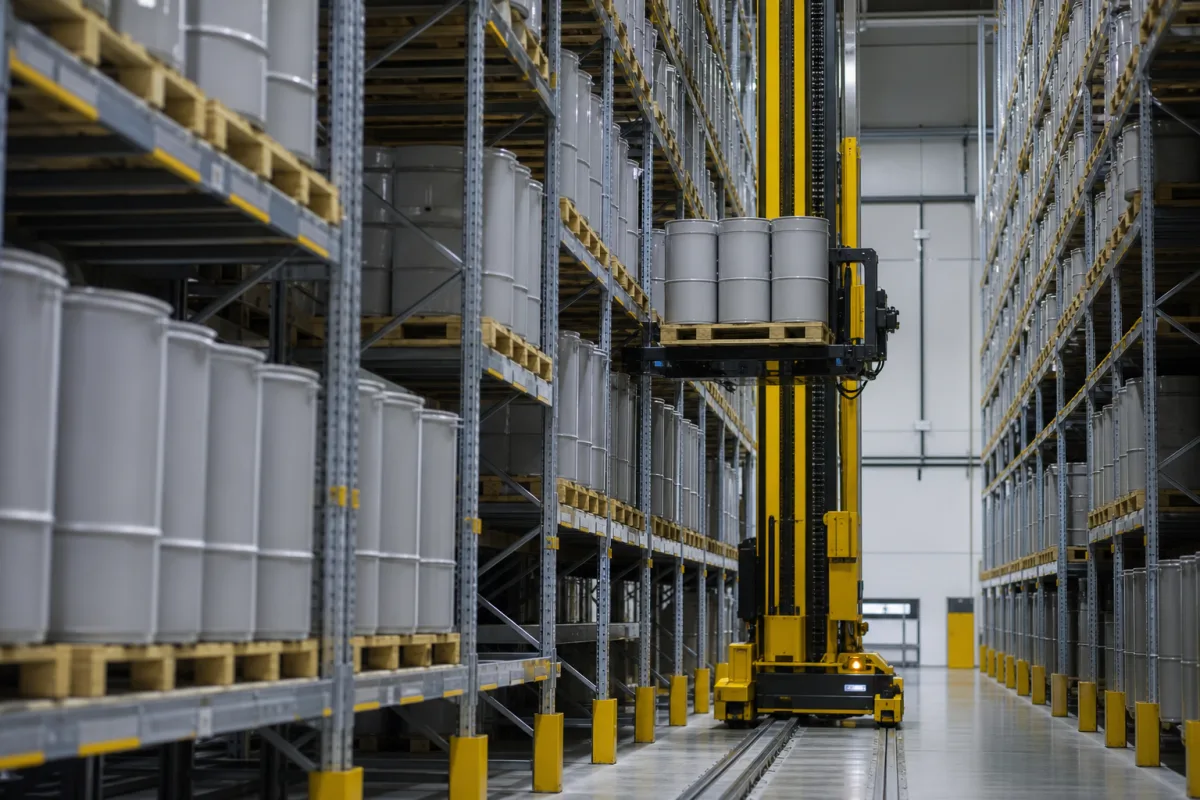
Pallet stacker crane for drum and chemical storage: a rail-guided retrieval machine in one high-bay aisle
The rail-bound crane that runs one aisle of a high-bay rack · double-column pallet stacker cranes for drummed and palletised chemicals: lift height, pallet load, travel and lift speed, positioning accuracy and the storage rules for flammable liquids
In an automated store for chemical drums, the machine that fetches a pallet from its rack location is a stacker crane: a mast on a floor rail, guided by a top rail, with a lifting carriage and telescopic forks that reach into the rack on either side of a single aisle. In INFORM's design it takes its power from a busbar along the aisle. Choosing one means fixing the pallet load and size, the rack height and depth, the speeds that set throughput, and — for flammable contents — what the building rules allow next to and above the rack.
Rail-guided pallet stacker cranes (storage and retrieval machines) that serve one aisle of a high-bay rack, with single- or multi-deep forks, as used to store drums, IBCs and palletised chemicals. Free-ranging automated guided vehicles, their guidance, traffic control and charging are covered on the Automated guided vehicle system (AGVS) page; AGV laser navigation and AGV on-board safety devices have their own pages; warehouse reach stackers and forklifts are outside this page.
CNFX editorial research · Sources checked October 12, 2026 · 3 sources
Ratings of a double-column pallet crane: 1,500 kg, 24 m, 180 m/min travel and ±3 mm on every axis
INFORM's Panther series is a double-column stacker crane for pallets. Its project table for model TMHS-P1-1500-24 shows the figures a buyer compares between cranes: load, height, three sets of speeds and accelerations, positioning accuracy, motor power and supply. [1]
The same page gives different headline figures from its table: the summary says operating speed "can reach 240m/min" with 0.6 m/s² acceleration and suits systems "under 1500kg and 25m", while the TMHS-P1-1500-24 table gives 180 m/min, 0.5 m/s² and 24 m. [1] Ask which figures the quoted crane is guaranteed to; 240 m/min is 4 m/s, a third faster than the table (Editorial calculation).
INFORM lists the crane's net weight at about 11,500–12,000 kg depending on single- or double-deep version and shelf type, says models over 30 m can be built to order, and names chemical and pharmaceutical storage among its uses alongside cold-chain storage at −25 °C — although the standard ambient in the table is −5 to 40 °C. [1] Editorial note: a crane for a cold or a hot store should be quoted against that temperature, not the standard table.
Send the pallet or drum-pallet size and gross weight, rack height and depth (single or double deep), required cycles per hour, ambient temperature, and whether the store holds flammable liquids; ask for travel, lift and fork speeds with accelerations, positioning accuracy and supply power.
02
Aisle width, first-level height and rail sizes fixed by the pallet
Unlike a vehicle, a stacker crane fixes the rack geometry around itself. INFORM's dimension rules tie aisle width, lowest beam level and top level to the load depth and height. [1]
Editorial calculation: for a 1,200 mm deep drum pallet (D < 1,300 mm) the rule gives a 1,500 mm aisle; for a 1,400 mm deep IBC pallet it gives 1,600 mm. Those two figures follow directly from INFORM's W2 rule and apply only to this crane series. [1]
D + 200 mm when load depth D ≥ 1,300 mm; 1,500 mm when D < 1,300 mm [1]
First (lowest) level H1
≥ 700 mm single-deep, ≥ 800 mm double-deep; 650 / 750 mm when the crane is within 8 m tall [1]
Top level H2
≥ H + 675 mm when load height H ≥ 1,130 mm; ≥ 1,800 mm otherwise [1]
Wheel base M
W + 2,700 mm when W ≥ 1,300 mm; 4,000 mm otherwise [1]
End buffer distance A5
≥ 300 mm with polyurethane buffers, ≥ 100 mm with hydraulic buffers [1]
Floor rail / top rail
38 kg/m floor rail; 100 × 100 × 10 mm angle top rail, supports at most 1,300 mm apart [1]
03
Throughput and height in a working system: three cranes, 33 m, 11,100 locations, 200 pallets per hour
Swisslog's order from the German food retailer Bela in Neumünster, Germany, shows how cranes, height and throughput are sized together: more than 11,100 storage locations served by three heavy-duty Vectura stacker cranes for double-pallet handling, at an operational height of 33 m, with 228 m of pallet conveyor and a total performance of 200 pallets per hour. [2]
Swisslog states that Vectura handles one, two or more loads in single-, double-, triple- and multi-deep layouts, operates at heights of up to 50 m, and works from −30 °C to +50 °C. [2] Editorial calculation: 11,100 locations over three cranes is about 3,700 locations per aisle, and 200 pallets per hour over three cranes is about 67 pallet moves per crane per hour, or one move every 54 seconds — a figure that includes conveyor hand-over, not crane travel alone.
In the Bela system the cranes and conveyor are run by Swisslog's SynQ material-flow software, and staff intervene only when a problem occurs. [2] Editorial note: for a chemical store, agree with the supplier how the material-flow software keeps incompatible substances in separate rack zones, since the crane itself goes wherever it is sent.
04
Drums of flammable liquid in the rack: 3 ft below sprinklers, 30-gallon stacking limit and Class I, Division 2 wiring
In the United States, OSHA's flammable liquids standard, 29 CFR 1910.106(d), sets rules that a stacker-crane drum store must be laid out to. In flammable liquid warehouses, no pile may be closer than 3 feet to the nearest beam, chord, girder or other obstruction, and piles must be 3 feet below sprinkler deflectors or other overhead fire protection discharge points. [3]
Editorial calculation: 30 US gallons is about 113.6 L, so a standard 55-gallon (about 208 L) drum is over the limit and may not be stacked on another drum in an inside storage room. [3]
INFORM's crane carries a list of safety devices that matter for drum loads: laser sensors, limit switches and hydraulic buffers against over-travel; a monitored electromagnetic brake; broken or slack rope or chain detection with a clamping device; fork-centre and cargo-position sensors; fork torque limiting; a cargo-shape check against falling loads; and a ladder with safety rope or cage for maintenance. [1] Editorial note: the INFORM table does not state any hazardous-area rating; where the rack zone is classified, ask the supplier for the explosion-protection design of motors, sensors and busbar, or whether the control cabinet stands outside the classified area.
Rule in 29 CFR 1910.106(d)
Where it applies
What it means for a crane store
No pile within 3 ft of beams or obstructions; 3 ft below sprinkler deflectors [3]
Flammable liquid warehouses or storage buildings
Fixes the highest usable rack level under the roof and in-rack sprinklers.
Containers in piles separated by pallets or dunnage for stability [3]
Flammable liquid warehouses
Drums go on pallets the forks can lift.
Aisles at least 3 ft wide where needed for access to doors, windows or standpipes [3]
Flammable liquid warehouses
Access aisles in addition to the crane aisle.
Containers over 30 gallons not stacked one upon another; one clear aisle at least 3 ft wide [3]
Inside storage rooms
Large drums one per position, not stacked.
Wiring and equipment approved for Class I, Division 2 for Category 1 and 2 liquids and Category 3 below 100 °F (37.8 °C) [3]
Inside storage rooms
Motors, sensors and drives in the room need hazardous-location approval.
The arrangement limits are in the tables themselves; obtain them for the liquid categories stored.
State the liquid categories and flash points stored, the hazardous-area classification of the rack zone, sprinkler and roof clearances, and drum and pallet sizes, and ask the supplier how each is reflected in the crane and rack design.
05
What a crane supplier needs for a chemical drum store
Paste it into your enquiry below or into an email to a maker, then replace every bracket.
Loads: [drum or IBC; pallet size; gross weight; drums per pallet]
Rack: [height; single or multi-deep; number of aisles and locations; clearances to roof and sprinklers]
Throughput: [pallet moves per hour; peak and average]
Environment: [temperature; humidity; hazardous-area classification]
Contents: [liquid categories and flash points; segregation rules]
Crane: [speeds and accelerations; positioning accuracy; safety devices; supply]
Controls: [warehouse software interface; zone management]
Explore company information and manufacturing capabilities, then discuss the scope of your project with a relevant supplier.
Share this page
Compiled and source-reviewed by the CNFX editorial team.
Each manufacturer above links to the page on that company's own website where the product is listed, with the date we checked it. How we source and review
· Page last updated 13 October 2026
Buyer questions
How fast does a pallet stacker crane travel?
INFORM's TMHS-P1-1500-24 table gives 180 m/min travel (3 m/s) at 0.5 m/s², and 45 m/min loaded lifting; its summary quotes up to 240 m/min. [1]
How high can a pallet stacker crane store?
INFORM's table model is rated to 24 m with custom versions over 30 m; Swisslog states Vectura works at up to 50 m, and its Bela cranes run at 33 m. [1][2]
How wide is the aisle for a pallet stacker crane?
For INFORM's Panther series, the aisle is load depth plus 200 mm for loads 1,300 mm deep or more, and 1,500 mm for shallower loads. [1]
How close to the sprinklers can flammable drums be stored?
OSHA 29 CFR 1910.106(d) requires piles in flammable liquid warehouses to be 3 feet below sprinkler deflectors and no closer than 3 feet to beams or other obstructions. [3]
Sources and what still needs a direct check
Sources checked 2026-10-12. Crane ratings, rack geometry and safety devices come from INFORM's Panther series product page; installed height, locations and throughput from Swisslog's announcement of its Bela project; storage, aisle and wiring rules for flammable liquids from OSHA's 29 CFR 1910.106.