Industry-Verified Manufacturing Data (2026)

Barrier Enclosure

Based on aggregated insights from multiple verified factory profiles within the CNFX directory, the standard Barrier Enclosure used in the Chemical Manufacturing sector typically supports operational capacities ranging from standard industrial configurations to heavy-duty production requirements.

Technical Definition & Core Assembly

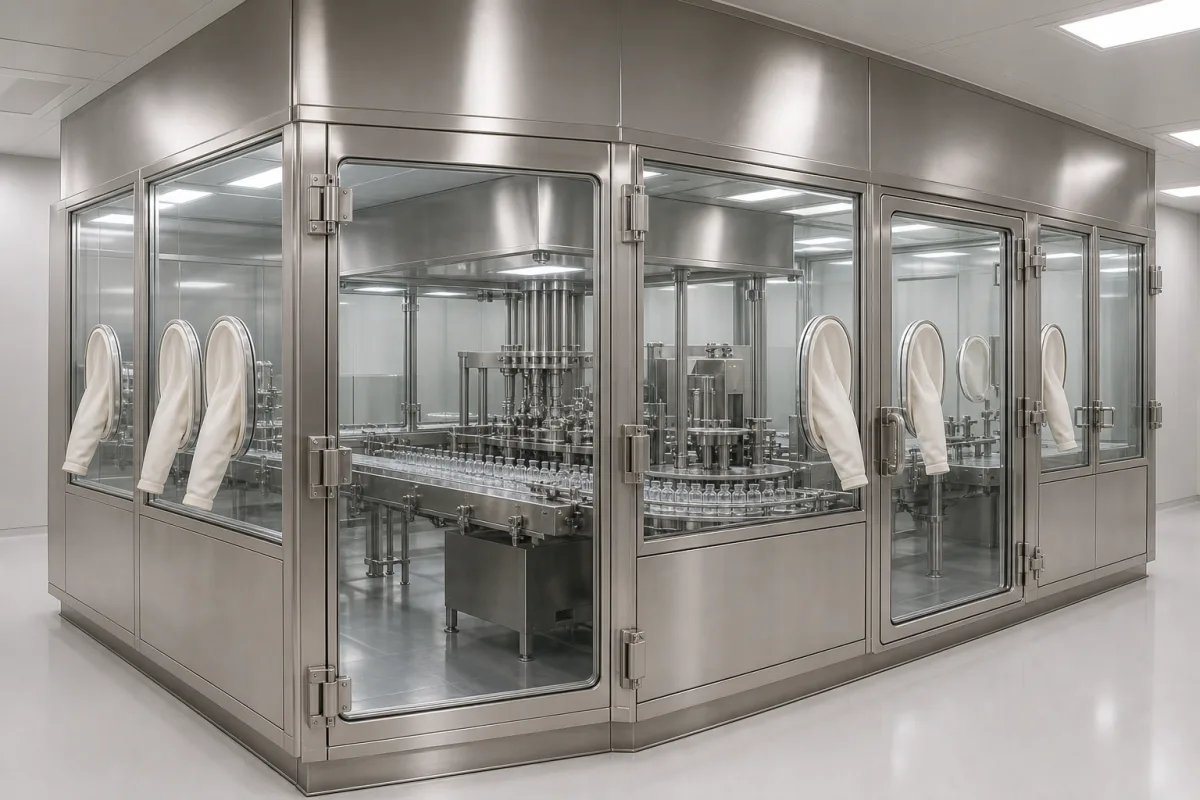
A canonical Barrier Enclosure is characterized by the integration of Viewing Panel and Glove Port Assembly. In industrial production environments, manufacturers listed on CNFX commonly emphasize Stainless steel (frame) construction to support stable, high-cycle operation across diverse manufacturing scenarios.

The physical structure that creates a sealed, controlled environment within an aseptic barrier system.
Product Specifications

Technical details and manufacturing context for Barrier Enclosure

Definition
The barrier enclosure is the rigid, sealed housing that physically separates the critical processing area from the surrounding environment in isolator or RABS (Restricted Access Barrier System) configurations. It maintains the required aseptic conditions by preventing contamination ingress and containing any potential hazards within the enclosure during pharmaceutical, biotech, or sterile manufacturing operations.
Working Principle
The enclosure creates a physical barrier using transparent panels (typically glass or polycarbonate) and sealed joints to isolate the internal workspace. It maintains differential pressure relative to the external environment, with HEPA-filtered air supply and exhaust systems ensuring proper airflow patterns. Glove ports or half-suits provide operator access while maintaining the integrity of the sealed environment.
Common Materials
Stainless steel (frame), Tempered glass/polycarbonate (viewing panels), Silicone gaskets (seals)
Technical Parameters
  • Overall dimensions (length × width × height) of the enclosure structure (mm) Customizable
Components / BOM
  • Viewing Panel
    Provides visual access to the internal workspace while maintaining barrier integrity
    Material: Tempered glass or polycarbonate
  • Glove Port Assembly
    Sealed interface for operator gloves, allowing manual manipulation inside the enclosure
    Material: Stainless steel with silicone gaskets
  • Structural Frame
    Provides rigid support and maintains dimensional stability of the enclosure
    Material: Stainless steel
  • Sealing Gasket
    Ensures airtight seals between panels and access points
    Material: Silicone or EPDM rubber
  • Pass-through Chamber
    Allows transfer of materials into/out of the enclosure without breaking containment
    Material: Stainless steel with interlocking doors
Engineering Reasoning
0.5-2.0 bar differential pressure
3.5 bar differential pressure or 0.1 mm gap width
Design Rationale: Plastic deformation of sealing gaskets exceeding 0.2% strain limit or laminar airflow disruption at Reynolds number > 2300
Risk Mitigation (FMEA)
Trigger Thermal cycling between 20°C and 80°C at 10 cycles/hour
Mode: Seal compression set exceeding 15% permanent deformation
Strategy: Install silicone gaskets with 70 durometer hardness and thermal expansion coefficient of 2.2×10⁻⁴/°C
Trigger Vibration at 50 Hz frequency with 0.5 mm amplitude
Mode: Fastener loosening leading to 0.05 mm gap formation
Strategy: Implement Nord-Lock washers with 45° wedge angle and 12.9 grade bolts torqued to 40 N·m

Industry Taxonomies & Aliases

Commonly used trade names and technical identifiers for Barrier Enclosure.

Applied To / Applications

This component is essential for the following industrial systems and equipment:

Industrial Ecosystem & Supply Chain DNA

Complementary Systems
Downstream Applications
Specialized Tooling

Application Fit & Sizing Matrix

Operational Limits
pressure: Up to 2 bar differential pressure (typical), 3 bar maximum design pressure
other spec: Particle retention: ≥0.2 μm, Cleanliness: ISO Class 5 or better, Flow rate: 0.1-5 m³/h per enclosure section
temperature: -20°C to 150°C (operating), -40°C to 180°C (sterilization cycles)
Media Compatibility
✓ Sterile pharmaceutical solutions ✓ Aseptic powder handling ✓ Cell culture media
Unsuitable: Highly corrosive chemicals (e.g., concentrated acids, strong oxidizers)
Sizing Data Required
  • Required internal volume (L or m³)
  • Number and type of process connections (ports, gloves, transfer systems)
  • Required cleanroom classification (ISO Class) and air change rate

Reliability & Engineering Risk Analysis

Failure Mode & Root Cause
Structural fatigue cracking
Cause: Cyclic loading from process vibrations, thermal expansion/contraction, or external impacts exceeding material endurance limits, often exacerbated by stress concentrations at weld joints or mounting points.
Seal/gasket degradation
Cause: Chemical attack from process fluids, thermal aging, compression set loss, or improper installation leading to containment breaches and environmental/process contamination.
Maintenance Indicators
  • Visible cracks, distortion, or corrosion on enclosure surfaces or welds
  • Audible hissing or whistling indicating pressure leaks, or abnormal vibration noises suggesting loose/internal component failure
Engineering Tips
  • Implement regular non-destructive testing (e.g., ultrasonic thickness testing, dye penetrant inspection) at high-stress areas to detect incipient cracks before catastrophic failure.
  • Establish preventive seal replacement schedules based on material compatibility studies with process fluids and thermal cycling data, using manufacturer-recommended torque procedures during installation.

Compliance & Manufacturing Standards

Reference Standards
ISO 14122-3:2016 (Safety of machinery - Permanent means of access to machinery - Part 3: Stairs, stepladders and guard-rails) ANSI/ASSE A1264.1-2017 (Safety Requirements for Workplace Floor and Wall Openings, Stair and Railing Systems) DIN EN 131-1:2017 (Ladders - Part 1: Terms, types, functional sizes)
Manufacturing Precision
  • Flatness: +/- 1.5mm per meter
  • Squareness: +/- 0.5 degrees
Quality Inspection
  • Load Testing (Static and Dynamic)
  • Dimensional Verification (using CMM or laser scanning)

Factories Producing Barrier Enclosure

Verified manufacturers with capability to produce this product in China

✓ 96% Supplier Capability Match Found

T Technical Director from Australia Feb 11, 2026
★★★★★
"The Barrier Enclosure we sourced perfectly fits our Chemical Manufacturing production line requirements."
Technical Specifications Verified
P Project Engineer from Singapore Feb 08, 2026
★★★★☆
"Found 18+ suppliers for Barrier Enclosure on CNFX, but this spec remains the most cost-effective. (Delivery took slightly longer than expected, but technical support was excellent.)"
Technical Specifications Verified
S Sourcing Manager from Germany Feb 05, 2026
★★★★★
"The technical documentation for this Barrier Enclosure is very thorough, especially regarding technical reliability."
Technical Specifications Verified
Verification Protocol

“Feedback is collected from verified sourcing managers during RFQ (Request for Quote) and factory evaluation processes on CNFX. These reports represent historical performance data and technical audit summaries from our B2B manufacturing network.”

11 sourcing managers are analyzing this specification now. Last inquiry for Barrier Enclosure from Mexico (18m ago).

Supply Chain Compatible Machinery & Devices

Continuous Flow Reactor System

Automated chemical synthesis system for continuous production.

Explore Specs →
Modular Distillation Column System

Pre-engineered modular system for continuous separation of chemical mixtures via distillation.

Explore Specs →
Automated Batch Crystallization System

Automated system for controlled crystallization of chemical compounds in batch processes.

Explore Specs →
Automated pH Monitoring and Dosing System

Automated system for continuous pH monitoring and chemical dosing in process streams.

Explore Specs →

Frequently Asked Questions

What materials are used in chemical manufacturing barrier enclosures?

Our barrier enclosures feature stainless steel frames for durability, tempered glass or polycarbonate viewing panels for visibility, and silicone gaskets for reliable sealing in chemical environments.

How does a barrier enclosure maintain aseptic conditions in chemical manufacturing?

The enclosure creates a sealed, controlled environment through structural integrity, proper sealing gaskets, and integrated components like glove ports and pass-through chambers that prevent contamination while allowing safe material transfer.

What are the key components of a chemical manufacturing barrier enclosure?

Essential components include the structural frame, viewing panels, glove port assemblies for operator access, sealing gaskets for airtight closure, and pass-through chambers for safe material transfer without breaking containment.

Can I contact factories directly on CNFX?

CNFX is an open directory, not a transaction platform. Each factory profile provides direct contact information and production details to help you initiate direct inquiries with Chinese suppliers.

Get Quote for Barrier Enclosure

Request technical pricing, lead times, or customized specifications for Barrier Enclosure directly from verified manufacturing units.

Your business information is encrypted and only shared with verified Barrier Enclosure suppliers.

Thank you! Your message has been sent. We'll respond within 1–3 business days.

Need to Manufacture Barrier Enclosure?

Connect with verified factories specializing in this product category

Add Your Factory Contact Us
Previous Product
Barcode/QR Scanner
Next Product
Binder Storage Tank