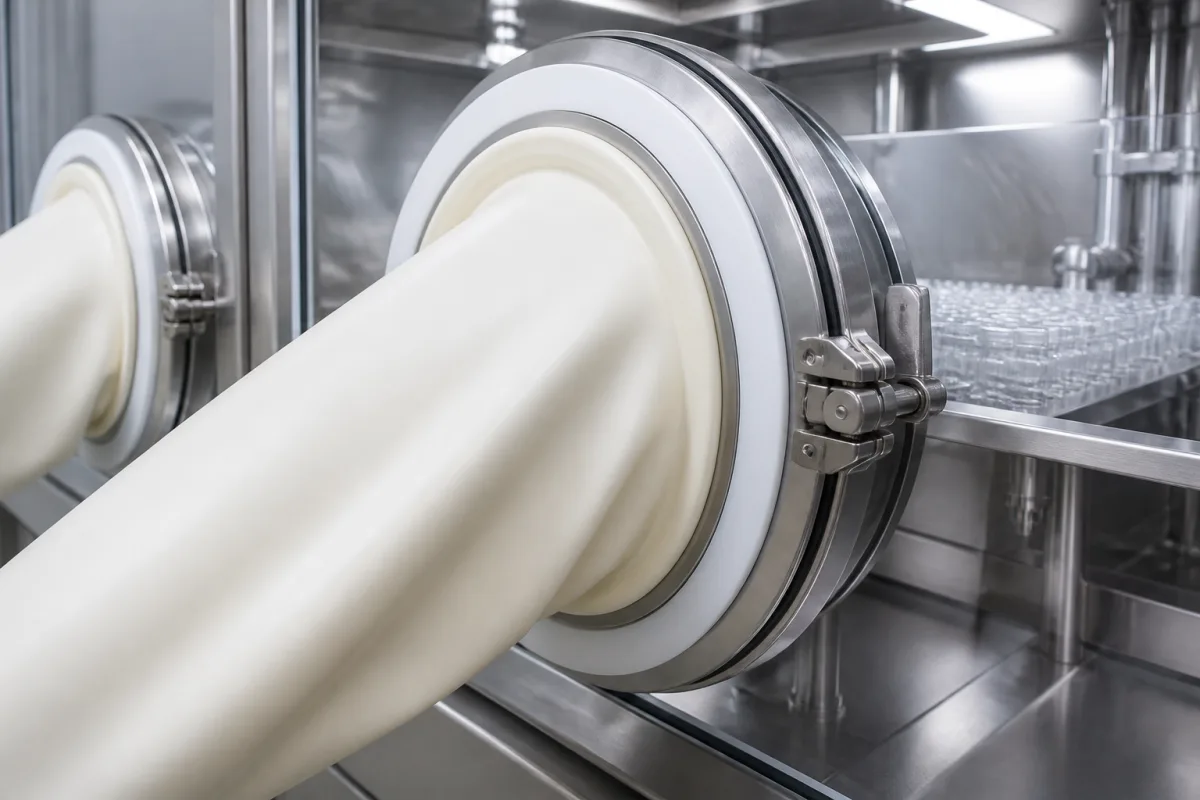
Glove ports and glove systems for isolators and RABS · Port ring and sleeve/glove assembly, glove change without loss of containment, material resistance, Annex 1 and FDA glove integrity expectations, ISO 10648-2 leak-tightness classes, pressure-decay glove testers, glove-print limits
A glove port assembly is the sealed ring, clamp and glove or sleeve-and-glove set fitted to the wall of an isolator or restricted access barrier system (RABS), letting operators reach into the grade A enclosure without breaking the barrier; the glove can be changed through the port and tested for leaks in place. Ask three things first: which barrier and decontamination agent it must suit, how the glove integrity will be tested and at what frequency, and what glove materials, sizes and change procedure the operation needs.
Glove ports, port rings, sleeves and gloves for pharmaceutical isolators and RABS, with glove-change and leak-test interfaces. Complete isolators and RABS, rapid transfer ports, cleanroom gowning gloves and laboratory glove boxes for non-sterile work are outside this page except where compared.
CNFX editorial research · Sources checked October 12, 2026 · 6 sources
EU GMP Annex 1 (August 2022) defines a RABS as an enclosed but not fully sealed system with a rigid wall and integrated gloves separating its grade A interior from the cleanroom, through which operators use gloves, half suits and transfer ports. It says direct intervention into grade A without barrier and glove port technology should be minimised, and that the impact of glove manipulations and possible loss of barrier or glove integrity should be considered in the isolator risk assessment. [1]
Annex 1 requires materials used for glove systems in isolators and RABS to be shown to have appropriate mechanical and chemical resistance, and the frequency of glove replacement to be defined in the contamination control strategy (CCS). For RABS, gloves used in grade A should be sterilised before installation and sterilised or bio-decontaminated by a validated method before each campaign, and disinfected after any exposure to the background environment. [1]
FDA's 2004 guidance on sterile drug products produced by aseptic processing (Appendix 1, aseptic processing isolators) calls a faulty glove or sleeve (gauntlet) assembly a route of contamination and a critical breach of isolator integrity. It asks for durable glove materials with a well-justified replacement frequency, replacement frequencies in written procedures so parts are changed before they break down or degrade, and daily attention to the integrity of gloves, half-suits and seams within a preventive maintenance programme. [2]
Both documents ask that gloves be extended with the fingers separated during isolator decontamination so the agent reaches all glove surfaces, and FDA notes that gloves, sleeves and half-suits can be among the harder places to reach during decontamination. Because microscopic holes can let microorganisms pass and no highly sensitive glove integrity test exists, FDA recommends attention to the sanitary quality of the inner surface of the installed glove and the use of a second pair of thin gloves. [1][2]
Editorial note: give the supplier the decontamination agent (for example vaporised hydrogen peroxide) and disinfectants used, the products handled, and the reach and dexterity needed, so glove material, thickness and size can be matched; ask for chemical-resistance and permeation data.
Give the supplier the barrier type (isolator or RABS) and maker, port diameter and wall thickness, glove or sleeve-and-glove configuration, glove material, thickness and sizes, decontamination and disinfection agents, products handled (including cytotoxics), change-through-port method, leak-test method and equipment interface, documentation and quantities.
02
Plan glove integrity testing and monitoring
For isolators, Annex 1 requires leak testing of the glove system with a method shown to suit the task, at defined intervals, and glove integrity testing at a minimum at the beginning and end of each batch or campaign, with more testing as the validated campaign length requires; glove integrity monitoring should include a visual inspection with each use and after any manipulation that may affect integrity. For manual aseptic processing of single units or small batches, frequency may be based on other criteria such as each manufacturing session. For RABS, gloves should be visually examined with each use and integrity tested at periodic intervals. [1]
FDA asks that gloves be visually evaluated for macroscopic physical defects with every use and states: "Physical integrity tests should also be performed routinely." In its isolator section FDA writes: "A breach of isolator integrity should normally lead to a decontamination cycle." It lists holes in gloves and seams among the causes of lost integrity, asks that breaches be investigated, and says product potentially affected by a breach that may have compromised the environment should be rejected. [2]
Its viable monitoring limits for glove prints of five fingers on both hands are no growth in grade A and 5 CFU per glove in grade B. [1]
Editorial calculation: an isolator with 8 glove ports running a 5-batch campaign, tested at the start and end of each batch, needs 8 × 5 × 2 = 80 glove integrity tests; at an assumed 10 minutes per test that is over 13 hours if the ports are tested one at a time, or 10 rounds of about 100 minutes in total if all 8 ports can be tested in parallel, so ask whether the tester can check all ports at once and how test data are recorded.
03
Set the leak-tightness class and the glove test method
ISO 10648-2:1994 classifies containment enclosures by leak tightness; the full text is sold by ISO, so this page uses a published summary. In Clean Air and Containment Review (Issue 11, July 2012), Tim Coles reports that ISO 14644-7:2004 and ISO 10648-2:1994 both specify four classes, expressed as percentage volume loss per hour: Class 1 0.05%, Class 2 0.25%, Class 3 1.0% and Class 4 10.0%. He offers broad advice, not a rule: Class 1 for Class III microbiological safety cabinets and very high containment isolators, Class 2 for negative-pressure aseptic isolators, Class 3 for positive-pressure aseptic isolators, and Class 4 not appropriate for pharmaceutical isolators. [3]
The same article converts a pressure-decay reading to leak rate with L = PD × 6,000 / (SP × M), where L is % volume loss per hour, PD the pressure decay in Pa, SP 101,325 plus the starting pressure in Pa, and M the test time in minutes. Its worked examples: a start at 200 Pa with a 25 Pa decay over 5 minutes gives 0.30% per hour, just short of Class 2; for an aseptic isolator running at 50 Pa, a 150 Pa test for 10 minutes allows up to 42 Pa decay for Class 2. It suggests testing at FAT, SAT, OQ, planned preventive maintenance and after any repair that breached the sealed structure, and notes that sleeves can be everted during a whole-isolator test, while gloves, sleeves and half-suits can also be tested separately with devices that close off the port and run a pressure-decay test. [3]
As one published example of such a device, SKAN describes its WirelessGT glove tester as a pressure-decay test in accordance with ISO 10648-2: the unit is placed in the glove port, identifies the port by RFID, inflates its seal, holds the test pressure for a stabilisation period to account for temperature and material effects, and then evaluates the pressure drop. SKAN states inflation times under 30 seconds, detection of leaks with diameters of 100 µm and above, up to 48 gloves tested in parallel, up to 20 test cycles per battery charge, and a test disc adapted to third-party glove-port designs. [4]
Editorial note: a pressure-decay pass shows the glove holds pressure within the set limit; it does not prove the absence of holes smaller than the tester's stated detection limit, which is why FDA also points to the inner-glove and second-glove measures above.
04
Compare published port and glove-change designs
Glove port hardware differs in how the glove is fixed and changed. The examples below are from makers' own published pages and data sheets; they show what each company offers, not tested performance in your barrier.
Getinge's DPTE-Glove System replaces a fixed glove port with a closed Alpha port on the barrier wall and a sterile Beta glove connected only when an intervention is needed. Getinge lists a round Ø240 Alpha port, mounting on walls up to 20 mm, a door that unlocks when the Beta part is rotated 60° and opens to 165°, and interlocks that keep the Alpha door closed unless the glove is properly connected and stop the glove being disconnected unless the double door is closed. The Beta CSM glove is supplied integrity-tested and gamma-irradiated, validated for a shelf life of 18 months from production and for up to 50 connections, and the system is retrofittable to round 240 glove ports. Getinge's argument is that fewer permanently fitted gloves means fewer leak tests. [5]
Piercan's BCS secured cuff ring joins the glove to an arm-guard sleeve so the glove can be changed without loss of containment, either by over-pressure (removing the glove from inside the isolator towards the exterior) or by under-pressure (removing it towards the interior). Its data sheet lists PBT, described as class VI biocompatible, for the glove and arm-guard safety sleeve parts, an SEBS thermoplastic elastomer lip, FDA compliance under 21 CFR 177.2600, an internal diameter of Ø 91 mm and width of 50 mm, a glove clipping effort of 70 N and changing effort of 110 N, and a bacterial test in the dynamic phase with 5 glove changes run to Piercan's own protocol. [6]
Editorial note: ask each supplier which leak-test disc or adapter fits the chosen port, whether the glove-change method keeps the barrier closed, and whether the glove, cuff ring and port were tested together after the decontamination agent you use.
05
Find glove port manufacturers
No manufacturer record has been reviewed for this product yet. Send your specification and CNFX will match it against manufacturer records.
06
Trace the assembly components
This is a functional reference built from the sources cited; it is not one maker's design.
Part
Role
Fix in the order
Port ring and clamp
Seals the glove or port to the barrier wall; one published port is Ø240 for walls up to 20 mm. [5]
Fill the specification fields with values for your barrier
A glove port quotation needs values for your barrier and process. The table explains each field, gives published values where a reviewed source states them, and says what to obtain from the supplier.
Explore company information and manufacturing capabilities, then discuss the scope of your project with a relevant supplier.
Share this page
Compiled and source-reviewed by the CNFX editorial team.
Published product pages show what a company offers, not tested performance. Confirm the legal seller, factory, material data and scope for your order. How we source and review
· Page last updated 13 October 2026
Buyer questions
At what frequency must isolator gloves be integrity tested?
EU GMP Annex 1 says at a minimum at the beginning and end of each batch or campaign, with more testing as the validated campaign length requires; FDA asks for daily attention to glove integrity. [1][2]
Do RABS gloves need to be sterile?
Yes; Annex 1 says gloves used in grade A should be sterilised before installation and sterilised or bio-decontaminated before each campaign. [1]
What microbial limit applies to glove prints?
No growth in grade A and 5 CFU per glove in grade B. [1]
What leak rate should an isolator meet?
A published summary of ISO 10648-2 lists four classes from 0.05% to 10.0% volume loss per hour; its author suggests Class 2 for negative-pressure and Class 3 for positive-pressure aseptic isolators. [3]
Sources and what still needs a direct check
Sources checked 2026-10-12. EU GMP Annex 1 and the FDA aseptic processing guidance set expectations for sterile manufacture; they do not specify glove port designs. The leak classes come from a published summary of ISO 10648-2, and the port, cuff-ring and tester figures come from makers' own pages. Materials and test methods for your barrier must come from the supplier's data and your validation.