Industry-Verified Manufacturing Data (2026)

Demister/Mist Eliminator

Based on aggregated insights from multiple verified factory profiles within the CNFX directory, the standard Demister/Mist Eliminator used in the Chemical Manufacturing sector typically supports operational capacities ranging from standard industrial configurations to heavy-duty production requirements.

Technical Definition & Core Assembly

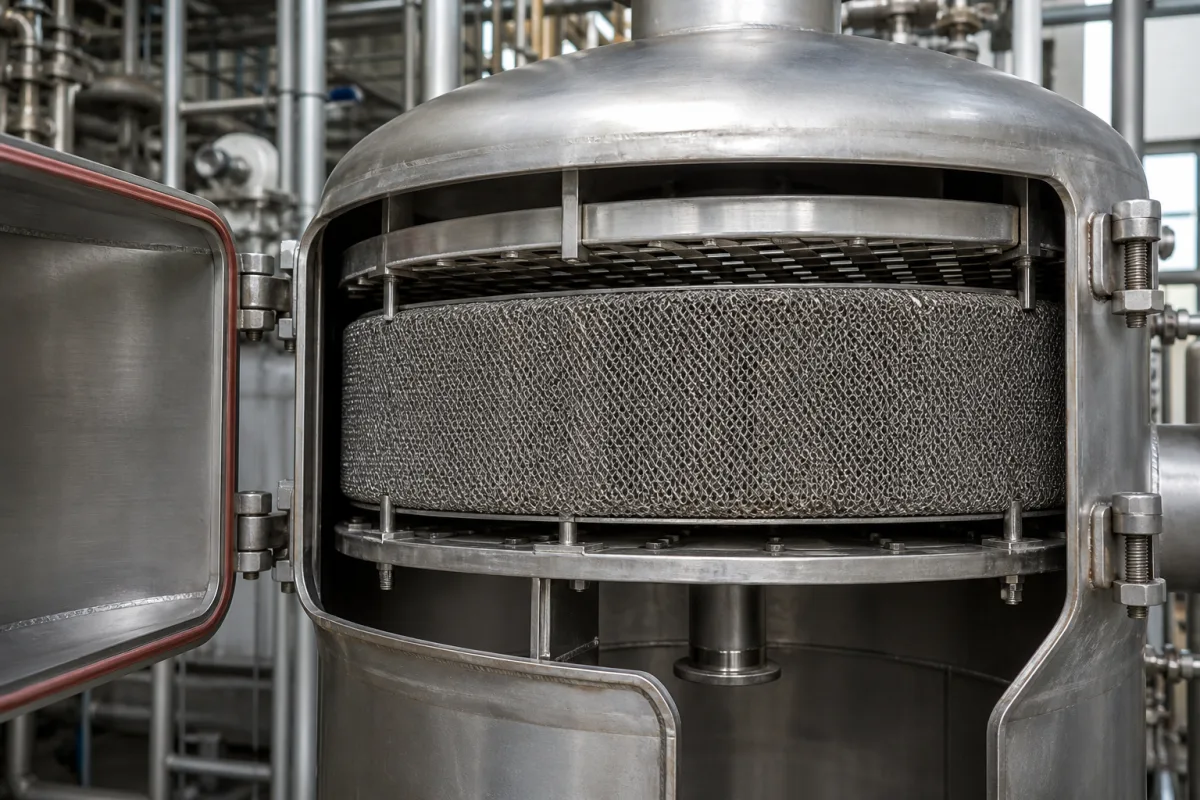
A canonical Demister/Mist Eliminator is characterized by the integration of Mesh Pad and Support Grid. In industrial production environments, manufacturers listed on CNFX commonly emphasize Stainless Steel construction to support stable, high-cycle operation across diverse manufacturing scenarios.

A device used to remove liquid droplets or mist from gas streams in industrial processes.
Product Specifications

Technical details and manufacturing context for Demister/Mist Eliminator

Definition
A critical component within Gas Cleaning Plants that separates entrained liquid droplets from gas streams through impingement, centrifugal force, or filtration mechanisms, ensuring clean gas output and preventing downstream equipment damage.
Working Principle
Operates by forcing gas streams containing liquid droplets through mesh pads, vanes, or cyclonic separators where droplets collide with surfaces, coalesce into larger droplets, and drain away by gravity while clean gas passes through.
Common Materials
Stainless Steel, Polypropylene, Fiberglass
Technical Parameters
  • Mesh pad thickness or vane spacing (mm) Per Request
Components / BOM
  • Mesh Pad
    Primary separation surface where droplets coalesce
    Material: stainless steel
  • Support Grid
    Structural framework holding mesh pads in place
    Material: carbon steel
  • Drainage System
    Channels collected liquid away from gas stream
    Material: stainless steel
Engineering Reasoning
0.1-10 bar differential pressure, -40°C to 200°C temperature, 0.5-10 m/s gas velocity
15 bar differential pressure causing mesh deformation, 250°C temperature degrading polymer components, 15 m/s gas velocity causing re-entrainment
Design Rationale: Excessive differential pressure causes plastic deformation of wire mesh elements; high temperature degrades polypropylene/polyester materials; high gas velocity exceeds droplet capture efficiency threshold causing re-entrainment
Risk Mitigation (FMEA)
Trigger Corrosive gas stream with pH < 2.0
Mode: 316L stainless steel mesh corrosion leading to structural failure
Strategy: Hastelloy C-276 alloy mesh construction with 0.5 mm minimum thickness
Trigger Liquid loading exceeding 0.3 kg/m²·s
Mode: Mesh flooding causing 100% pressure drop increase and flow restriction
Strategy: Dual-stage mesh design with 150 mm spacing and 99% porosity lower stage

Industry Taxonomies & Aliases

Commonly used trade names and technical identifiers for Demister/Mist Eliminator.

Applied To / Applications

This component is essential for the following industrial systems and equipment:

Industrial Ecosystem & Supply Chain DNA

Complementary Systems
Downstream Applications
Specialized Tooling

Application Fit & Sizing Matrix

Operational Limits
pressure: Up to 100 bar (standard), higher with reinforced designs
flow rate: 0.5 to 50 m/s gas velocity (optimal range)
temperature: -40°C to 400°C (typical), up to 600°C with special materials
slurry concentration: Up to 10% solids by weight (standard), higher with specialized designs
Media Compatibility
✓ Natural gas processing (amine contactors) ✓ Chemical reactor off-gas streams ✓ Compressed air systems
Unsuitable: High-viscosity liquid entrainment (>500 cP)
Sizing Data Required
  • Gas flow rate (actual m³/h)
  • Droplet size distribution (microns)
  • Required separation efficiency (%)

Reliability & Engineering Risk Analysis

Failure Mode & Root Cause
Plugging/Fouling
Cause: Accumulation of solids, polymers, or viscous materials in the mesh or vanes, often due to inadequate upstream filtration, process upsets, or chemical reactions within the mist stream.
Structural Damage/Blowout
Cause: Mechanical failure of the mesh, pads, or support structure due to excessive pressure drop (ΔP), liquid overloading, corrosion, or fatigue from cyclic operation or vibration.
Maintenance Indicators
  • Sustained high differential pressure (ΔP) across the demister, exceeding design limits.
  • Visible liquid carryover or excessive mist in the outlet stream, indicating reduced separation efficiency.
Engineering Tips
  • Implement regular monitoring of differential pressure (ΔP) and trend analysis to detect fouling early and schedule cleaning before efficiency drops critically.
  • Specify and install appropriate upstream devices (e.g., inlet baffles, pre-filters) to remove large droplets and particulates, reducing the load on the demister and minimizing plugging and erosion.

Compliance & Manufacturing Standards

Reference Standards
ISO 14644-1:2015 (Cleanrooms and associated controlled environments) ANSI/ASME B31.3 (Process Piping) DIN EN 13445-3 (Unfired pressure vessels - Part 3: Design)
Manufacturing Precision
  • Mesh wire diameter: +/-0.01mm
  • Support grid flatness: 0.5mm per meter
Quality Inspection
  • Pressure drop test (air/water flow)
  • Material composition verification (PMI - Positive Material Identification)

Factories Producing Demister/Mist Eliminator

Verified manufacturers with capability to produce this product in China

✓ 96% Supplier Capability Match Found

P Project Engineer from Australia Jan 25, 2026
★★★★★
"Found 55+ suppliers for Demister/Mist Eliminator on CNFX, but this spec remains the most cost-effective."
Technical Specifications Verified
S Sourcing Manager from Singapore Jan 22, 2026
★★★★★
"The technical documentation for this Demister/Mist Eliminator is very thorough, especially regarding technical reliability."
Technical Specifications Verified
P Procurement Specialist from Germany Jan 19, 2026
★★★★★
"Reliable performance in harsh Chemical Manufacturing environments. No issues with the Demister/Mist Eliminator so far."
Technical Specifications Verified
Verification Protocol

“Feedback is collected from verified sourcing managers during RFQ (Request for Quote) and factory evaluation processes on CNFX. These reports represent historical performance data and technical audit summaries from our B2B manufacturing network.”

13 sourcing managers are analyzing this specification now. Last inquiry for Demister/Mist Eliminator from Brazil (26m ago).

Supply Chain Compatible Machinery & Devices

Automated Batch Crystallization System

Automated system for controlled crystallization of chemical compounds in batch processes.

Explore Specs →
Automated pH Monitoring and Dosing System

Automated system for continuous pH monitoring and chemical dosing in process streams.

Explore Specs →
Automated Powder Dispensing and Blending System

Automated system for precise dispensing and homogeneous blending of powdered chemicals.

Explore Specs →
Automated Solvent Recovery and Purification System

Automated system for recovering and purifying industrial solvents.

Explore Specs →

Frequently Asked Questions

What materials are best for demisters in corrosive chemical environments?

For highly corrosive environments, polypropylene or fiberglass demisters offer excellent chemical resistance. Stainless steel (grades 304 or 316) works well for moderate conditions. Material selection depends on temperature, pressure, and specific chemicals in your process.

How does the drainage system in a mist eliminator work?

The drainage system collects liquid droplets captured by the mesh pad and channels them away from the gas stream. Proper drainage prevents re-entrainment of liquid, maintaining separation efficiency. Systems typically include collection channels, drains, and sometimes pumps for continuous removal.

What maintenance is required for industrial demister pads?

Regular inspection for fouling, corrosion, or damage is essential. Cleaning may involve washing with appropriate solvents or water blasting. Replacement intervals depend on operating conditions, but typical industrial demisters last 2-5 years with proper maintenance and monitoring of pressure drop.

Can I contact factories directly on CNFX?

CNFX is an open directory, not a transaction platform. Each factory profile provides direct contact information and production details to help you initiate direct inquiries with Chinese suppliers.

Get Quote for Demister/Mist Eliminator

Request technical pricing, lead times, or customized specifications for Demister/Mist Eliminator directly from verified manufacturing units.

Your business information is encrypted and only shared with verified Demister/Mist Eliminator suppliers.

Thank you! Your message has been sent. We'll respond within 1–3 business days.

Need to Manufacture Demister/Mist Eliminator?

Connect with verified factories specializing in this product category

Add Your Factory Contact Us
Previous Product
Demister
Next Product
Dispersion Pump