Industry-Verified Manufacturing Data (2026)

Feed Pump

Based on aggregated insights from multiple verified factory profiles within the CNFX directory, the standard Feed Pump used in the Chemical Manufacturing sector typically supports operational capacities ranging from standard industrial configurations to heavy-duty production requirements.

Technical Definition & Core Assembly

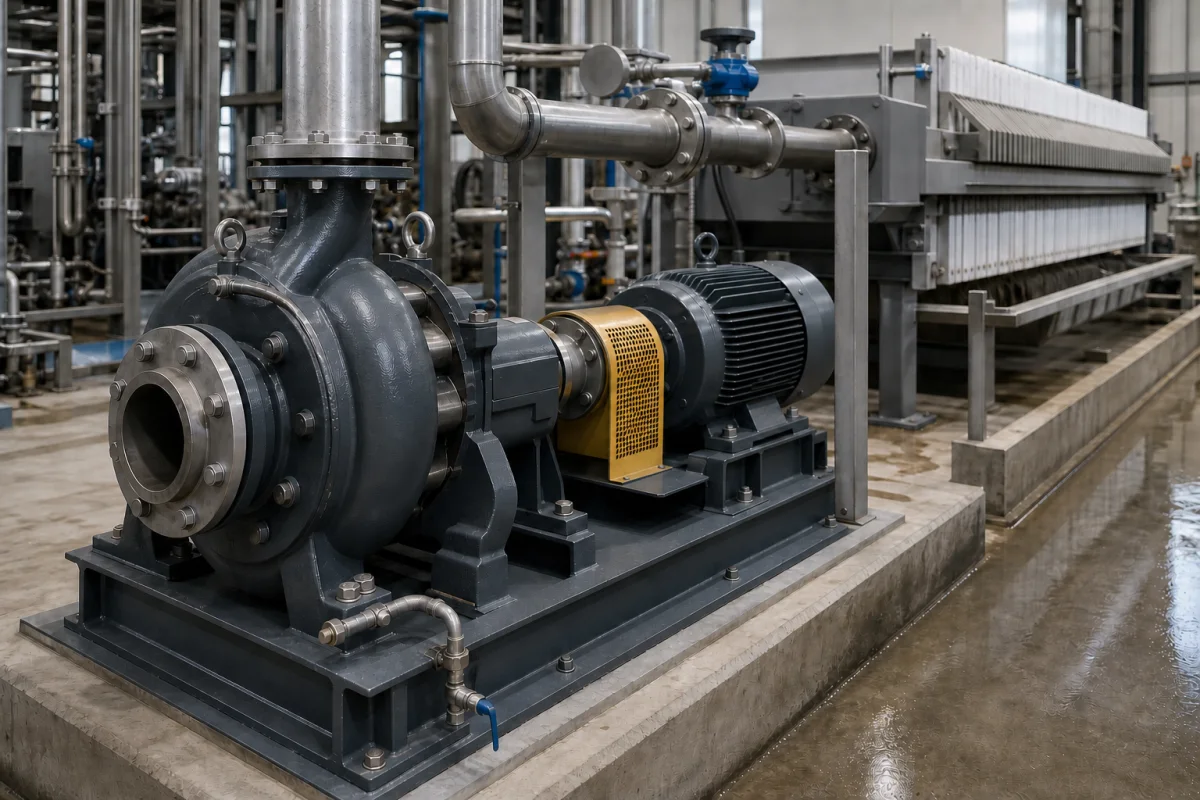
A canonical Feed Pump is characterized by the integration of Pump Casing/Housing and Impeller/Diaphragm/Piston. In industrial production environments, manufacturers listed on CNFX commonly emphasize Stainless Steel (e.g., 316L) construction to support stable, high-cycle operation across diverse manufacturing scenarios.

A pump component that delivers chemical slurry or liquid to the filtration press at controlled pressure and flow rate.
Product Specifications

Technical details and manufacturing context for Feed Pump

Definition
The feed pump is a critical component of an Industrial Chemical Filtration Press, responsible for transporting the chemical mixture (slurry or liquid) from the holding or mixing tank into the filtration chambers of the press. It ensures a consistent and controlled supply of material to be processed, maintaining the required pressure for efficient filtration and separation of solids from liquids within the chemical manufacturing process.
Working Principle
Typically operates using a positive displacement (e.g., diaphragm, piston, lobe) or centrifugal mechanism. It draws the chemical feed from an inlet source and pressurizes it, forcing the material through piping into the filtration press. Flow rate and pressure are controlled to match the filtration cycle requirements, often regulated by valves and control systems.
Common Materials
Stainless Steel (e.g., 316L), Cast Iron, Engineered Plastics (e.g., PTFE, PVDF)
Technical Parameters
  • Inlet/Outlet port diameter (mm) Per Request
Components / BOM
  • Pump Casing/Housing
    Contains the pumping mechanism and directs fluid flow
    Material: Stainless Steel or Cast Iron
  • Impeller/Diaphragm/Piston
    The moving element that creates pressure and moves the fluid
    Material: Stainless Steel, Rubber, or PTFE
  • Drive Shaft
    Transmits rotational power from the motor to the pumping element
    Material: Stainless Steel
  • Seals/Gaskets
    Prevent leakage of the chemical fluid from the pump
    Material: Viton, EPDM, PTFE
  • Inlet/Outlet Flanges
    Connection points for piping to and from the pump
    Material: Stainless Steel
Engineering Reasoning
3.5-15.0 bar (50-217 psi) at 5-25 m³/h flow rate
Cavitation occurs at NPSHa < 2.1 m (6.9 ft) below NPSHr, bearing failure at >120°C (248°F) housing temperature, seal failure at >0.5 mm shaft deflection
Design Rationale: Vapor pressure drop below slurry's 0.023 bar (0.33 psi) at 20°C causing cavitation bubbles; centrifugal force imbalance from 0.05 mm impeller wear generating 15g vibration; polymer swelling reducing 316L stainless steel corrosion resistance by 40% in pH<2 environments
Risk Mitigation (FMEA)
Trigger Abrasive silica particles (Mohs 7) exceeding 150 ppm concentration in slurry
Mode: Impeller erosion reducing efficiency from 85% to below 65% within 2000 operating hours
Strategy: Hardened AISI 440C stainless steel impeller with 60 HRC hardness and 0.8 mm wear-resistant coating
Trigger Dry running for >45 seconds at 2900 RPM without fluid lubrication
Mode: Mechanical seal carbon face thermal cracking at 280°C (536°F) interface temperature
Strategy: Dual PTFE secondary seal with 0.3 mm clearance and capacitive proximity sensor detecting <10% fill level

Industry Taxonomies & Aliases

Commonly used trade names and technical identifiers for Feed Pump.

Applied To / Applications

This component is essential for the following industrial systems and equipment:

Industrial Ecosystem & Supply Chain DNA

Complementary Systems
Downstream Applications
Specialized Tooling

Application Fit & Sizing Matrix

Operational Limits
pressure: Up to 10 bar
flow rate: 5 to 100 m³/h
temperature: 0°C to 120°C
slurry concentration: Up to 60% solids by weight
Media Compatibility
✓ Chemical slurries (e.g., mineral processing) ✓ Industrial wastewater ✓ Food-grade liquids (with compatible seals)
Unsuitable: Highly abrasive slurries with >60% solids or corrosive media exceeding pH 12
Sizing Data Required
  • Required flow rate (m³/h)
  • System pressure (bar)
  • Slurry properties (viscosity, solids concentration, particle size)

Reliability & Engineering Risk Analysis

Failure Mode & Root Cause
Cavitation
Cause: Insufficient Net Positive Suction Head (NPSH) due to low inlet pressure, high fluid temperature, or suction line restrictions causing vapor bubble formation and implosion on impeller surfaces.
Bearing failure
Cause: Lubrication degradation from contamination, moisture ingress, or improper greasing intervals leading to overheating, vibration, and eventual seizure or spalling.
Maintenance Indicators
  • Excessive vibration or audible knocking from pump casing indicating impeller imbalance or bearing wear
  • Unusual high-pitched whining or grinding noises during operation suggesting cavitation or mechanical interference
Engineering Tips
  • Implement NPSH margin monitoring and maintain suction strainer cleanliness to prevent cavitation damage
  • Establish precision alignment procedures during installation/repair and use vibration analysis for early bearing degradation detection

Compliance & Manufacturing Standards

Reference Standards
ISO 5199:2015 - Technical specifications for centrifugal pumps ANSI/HI 1.1-1.6 - American National Standard for Centrifugal Pumps DIN EN ISO 9906:2012 - Rotodynamic pumps - Hydraulic performance acceptance tests
Manufacturing Precision
  • Impeller diameter: +/-0.05mm
  • Shaft runout: 0.02mm maximum
Quality Inspection
  • Hydrostatic pressure test
  • Vibration analysis test

Factories Producing Feed Pump

Verified manufacturers with capability to produce this product in China

✓ 93% Supplier Capability Match Found

P Project Engineer from Germany Jan 25, 2026
★★★★★
"Standard OEM quality for Chemical Manufacturing applications. The Feed Pump arrived with full certification."
Technical Specifications Verified
S Sourcing Manager from Brazil Jan 22, 2026
★★★★★
"Great transparency on the Feed Pump components. Essential for our Chemical Manufacturing supply chain."
Technical Specifications Verified
P Procurement Specialist from Canada Jan 19, 2026
★★★★★
"The Feed Pump we sourced perfectly fits our Chemical Manufacturing production line requirements."
Technical Specifications Verified
Verification Protocol

“Feedback is collected from verified sourcing managers during RFQ (Request for Quote) and factory evaluation processes on CNFX. These reports represent historical performance data and technical audit summaries from our B2B manufacturing network.”

13 sourcing managers are analyzing this specification now. Last inquiry for Feed Pump from Brazil (11m ago).

Supply Chain Compatible Machinery & Devices

Automated Batch Crystallization System

Automated system for controlled crystallization of chemical compounds in batch processes.

Explore Specs →
Automated pH Monitoring and Dosing System

Automated system for continuous pH monitoring and chemical dosing in process streams.

Explore Specs →
Automated Powder Dispensing and Blending System

Automated system for precise dispensing and homogeneous blending of powdered chemicals.

Explore Specs →
Automated Solvent Recovery and Purification System

Automated system for recovering and purifying industrial solvents.

Explore Specs →

Frequently Asked Questions

What materials are recommended for chemical feed pumps handling corrosive slurries?

For corrosive chemical slurries, we recommend stainless steel (316L) for general corrosion resistance, or engineered plastics like PTFE or PVDF for highly aggressive chemicals. Material selection depends on the specific chemical composition and operating conditions.

How does a feed pump maintain controlled pressure for filtration press operations?

Our feed pumps use precision-engineered impellers, diaphragms, or pistons combined with variable speed drives to maintain consistent pressure and flow rates. This ensures optimal filtration press performance and prevents pressure spikes that could damage the filtration system.

What maintenance is required for chemical manufacturing feed pumps?

Regular maintenance includes inspecting seals and gaskets for chemical compatibility wear, checking impeller/diaphragm condition, and verifying flange connections. We recommend scheduled inspections based on operating hours and the abrasiveness/corrosiveness of the pumped media.

Can I contact factories directly on CNFX?

CNFX is an open directory, not a transaction platform. Each factory profile provides direct contact information and production details to help you initiate direct inquiries with Chinese suppliers.

Get Quote for Feed Pump

Request technical pricing, lead times, or customized specifications for Feed Pump directly from verified manufacturing units.

Your business information is encrypted and only shared with verified Feed Pump suppliers.

Thank you! Your message has been sent. We'll respond within 1–3 business days.

Need to Manufacture Feed Pump?

Connect with verified factories specializing in this product category

Add Your Factory Contact Us
Previous Product
Feed Preheater
Next Product
Feed System