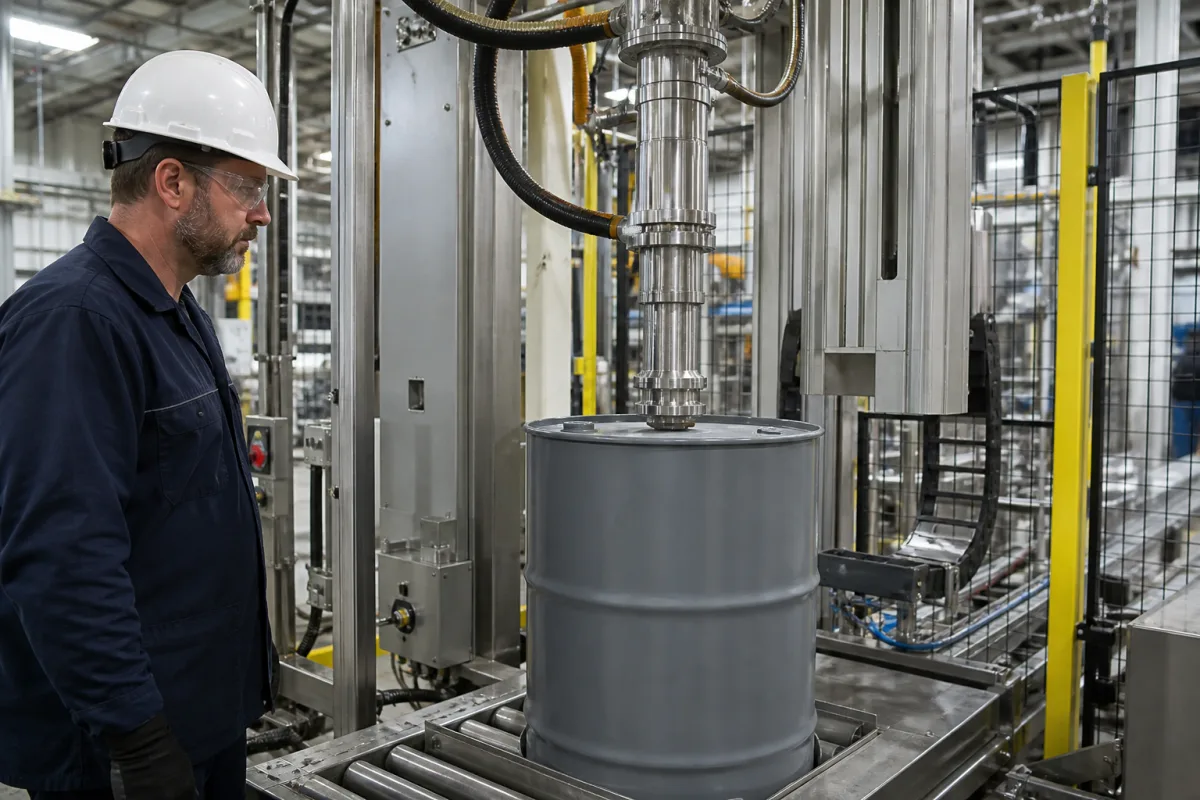
Filling head for drum and container filling of chemical liquids
Liquid filling into drums and containers · Subsurface lance filling against foam, splash and fumes, drip control, bonding and grounding for flammable liquids
A filling head is the nozzle or lance assembly of a liquid filling machine that delivers product into the container: a valve opens and closes the flow, a nozzle or lance directs it, and anti-drip features, fume hoods and grounding connections keep the operation clean and safe. For drums, the head can be a lance that dives into the drum. Ask three things first: whether the liquid foams, splashes or gives off fumes and therefore needs subsurface filling, how the head stops drips and fumes between containers, and whether the liquid is flammable so that nozzle and container must be bonded.
Filling heads, nozzles and filling lances for liquid filling of drums, pails, cans and bottles, including subsurface (bottom-up) and top filling, anti-drip valves, fume extraction and bonding. Complete filling lines, dispensing heads for adhesives, and powder fillers are outside this page.
CNFX editorial research · Sources checked October 12, 2026 · 5 sources
Fill below the surface to control foam, splash and fumes
US patent 4,957,147 (priority 1987) explains that with liquids that foam or produce fumes or odours, “the liquid is generally introduced at a relatively slow or ‘dribble’ rate initially with the tip of the lance near the bottom of the container”, then faster once the liquid has risen above the tip. Its apparatus monitors liquid level to prevent overfilling and to set the lance withdrawal speed, and provides a self-closing cap at the lance tip and a drip catcher that moves under the lance as it is withdrawn. [2]
US patent 4,703,780 (priority 1986) describes a drum filler that weighs the liquid in, prefills until the lance tip — the 1 to 8 inches nearest the drum bottom — is covered, then opens fully and raises the lance gradually so only a small portion stays submerged, reducing spillage, noxious fumes and build-up on the lance; it adds a wiper ring, a fume disposal hood and a drip collector. [3] US patent 4,932,445 (priority 1988) describes a fully pneumatic subsurface filler with a scale, timed lance descent and ascent, a movable drip tray and an exhaust box with a three-inch exhaust connection for noxious and hazardous liquids. [4]
Editorial calculation: in a drum of about 571 mm inside diameter (an assumed 200 L steel drum), each 25 mm (1 in) of liquid depth holds about 6.5 L, so a slow prefill to cover the bottom 2 inches of a lance takes roughly 13 L before fast filling begins. Ask the supplier how the prefill, fast fill and lance lift are controlled — by weight, level or time.
Give the supplier the liquids (viscosity, foaming, fuming, flashpoint, corrosiveness), containers (drums, IBCs, pails, bottles; opening size and height), fill method (subsurface or top, by weight or volume), accuracy and rate, drip and fume control needs, wetted materials and seals, hazardous-area classification, bonding and grounding arrangement, and cleaning or product-change needs.
02
Bond the nozzle to the container and control drips
OSHA's flammable liquids standard, 29 CFR 1910.106, states that Category 1 or 2 flammable liquids, or Category 3 flammable liquids with a flashpoint below 100 °F (37.8 °C), shall not be dispensed into containers unless the nozzle and container are electrically interconnected; this is met where the metal floorplate the container stands on is connected to the fill stem, or the fill stem is bonded to the container by a bond wire during filling. [1]
For tanks, the same standard requires that fill pipes for these liquids be designed to minimise static generation, terminating within 6 inches of the tank bottom, and that loading of tank vehicles through open domes have bonding facilities against static sparks. [1] Editorial note: subsurface lances apply the same idea to drums; ask whether the lance, drum stand and drum are bonded and earthed, and whether the electrical equipment suits the hazardous-area classification.
Npack describes its liquid fillers with 2 to 16 filling heads, a stated filling precision of ±0.5%, and filling nozzles designed to prevent dripping and drawing. [5] US patent 4,957,147 adds a self-closing cap at the lance tip and an annular wiper that cleans the lance as it is raised. [2]
03
Anti-drip, acid-resistant, peristaltic and drum-line filling nozzles on supplier sites
Listings include anti-drip filling nozzles on multi-head bottle fillers, corrosion-resistant nozzles for acid and bleach filling, filling nozzles for peristaltic-pump fillers, custom filling heads on can fillers and drum filling lines; ask each for the valve type, subsurface capability, drip and fume control, wetted materials and bonding.
04
Fill valve, lance, wiper, drip tray, fume hood and bond wire on a drum filler
Part
Role
Fix in the order
Fill valve
Opens, throttles and closes flow; slow then fast. [2][3]
Head count, fill accuracy, lance reach, fume connection and bonding for a filling-head order
Npack's 2–16 heads and ±0.5% are the only numeric values here; lance reach, prefill and fume extraction come from the drum-filling patents, and bonding from OSHA 29 CFR 1910.106.
5 companies list this product among what they make. Company figures are quoted from each
company's own website; every card states where the relationship came from.
Shanghai Npack Automation Equipment Co., Ltd.
Manufacturing site to be confirmed for the order
Lists multi-head liquid fillers with anti-drip, anti-draw filling nozzles.
Explore company information and manufacturing capabilities, then discuss the scope of your project with a relevant supplier.
Share this page
Compiled and source-reviewed by the CNFX editorial team.
Each manufacturer above links to the page on that company's own website where the product is listed, with the date we checked it. How we source and review
· Page last updated 13 October 2026
Buyer questions
Why fill drums below the liquid surface?
Drum-filling patents explain that starting slowly with the lance tip near the bottom and keeping it submerged reduces foaming, splashing and fumes. [2][3]
Does a filling nozzle need to be grounded?
OSHA 29 CFR 1910.106 forbids dispensing Category 1–2, or Category 3 below 100 °F flashpoint, flammable liquids into containers unless nozzle and container are electrically interconnected. [1]
How do filling heads stop drips?
Designs use a self-closing lance tip, a wiper ring and a drip catcher; bottle fillers use anti-drip nozzles. [2][5]
Sources and what still needs a direct check
Sources checked 2026-10-12. OSHA 29 CFR 1910.106 is a US regulation; the patents describe specific drum-filling inventions and their background. Npack describes its own machines.