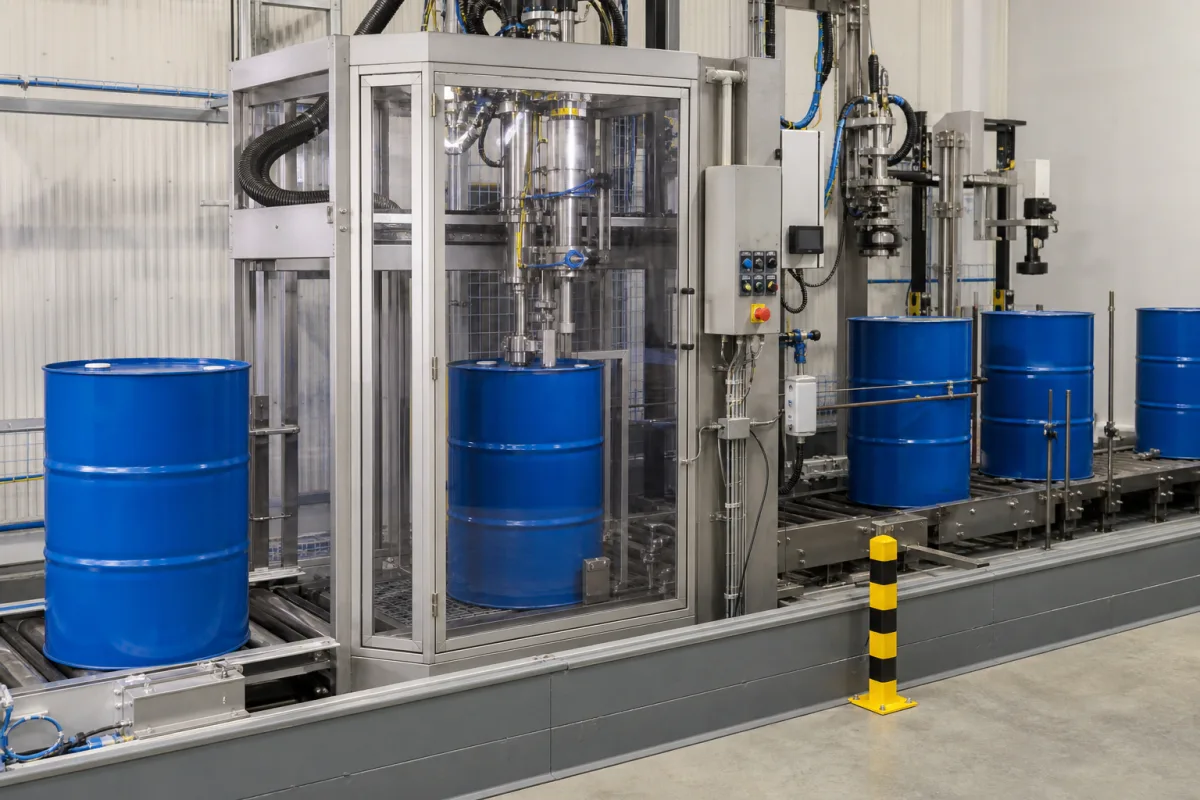
Automated chemical drum filling and sealing system (drum filling and capping line)
Automatic drum filling and capping lines for chemicals · Net-weight filling to the drum's marked limits, ullage at 55 °C, bonding and grounding for flammable liquids, enclosed filling with extraction, conveyors and capping
An automated drum filling and sealing system fills industrial drums, such as 200 L (55 gallon) drums, with liquid or viscous chemicals and closes them: drums travel on roller conveyors into an enclosed filling station where a lance fills them by weight or volume, and then to a capping unit that fits and tightens the bung closures. Ask three things first: which drums, liquids and hazard classes the line handles, how it fills accurately within the packaging's limits, and how it controls static, vapours and spills.
Semi-automatic and automatic filling and capping lines for 200 L drums and similar non-bulk containers of liquid and viscous chemicals, including weigh-fillers, conveyors and capping units. IBC fillers, pail and can fillers, drum pumps and bulk tank loading are outside this page except where compared.
CNFX editorial research · Sources checked October 12, 2026 · 5 sources
Fill within the packaging's marked limits and leave ullage
For hazardous materials shipped in the US, 49 CFR 173.24a(b) allows a non-bulk packaging of up to 400 kg to be filled with a liquid only when the liquid's specific gravity or the package's gross mass does not exceed what is marked on the packaging, or a specific gravity of 1.2 if none is marked (with limited exceptions for higher-performance packing groups), and never above the marked maximum gross mass. Section 173.24a(d) states that liquids must not completely fill a receptacle at 55 °C (131 °F) or less, and (b)(5) that no hazardous material may remain on the outside of a package after filling. [1]
Editorial calculation: a liquid of specific gravity 1.1 filled to 200 L weighs about 220 kg net; check that the drum's marking covers that gravity and gross mass, and set the filler's target below the volume at which thermal expansion to 55 °C would fill the drum. Ask the supplier for the filler's weighing accuracy at your net mass. [1]
Editorial note: give the supplier the drum types (steel, plastic; bung or open-head), closures, products, viscosities and target net masses, so the lance, scale and capping head can be sized.
Give the supplier the products and their hazard classes, specific gravity and viscosity, drum types and closures, target net mass and accuracy, throughput (drums per hour), above- or sub-surface filling, foaming, hazardous-area classification, bonding and grounding, vapour extraction, drip and spill control, conveyor layout, labelling or marking, and data recording.
02
Control static, vapours and spills
OSHA's flammable liquids standard 29 CFR 1910.106 requires that Category 1 or 2 flammable liquids, and Category 3 flammable liquids with a flashpoint below 100 °F (37.8 °C), not be dispensed into containers unless the nozzle and container are electrically interconnected; this is deemed met where the metal floorplate the container stands on is electrically connected to the fill stem, or the fill stem is bonded to the container with a bond wire during filling. The same requirement applies to container filling facilities, and electrical equipment must be installed to the hazardous-location rules in the standard. [2]
Editorial note: ask the supplier how the drum is bonded on the scale and conveyor, whether the filling station is enclosed with local exhaust, how drips are caught when the lance withdraws, and which electrical equipment rating it supplies for your hazardous area. [2]
03
Specify fill accuracy as an OIML class, and the fill mode for the product
OIML R 61-1 (Edition 2017) specifies metrological and technical requirements for automatic gravimetric filling instruments (AGFIs), which produce a predetermined mass of individual fills by automatic weighing, with no constraint on maximum or minimum capacity. The manufacturer specifies an accuracy class X(x), where the class factor x is ≤ 2 and of the form 1, 2 or 5 × 10^k. At initial verification each fill may deviate from the average by no more than the Table 2 limit multiplied by x; for fills above 15 000 g the class X(1) limit is 0.8 % of the fill at initial verification and 1 % in service. [4]
Feige FILLING describes its drum fillers as a filling valve plus a weigh scale running in coarse fill/fine fill mode, with the flow restricted at the end by a two-stage or analogue valve setting "to stay within calibration error limits". It lists four fill modes: below-surface for products that foam or give off explosive gas, above-surface for open-head containers, below-bunghole for bunghole containers, and surface filling for highly viscous products. Its automatic lines monitor capping torque and reject drums with missing bung seals or wedged plugs, and it offers ATEX versions. [5]
These link to the US rules this page already cites. A tight-head 1A1 steel drum's openings may not exceed 7.0 cm [3], and Category 1 or 2 flammable liquids require the nozzle and container to be electrically interconnected [2]; ask how the lance fits the bung and how the filler bonds nozzle and drum. Ask the supplier for the OIML class (or the national equivalent) the weigher is verified to, the fill mode for each product, and the torque monitoring limits.
Editorial calculation: for a 200 kg fill (200 000 g), class X(1) allows each fill to deviate up to 1.6 kg from the average at initial verification (0.8 %), class X(0.5) up to 0.8 kg and class X(0.2) up to 0.32 kg. [4]
Fill mass F (g)
mpd of each fill, class X(1), initial verification
In service
1 000 < F ≤ 10 000
1.2 % of F
1.5 % of F
10 000 < F ≤ 15 000
120 g
150 g
F > 15 000
0.8 % of F
1 % of F
Values are from OIML R 61-1:2017 (text extracted from the PDF) and Feige FILLING's drum filling page; national rules decide which accuracy class applies to a given use.
04
Match the lance and capping head to the drum type
US packaging standard 49 CFR 178.504 codes steel drums as 1A1 (non-removable head) and 1A2 (removable head). Openings for filling, emptying and venting in a 1A1 drum may not exceed 7.0 cm (3 inches) in diameter; a drum with larger openings counts as removable-head. Closures must stay secure and leakproof under normal conditions of transport, with gaskets or other sealing elements unless the closure is inherently leakproof, and every removable head needs a gasket. [3]
The same section caps a steel drum at 450 L (119 gallons) maximum capacity and 400 kg (882 pounds) maximum net mass, requires welded body seams on drums designed for more than 40 L of liquid, and requires internal coatings or treatments where the steel is not compatible with the contents. [3]
Editorial calculation: a lance for a 1A1 bung must pass through an opening of at most 70 mm, so with an assumed 3 mm clearance all round, the lance outer diameter is limited to 64 mm; for a 200 L drum filled at an assumed 100 L/min, the bulk fill takes 2 minutes before the fine-fill and capping steps. Ask the supplier for the lance diameter, the measured fill rate on your product and the capping head's closure range (bung plugs for 1A1, lids and clamping rings for 1A2). [3]
05
Conveyor, lance, scale, bonding and capper on a drum line
Bonding and the capper's closure range are the rows tied to US rules; conveyor and extraction sizing come from your layout. [2][3]
Equipment
Role
Fix in the order
Roller conveyors
Move drums.
Length; accumulation.
Filling lance and valve
Fill without overflow.
Sub-surface; drip tray; ≤70 mm bung on 1A1 drums. [3]
1 company lists this product among what they make. Company figures are quoted from each
company's own website; every card states where the relationship came from.
Zhongheng Weighing Apparatus(Suzhou)Co.,Ltd.
Manufacturing site to be confirmed for the order
Its website has a product page for automated chemical drum filling and sealing system.
Explore company information and manufacturing capabilities, then discuss the scope of your project with a relevant supplier.
Share this page
Compiled and source-reviewed by the CNFX editorial team.
Each manufacturer above links to the page on that company's own website where the product is listed, with the date we checked it. How we source and review
· Page last updated 13 October 2026
Buyer questions
How full can a chemical drum be filled?
Under 49 CFR 173.24a, liquids must not completely fill a receptacle at 55 °C, and fill must stay within the packaging's marked specific gravity and gross mass. [1]
Do drum fillers need bonding for flammable liquids?
Yes; OSHA 1910.106 requires nozzle and container to be electrically interconnected for Category 1–2 and low-flashpoint Category 3 liquids. [2]
What specific gravity can an unmarked drum take?
49 CFR 173.24a uses a specific gravity of 1.2 where none is marked. [1]
What is the largest opening on a tight-head steel drum?
49 CFR 178.504 limits filling, emptying and venting openings on a 1A1 non-removable head drum to 7.0 cm (3 inches); larger openings make it a removable-head 1A2 drum. [3]
How accurate must an automatic drum weigh-filler be?
Under OIML R 61-1:2017 the manufacturer declares an accuracy class X(x); for fills above 15 kg, class X(1) allows each fill to deviate from the average by up to 0.8 % at initial verification and 1 % in service, scaled by the class factor x. [4]
Sources and what still needs a direct check
Sources checked 2026-10-12. All three sources are US federal regulations — the DOT packaging rules for filling limits and for steel drum construction, and the OSHA flammable liquids standard; other jurisdictions have equivalent rules.