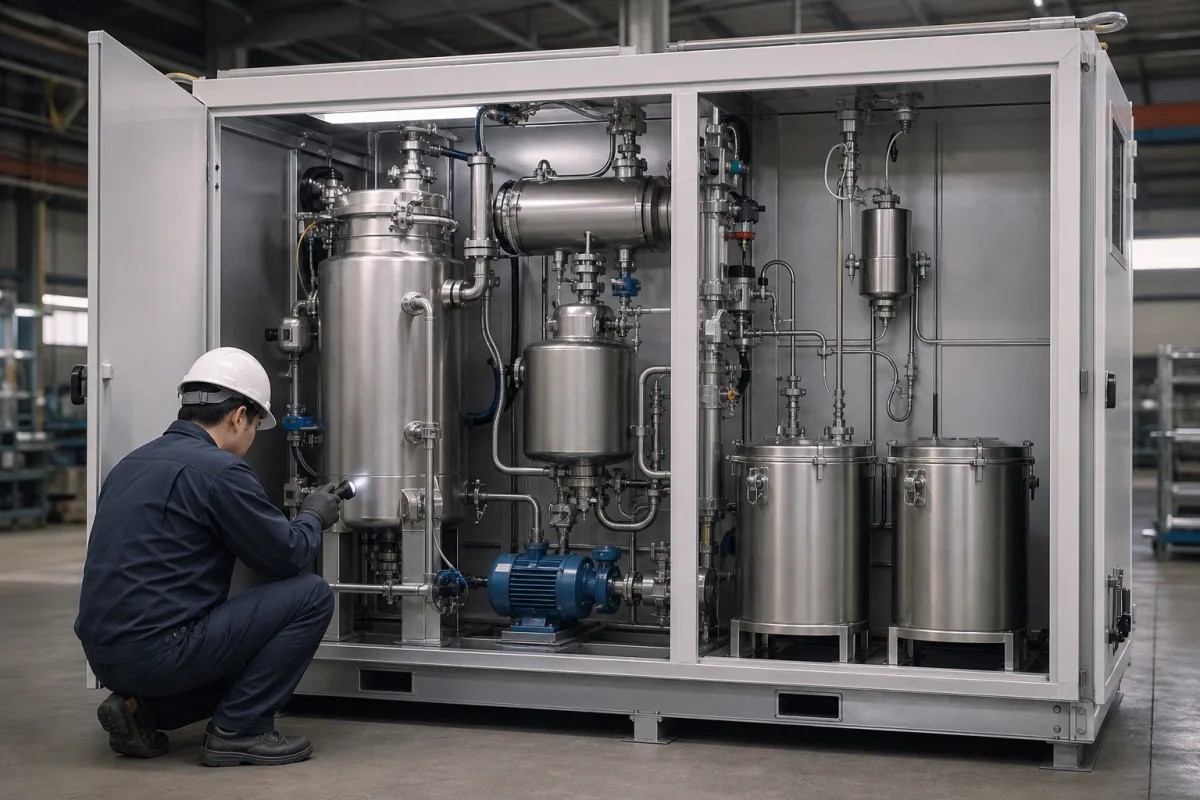
Solvent distillation units · Boiling point and auto-ignition limits, vacuum for high boilers, batch size and cycle time
A solvent recovery unit is a batch still that boils contaminated cleaning or paint solvent, condenses the vapour back to clean solvent and leaves paint, resin or oil behind as residue. Ask three things first: whether your solvent's boiling point and auto-ignition temperature fall inside the unit's certified limits, whether it needs vacuum to distil high-boiling solvents, and what batch size and full cycle time, including cooling, give your daily volume.
Batch distillation units for recovering flammable and non-flammable cleaning and process solvents, with direct electric, heat-transfer-oil or steam heating and optional vacuum. Continuous distillation columns, activated-carbon vapour recovery and solvent-free washers are outside this page.
CNFX editorial research · Sources checked October 11, 2026 · 4 sources
Uni-ram's manual for its URS500 and URS600 recyclers states that the dirty solvent's boiling point must be below 200 °C and its auto-ignition temperature above 260 °C for safe operation, that the unit must not be installed where the auto-ignition temperature of the solvent or atmosphere is below 250 °C, and that nitrocellulose, which self-ignites at 135–166 °C, must never be recycled. The units are certified by ETL to UL 2208 and CSA C22.2 No. 30 and No. 88 for Class 1 Division 1 and Division 2, Group D locations. [1]
The manual advises estimating the operating set point as the pure solvent's boiling point from its safety data sheet plus 45 °C, and choosing the lowest of six set points (90, 115, 140, 165, 190 and 200 °C, factory set at 200 °C) that leaves about 500 ml in the tank; the mixture's boiling point rises as it gets dirtier. It heats the solvent directly by electricity with no heat-transfer oil, cuts power if tank, condenser or fan motor temperatures exceed a preset level or boiling starts late, and relieves tank pressure above 0.5–1.0 psi. It defines the area within 16 in behind and 10 ft at each side and front as Class 1 Division 2, Group D at most. [1]
Editorial calculation: a solvent whose pure boiling point is 100 °C would need about 100 + 45 = 145 °C, above the 140 °C step, so the 165 °C set point; the 200 °C maximum then covers pure solvents up to about 155 °C by the same rule. The boiling point is an assumed example. [1]
Give the supplier the solvent names and safety data sheets (boiling point, flash point, auto-ignition temperature), contaminants (paint, resin, oil, pigment), daily volume, hazardous-area classification of the installation site, cooling available (air or water), compressed air if a pneumatic vacuum is used, power supply, and how residues will be removed and disposed of.
02
Size the batch, the vacuum and the cycle time
Tieser's Distatic units, as listed by a distributor, boil solvent in a stainless steel vessel heated by a jacket of heat-transfer oil, with air- or water-cooled condensers and working capacities of 12, 25, 60 and 120 L. The DV 25 Ax model takes 25–30 L in a 40 L boiler, distils in about 3–4 hours, needs 3–7 hours to cool depending on operating temperature, draws about 2.04 kW at 230 V, and covers solvents of 50–200 °C (T2) or 50–180 °C (T3) with EEx od IIB T2 marking. [2]
All Tieser systems can take a vacuum unit, described as suited to solvents with very high boiling points or where boiling point and auto-ignition temperature are close; the pneumatic version needs dry, oil-free air at 6 bar or more and at least 450 L/min while building vacuum, and holds –0.5 to –0.7 bar. [2] OFRU's Compact vacuum distiller draws from a 200 L drum and reaches about 10–25 L/h depending on solvent and contamination, needing electrical control, cooling water and compressed air. [3] Uni-ram's units take 5 US gal (20 L), with a 1.5 gal (6 L) minimum. [1]
Editorial calculation: a 25–30 L batch that distils in 3–4 h and cools in 3–7 h takes about 6–11 h per cycle, roughly 2.3–5 L/h averaged over the cycle, so a single DV 25 unit handles about one batch per shift; a 200 L drum per day would need a continuous-feed unit like OFRU's at 10–25 L/h, taking about 8–20 h. [2][3]
03
Consider a recycler built into the parts washer
Safety-Kleen's SystemOne "S" series combines a solvent parts-washer sink with on-site distillation, so the solvent is recycled in place rather than in a separate still. Its specification lists four sink sizes for maintenance, transmission, aircraft and heavy-equipment work, push-button on/off and recycle controls with LED diagnostics, and recycling either on demand or on a programmable 7-day/24-hour schedule. [4]
Editorial calculation: 115 V × 11.9 A is about 1.37 kW, below the 2.04 kW of the Tieser DV 25 Ax above. A 15 gal (about 57 L) distillation tank over a 4-hour recycle averages about 3.75 gal/h (about 14 L/h), and the 18 gal annual top-off is about 60% of one 30 gal pure-solvent reservoir. [4][2]
An integrated washer recycles the solvent of its own sink; a separate batch still such as the Uni-ram or Tieser units above takes dirty solvent carried to it from wherever it is used. Ask either type of supplier for the boiling-point and auto-ignition limits of the solvent it accepts, the hazardous-area rating and the residue handling. [4][1]
SystemOne S series item
Stated value
Sink reservoir / distillation tank / pure solvent reservoir
Fuse protection, dual temperature sensor, fire lid fusible link, residue port safety guard [4]
Annual solvent top-off
Average 18 gal once a year, based on a 15-year statistical average [4]
04
Low-boiling and explosion-proof recovery machines with vacuum add-ons
The listing reviewed offers solvent recovery machines for specific solvents, explosion-proof versions, vacuum pressure-reducing devices, recovery bags and heat-transfer oil; ask for the certification, temperature range and capacity of the model offered.
05
What boils, condenses, relieves and collects inside a solvent still
Explore company information and manufacturing capabilities, then discuss the scope of your project with a relevant supplier.
Share this page
Compiled and source-reviewed by the CNFX editorial team.
Each manufacturer above links to the page on that company's own website where the product is listed, with the date we checked it. How we source and review
· Page last updated 13 October 2026
Buyer questions
Which solvents can a solvent recycler distil?
Uni-ram's units need a dirty-solvent boiling point below 200 °C and auto-ignition above 260 °C, and exclude nitrocellulose. [1]
What temperature should a solvent recycler be set to?
Uni-ram suggests the pure solvent's boiling point plus 45 °C, at the lowest set point that completes recycling. [1]
When is vacuum distillation needed?
For very high-boiling solvents or where boiling point and auto-ignition temperature are close, according to Tieser. [2]
How long does a distillation batch take?
Tieser's 25–30 L unit distils in about 3–4 hours and needs 3–7 hours to cool. [2]
Sources and what still needs a direct check
Sources checked 2026-10-11. Uni-ram is a recycler maker publishing its manual; the Tieser data come from a distributor's product page; the OFRU description is from a trade publication. Figures are for those makers' units, not general limits; your local code governs installation. Safety-Kleen's SystemOne specification adds a parts washer with built-in solvent recycling.