Industry-Verified Manufacturing Data (2026)

ID Fan

Based on aggregated insights from multiple verified factory profiles within the CNFX directory, the standard ID Fan used in the Chemical Manufacturing sector typically supports operational capacities ranging from standard industrial configurations to heavy-duty production requirements.

Technical Definition & Core Assembly

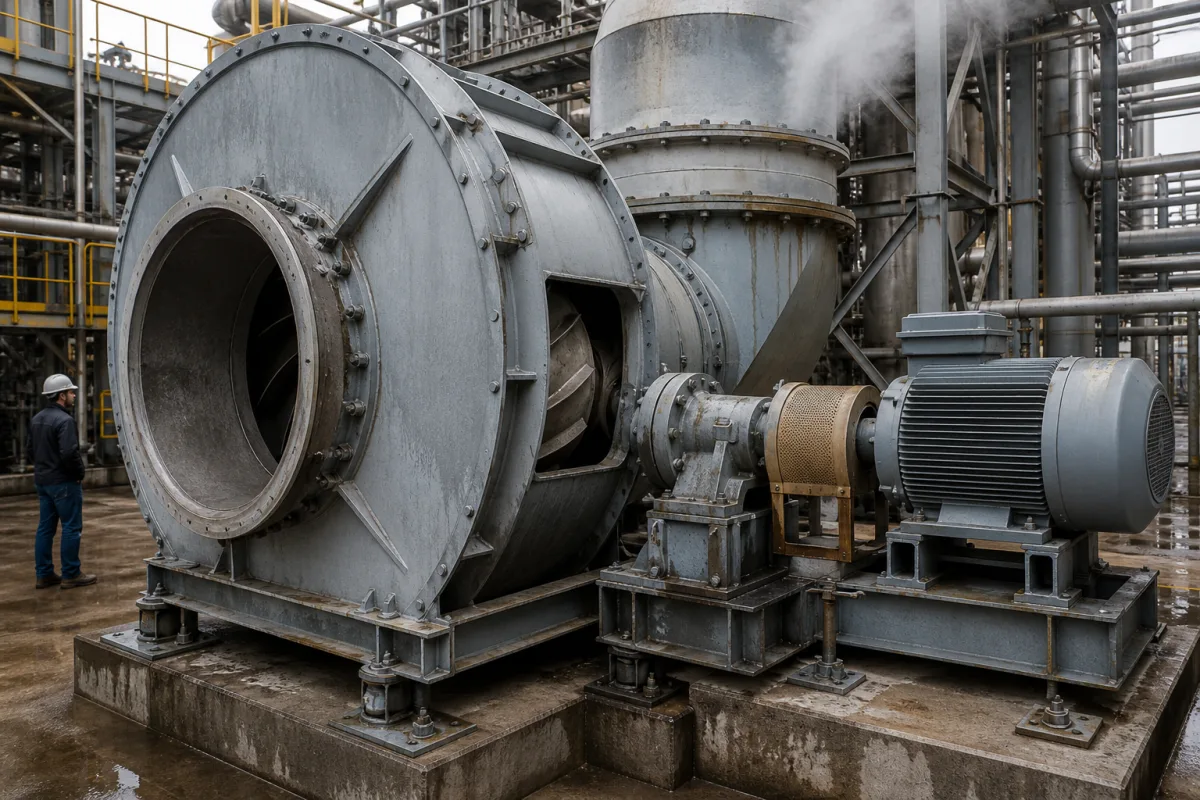
A canonical ID Fan is characterized by the integration of Impeller and Casing / Housing. In industrial production environments, manufacturers listed on CNFX commonly emphasize Carbon Steel construction to support stable, high-cycle operation across diverse manufacturing scenarios.

A centrifugal or axial fan used to create negative pressure and draw exhaust gases through an off-gas cleaning system.
Product Specifications

Technical details and manufacturing context for ID Fan

Definition
The ID (Induced Draft) Fan is a critical component within an Off-gas Cleaning System, responsible for creating the necessary negative pressure (suction) to pull contaminated exhaust gases from industrial processes through the entire cleaning train. It ensures proper gas flow through scrubbers, filters, and other treatment units before the cleaned gas is discharged to the atmosphere.
Working Principle
The fan's impeller rotates at high speed, imparting kinetic energy to the gas stream. This creates a region of low pressure at the fan inlet, drawing gas in. The gas is then accelerated and discharged at the outlet, overcoming the system's pressure drop (resistance from ducts, dampers, and cleaning equipment).
Common Materials
Carbon Steel, Stainless Steel (for corrosive gases), Alloy Steel
Technical Parameters
  • Volumetric Flow Rate - The primary capacity specification defining the volume of gas the fan must handle per hour. (m³/h) Standard Spec
Components / BOM
  • Impeller
    Rotating component with blades that imparts energy to the gas, creating flow and pressure.
    Material: Steel (Carbon, Stainless, or Alloy)
  • Casing / Housing
    Encloses the impeller, guides the gas flow, and contains the pressure.
    Material: Steel Plate
  • Shaft
    Transmits torque from the motor to the impeller.
    Material: Alloy Steel
  • Bearings
    Support the rotating shaft, minimizing friction and maintaining alignment.
    Material: Steel (with Babbitt or roller elements)
  • Drive System (Motor & Coupling)
    Provides the rotational power to the fan shaft.
    Material: Various (Motor: Copper, Steel; Coupling: Steel, Rubber)
  • Inlet/Outlet Dampers or Vanes
    Control the flow of gas into or out of the fan for system regulation.
    Material: Steel
Engineering Reasoning
0.5-1.2 kPa negative pressure differential, 800-3600 RPM rotational speed, 15-150°C gas temperature range
Impeller stress exceeds 250 MPa yield strength of cast aluminum alloy, bearing temperature exceeds 120°C lubricant breakdown point, shaft deflection exceeds 0.15 mm/meter runout tolerance
Design Rationale: High-cycle fatigue from resonant vibration at 47-53 Hz natural frequency, abrasive wear from particulate loading exceeding 50 mg/Nm³, thermal expansion mismatch between stainless steel shaft (17.3 μm/m·K) and aluminum housing (23.1 μm/m·K)
Risk Mitigation (FMEA)
Trigger Unbalanced impeller mass distribution exceeding 0.5 g·mm/kg imbalance tolerance
Mode: Excessive vibration amplitude >7.1 mm/s RMS causing bearing race spalling
Strategy: Dynamic balancing to ISO 1940 G2.5 standard with 0.1 g·mm/kg residual imbalance
Trigger Condensation formation below acid dew point temperature of 140°C for sulfuric acid
Mode: Corrosive pitting attack at rate >0.5 mm/year on carbon steel components
Strategy: Maintain gas stream temperature >160°C with electric trace heating and insulation

Industry Taxonomies & Aliases

Commonly used trade names and technical identifiers for ID Fan.

Applied To / Applications

This component is essential for the following industrial systems and equipment:

Industrial Ecosystem & Supply Chain DNA

Complementary Systems
Downstream Applications
Specialized Tooling

Application Fit & Sizing Matrix

Operational Limits
pressure: Up to 10 kPa negative pressure (typical), higher for specialized designs
flow rate: 1,000 to 500,000 m³/h (depending on size and design)
temperature: Up to 400°C (with appropriate materials)
slurry concentration: Not applicable - designed for gases only
Media Compatibility
✓ Flue gases from combustion processes ✓ Process exhaust with particulate matter ✓ Corrosive off-gases (with appropriate material selection)
Unsuitable: Environments with explosive dust concentrations or flammable gas mixtures without proper explosion-proof design
Sizing Data Required
  • Required volumetric flow rate (m³/h)
  • System pressure drop (Pa or kPa)
  • Gas temperature and composition

Reliability & Engineering Risk Analysis

Failure Mode & Root Cause
Imbalance-induced bearing failure
Cause: Accumulation of material on fan blades causing mass imbalance, leading to excessive vibration that accelerates bearing wear and eventual seizure or fracture.
Fatigue cracking of blades or impeller
Cause: Cyclic stresses from aerodynamic forces, resonance conditions, or thermal cycling, often exacerbated by corrosion or material defects, leading to crack initiation and propagation.
Maintenance Indicators
  • Excessive vibration levels detected by sensors or felt physically, often accompanied by unusual humming or rumbling noises.
  • Sudden increase in motor amperage or power consumption without a corresponding change in system demand, indicating increased mechanical resistance.
Engineering Tips
  • Implement regular dynamic balancing and alignment checks using vibration analysis tools to detect and correct imbalance before it causes bearing or structural damage.
  • Establish a rigorous cleaning schedule for fan blades and internal passages to prevent material buildup, and apply protective coatings to combat corrosion in harsh environments.

Compliance & Manufacturing Standards

Reference Standards
ISO 5801:2017 - Industrial fans - Performance testing using standardized airways ANSI/AMCA 210-16 - Laboratory Methods of Testing Fans for Certified Aerodynamic Performance Rating DIN EN ISO 14694:2005 - Industrial fans - Specifications for balance quality and vibration levels
Manufacturing Precision
  • Impeller diameter: +/-0.5% of nominal dimension
  • Shaft alignment: Runout tolerance of 0.05mm per 100mm length
Quality Inspection
  • Vibration analysis test to ISO 10816 standards
  • Non-destructive testing (NDT) of welds using magnetic particle inspection

Factories Producing ID Fan

Verified manufacturers with capability to produce this product in China

✓ 96% Supplier Capability Match Found

T Technical Director from Australia Jan 26, 2026
★★★★★
"Impressive build quality. Especially the technical reliability is very stable during long-term operation."
Technical Specifications Verified
P Project Engineer from Singapore Jan 23, 2026
★★★★☆
"As a professional in the Chemical Manufacturing sector, I confirm this ID Fan meets all ISO standards. (Delivery took slightly longer than expected, but technical support was excellent.)"
Technical Specifications Verified
S Sourcing Manager from Germany Jan 20, 2026
★★★★★
"Standard OEM quality for Chemical Manufacturing applications. The ID Fan arrived with full certification."
Technical Specifications Verified
Verification Protocol

“Feedback is collected from verified sourcing managers during RFQ (Request for Quote) and factory evaluation processes on CNFX. These reports represent historical performance data and technical audit summaries from our B2B manufacturing network.”

15 sourcing managers are analyzing this specification now. Last inquiry for ID Fan from India (53m ago).

Supply Chain Compatible Machinery & Devices

Modular Distillation Column System

Pre-engineered modular system for continuous separation of chemical mixtures via distillation.

Explore Specs →
Automated Batch Crystallization System

Automated system for controlled crystallization of chemical compounds in batch processes.

Explore Specs →
Automated pH Monitoring and Dosing System

Automated system for continuous pH monitoring and chemical dosing in process streams.

Explore Specs →
Automated Powder Dispensing and Blending System

Automated system for precise dispensing and homogeneous blending of powdered chemicals.

Explore Specs →

Frequently Asked Questions

What materials are recommended for ID fans handling corrosive gases in chemical plants?

For corrosive gases in chemical manufacturing, stainless steel ID fans are recommended due to their corrosion resistance. Carbon steel is suitable for non-corrosive applications, while alloy steel offers enhanced durability for specific conditions.

What are the key components in an ID fan's bill of materials (BOM)?

The essential BOM components include: impeller for airflow generation, casing/housing for structural integrity, shaft for power transmission, bearings for smooth rotation, drive system (motor & coupling) for operation, and inlet/outlet dampers/vanes for flow control.

How does an ID fan function in an off-gas cleaning system?

An ID fan creates negative pressure (vacuum) to draw exhaust gases through the off-gas cleaning system, ensuring proper airflow for effective pollutant removal before safe discharge, maintaining system efficiency and environmental compliance.

Can I contact factories directly on CNFX?

CNFX is an open directory, not a transaction platform. Each factory profile provides direct contact information and production details to help you initiate direct inquiries with Chinese suppliers.

Get Quote for ID Fan

Request technical pricing, lead times, or customized specifications for ID Fan directly from verified manufacturing units.

Your business information is encrypted and only shared with verified ID Fan suppliers.

Thank you! Your message has been sent. We'll respond within 1–3 business days.

Need to Manufacture ID Fan?

Connect with verified factories specializing in this product category

Add Your Factory Contact Us
Previous Product
Hydraulic Closure System
Next Product
In-line Separation Unit