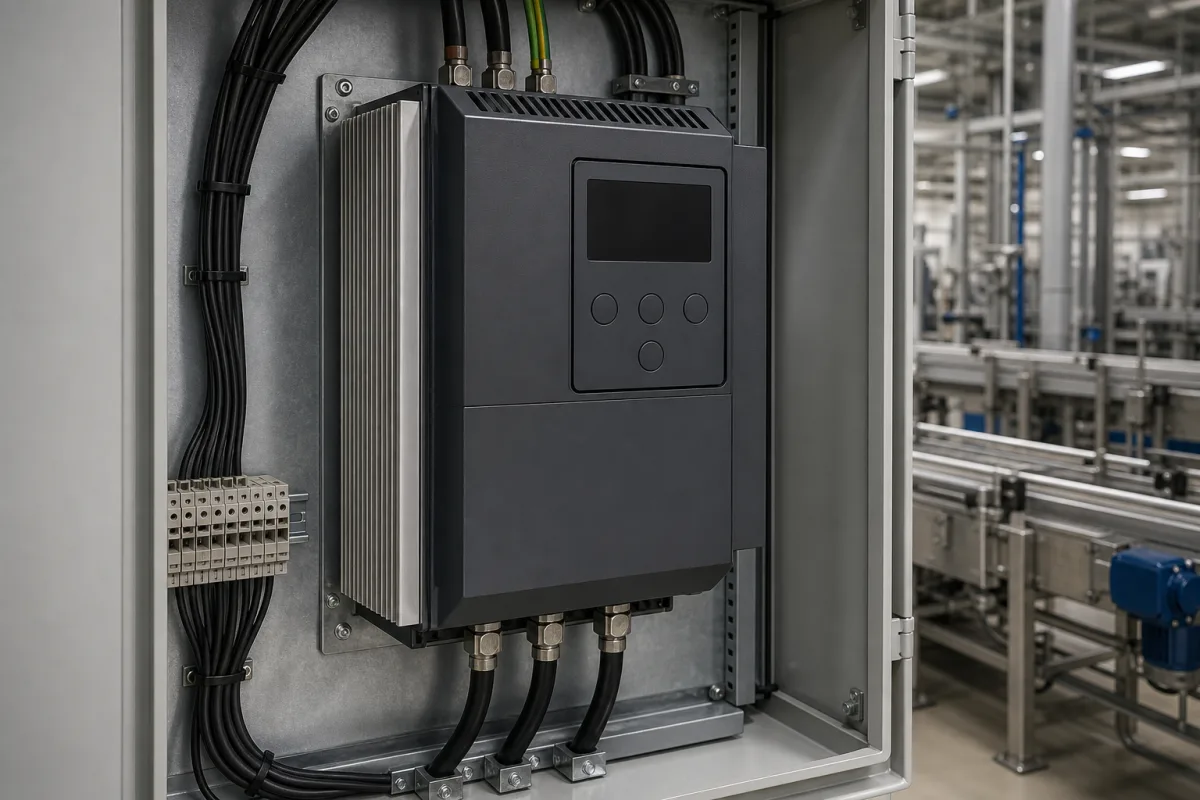
Motor control · Load type, savings and motor protection
On centrifugal fans and pumps input power varies with the cube of speed, so DOE says a 20% speed cut can reduce input power by about 50%; on constant-torque machines power varies linearly with speed, so savings are smaller and the drive is bought for control. Size the drive for the motor and the load type, estimate savings from the duty cycle, and plan cabling and motor protection, because fast-switching drives can damage windings and bearings.
Low-voltage PWM AC drives (inverters) for induction and permanent-magnet motors on pumps, fans, compressors, conveyors and machines, including pump-specific and solar-pump drives. Servo drives and DC drives are outside this page.
CNFX editorial research · Sources checked October 12, 2026 · 7 sources
Know whether the load is variable or constant torque
The US Department of Energy explains that for centrifugal fans and pumps with no static lift, flow varies with speed and input power with the cube of speed, so a 20% speed or flow reduction can cut input power by about 50%. For constant-torque loads such as cranes, hoists, conveyors, extruders, mixers, positive-displacement pumps and reciprocating or screw compressors, power varies only linearly with speed. [1]
To estimate savings, DOE says you need the duty cycle, the share of time at each operating point, and the efficiency of the drive and motor at each point; motor efficiency also falls at light load and with a non-sinusoidal supply. [1]
Give the supplier the driven machine and its load type, the motor nameplate, the speed range, the duty cycle and whether the drive replaces a throttle valve, damper or fixed-speed starter.
02
Account for part-load efficiency honestly
DOE notes that drive efficiency falls as motor load falls, more so for small drives, but that this matters less than it seems. In its example, a fan needing 16.4 kW at full speed for 20 shaft hp needs only about 2.8 kW at half speed, even with 77.8% motor and 86% drive efficiency, an 82.9% reduction in input power. [1]
DOE reminds that system efficiency is the product of drive, motor and driven-equipment efficiencies, and suggests asking suppliers for drive efficiency against speed or output power. [1]
As an editorial calculation using the affinity law only: at 80% speed a centrifugal fan needs about 0.8³ ≈ 51% of full-speed shaft power, consistent with DOE's 'about 50%' for a 20% reduction.
03
Protect the motor from voltage spikes and bearing currents
DOE explains that PWM drives switch transistors at carrier frequencies "usually between 2 kilocycles per second (kHz) and 20 kHz"; fast rise times and long cables cause voltage overshoots that stress motor windings, and carrier frequencies above 5 kHz are likely to cause bearing damage unless protective measures are taken. [2]
DOE suggests locating the drive close to the motor, or fitting line or load reactors at the drive end or dV/dt filters where that is not possible; considering inverter-duty motors; insulating both motor bearings and/or using a shaft-grounding brush; and correct drive setup, cabling and grounding to reduce bearing fluting. [2]
Ask the supplier for the maximum motor cable length without and with filters, the carrier-frequency range and the filters or reactors recommended for your cable run.
04
Compare what suppliers offer
Suppliers linked to this page list general-purpose and vector AC drives, four-quadrant drives, pump and solar-pump inverters. [3][4][5]
GTAKE lists AC drives and four-quadrant drives; AnyHz lists low-voltage VFDs and frequency converters; Canroon lists multi-function and water-pump inverters; GEYA lists VFDs within solar-energy equipment. [3][4][6][7]
05
Trace the drive components
This is a functional reference built from the sources cited; it is not one maker's parts list.
Fill the specification fields with values for your motor
A drive quotation needs motor- and load-specific values. The table explains each field, gives published values where a reviewed source states them, and says what to obtain from the supplier.
Field
What it means and published values
Ask the supplier for
Rated power (kW)
Match motor current and load type (variable or constant torque). [1]
Explore company information and manufacturing capabilities, then discuss the scope of your project with a relevant supplier.
Share this page
Compiled and source-reviewed by the CNFX editorial team.
Published product pages show what a company offers, not tested performance. Confirm the legal seller, factory and scope for your order. How we source and review
· Page last updated 13 October 2026
Buyer questions
How much energy does a VFD save on a fan or pump?
DOE explains that for centrifugal fans and pumps without static lift, input power varies with the cube of speed, so a 20% speed reduction can cut power by about 50%. [1]
Is drive efficiency at low load a problem?
DOE notes drive efficiency drops at light load, but its example fan at half speed still needs only about 2.8 kW instead of 16.4 kW, an 82.9% reduction. [1]
Can a VFD damage the motor?
DOE warns fast-switching PWM drives can cause voltage spikes and bearing currents; keep cables short or add reactors or dV/dt filters, and consider insulated bearings or shaft grounding. [2]
Sources and what still needs a direct check
Sources checked 2026-10-12. The DOE Advanced Manufacturing Office motor tip sheets are US government sources (2012 editions). Supplier pages describe their own offers. IEC 61800 series and IEEE 519 were not read for this page.