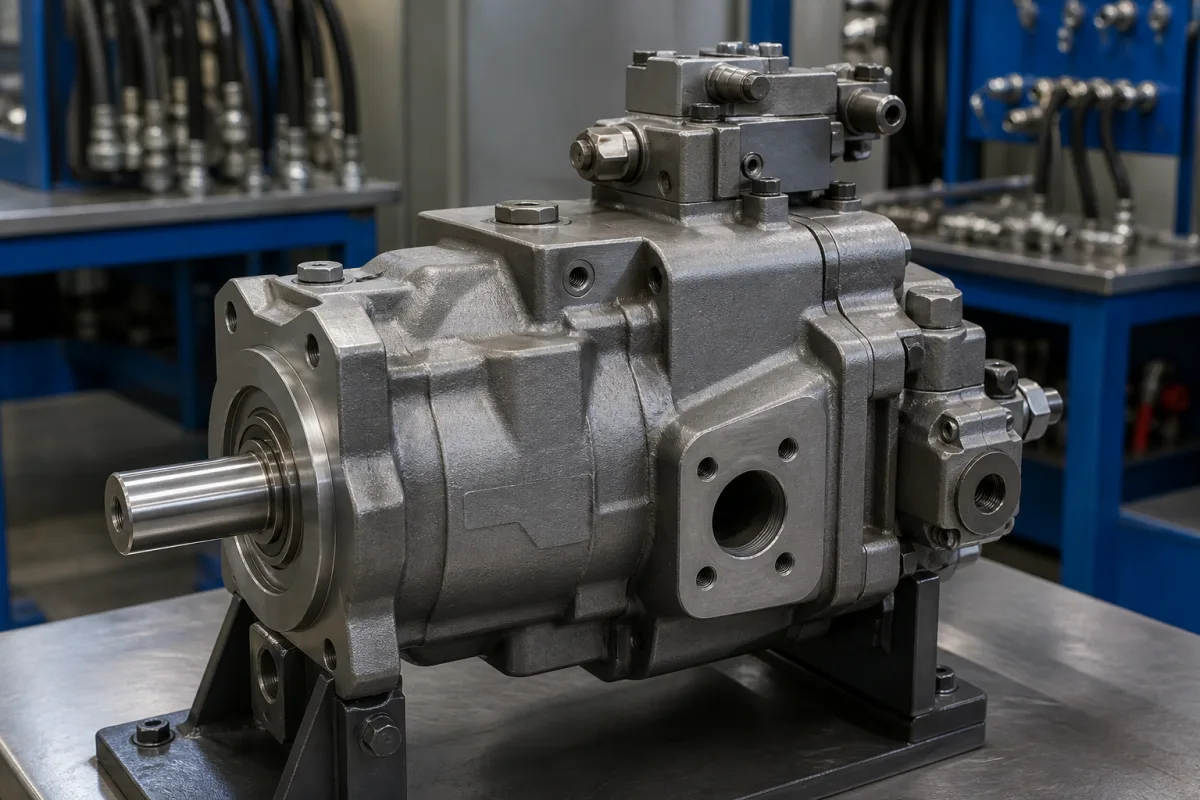
Fluid power · Displacement, drive power and oil condition
A hydraulic pump delivers flow; pressure comes from the load. Size the displacement and speed for the flow the actuators need, size the motor or engine for that flow at system pressure, and then protect the pump: Rexroth's A10VSO data sheet requires at least 0.8 bar absolute at the suction port to prevent cavitation damage and a fluid cleanliness of at least 20/18/15 to ISO 4406.
Gear, vane and axial piston pumps for industrial and mobile hydraulic systems, fixed and variable displacement, including pumps for power units and replacement pumps for machines. Hydraulic motors and valves have their own pages.
CNFX editorial research · Sources checked October 10, 2026 · 6 sources
Size flow and drive power from displacement and pressure
Bosch Rexroth's A10VSO data sheet gives the relations used to size a pump: flow qv = Vg × n × ηv ÷ 1000 in L/min, with displacement Vg in cm³ per revolution and speed n in rpm; drive power P = qv × Δp ÷ (600 × ηt) in kW, with differential pressure Δp in bar and total efficiency ηt = volumetric efficiency × hydraulic-mechanical efficiency. [1]
As an editorial calculation example only, using those relations: a 45 cm³ pump at 1,500 rpm with 95% volumetric efficiency delivers about 64 L/min; at 200 bar with 88% total efficiency it needs about 64 × 200 ÷ (600 × 0.88) ≈ 24 kW at the shaft. Check the efficiencies on the data sheet of the pump offered rather than assuming them.
The same data sheet notes that flow is proportional to drive speed and displacement, and that a variable pump changes flow by adjusting the swashplate angle; it lists maximum speeds that fall as displacement size rises. [1]
Give the supplier the flow each actuator needs, the working and peak pressure, the duty cycle and the drive speed. A fixed pump sized for peak flow wastes power at part load; ask whether a variable or pressure-compensated pump fits.
02
Choose gear, vane or piston construction
Hydraflu sells gear and multiple-section pumps for power units, Poocca gear, piston and vane pumps, and Guoyue vane pumps alongside pumps for construction machinery. [2][3][4]
Rexroth describes its A10VSO as a variable axial piston pump of swashplate design for open circuits, with a choice of controllers; such pumps can match flow to demand. Gear pumps are listed by suppliers for power units, forklifts and other mobile machines. [1][2][6]
Ask for the rated and peak pressure, speed range, noise level and controller options of each candidate, and whether a replacement pump is the original make, a licensed make or an interchangeable design.
03
Keep viscosity, inlet pressure and cleanliness within limits
Rexroth's A10VSO data sheet gives an optimum operating viscosity of 36 to 16 mm²/s, a short-term minimum of about 10 to 7 mm²/s and a cold-start maximum of 1,600 mm²/s under stated limits of temperature, load and time. It requires at least 0.8 bar absolute at the suction port to prevent damage to the pump. [1]
The data sheet requires a cleanliness level of at least 20/18/15 to ISO 4406, tightened to 19/17/14 when viscosity falls below 10 mm²/s. [1]
Ask the supplier for these limits on the pump offered and design the reservoir, suction line, filters and oil cooler to meet them: a long, narrow or clogged suction line can starve the pump even when the rest of the system is correct.
04
Own-brand gear pumps, interchangeable piston pumps and forklift replacements
Zhenyuan and Poocca list pumps under other makers' model names, while Hydraflu lists its own gear pumps; the replacement status changes what a price comparison means. [2][5][3]
Hydraflu lists gear pumps, multiple pumps and hand-operated pumps; Zhenyuan lists axial piston pumps under Rexroth and Danfoss model names; Leading lists forklift gear pumps. Confirm whether a pump is new original equipment, remanufactured or interchangeable before comparing prices. [2][5][6]
05
Housing, drive shaft, rotating group, controller and shaft seal
Part
Role
Fix in the order
Housing
Holds the rotating group and ports; drain ports on piston pumps. [1]
Material, port positions and drain ports.
Drive shaft
Takes input torque; through-drive pumps pass torque to further pumps. [1]
Shaft type, permissible input and through-drive torque.
Adjusts displacement to pressure, flow or power demand. [1]
Controller type and settings.
Seals
Shaft seal material sets temperature and viscosity limits. [1]
Seal material (e.g. FKM) and fluid compatibility.
06
Displacement, pressure, speed, viscosity and mounting flange for a pump order
Every published row here comes from the A10VSO data sheet, so treat its viscosity and speed values as one piston pump's limits and ask for the same rows for the pump offered.
Field
What it means and published values
Ask the supplier for
Displacement (cm³/rev)
With speed and ηv sets flow: qv = Vg × n × ηv ÷ 1000. [1]
Paste it into your enquiry below or into an email to a maker, then replace every bracket.
Duty: [flow per actuator; working and peak pressure; duty cycle]
Drive: [electric motor or engine; speed; direction of rotation]
Type: [gear, vane or piston; fixed or variable; controller]
Circuit: [open or closed; through-drive or multiple pump]
Oil: [fluid type; viscosity grade; operating temperature range; cleanliness target]
Installation: [suction line and reservoir position; mounting flange; shaft]
Replacement: [original model; nameplate; original, remanufactured or interchangeable]
Documents: [data sheet; efficiency curves; test report]
12 companies list this product among what they make. Company figures are quoted from each
company's own website; every card states where the relationship came from.
Hydraflu Hydraulic Co.
Baoshan, Shanghai — website contact address
Lists hydraulic gear pumps, multiple pumps and hand-operated pumps for power units.
Explore company information and manufacturing capabilities, then discuss the scope of your project with a relevant supplier.
Share this page
Compiled and source-reviewed by the CNFX editorial team.
Each manufacturer above links to the page on that company's own website where the product is listed, with the date we checked it. How we source and review
· Page last updated 13 October 2026
Buyer questions
How do I calculate hydraulic pump flow?
Rexroth's data sheet gives qv = Vg × n × ηv ÷ 1000 in L/min, with displacement in cm³/rev, speed in rpm and volumetric efficiency. [1]
How much power does a hydraulic pump need?
Rexroth gives P = qv × Δp ÷ (600 × ηt) in kW, with flow in L/min, pressure difference in bar and total efficiency. [1]
How clean must hydraulic oil be for a piston pump?
Rexroth's A10VSO data sheet requires at least 20/18/15 to ISO 4406, and 19/17/14 when viscosity falls below 10 mm²/s. [1]
Sources and what still needs a direct check
Sources checked 2026-10-10. Bosch Rexroth is a hydraulic pump manufacturer; its data sheet values apply to the A10VSO and are used here as a worked reference, not as limits for other pumps. Supplier pages describe their own offers. ISO 4406 was not read for this page.