Editorial Technical Reference

Liquid Level Gauge

This page explains how Liquid Level Gauge is classified within Chemical Manufacturing. Technical values and manufacturer relationships are research references; confirm the current specification and supplier evidence for each order.

Technical Definition & Core Assembly

A measurement device that indicates the level of liquid CO₂ within a storage tank.
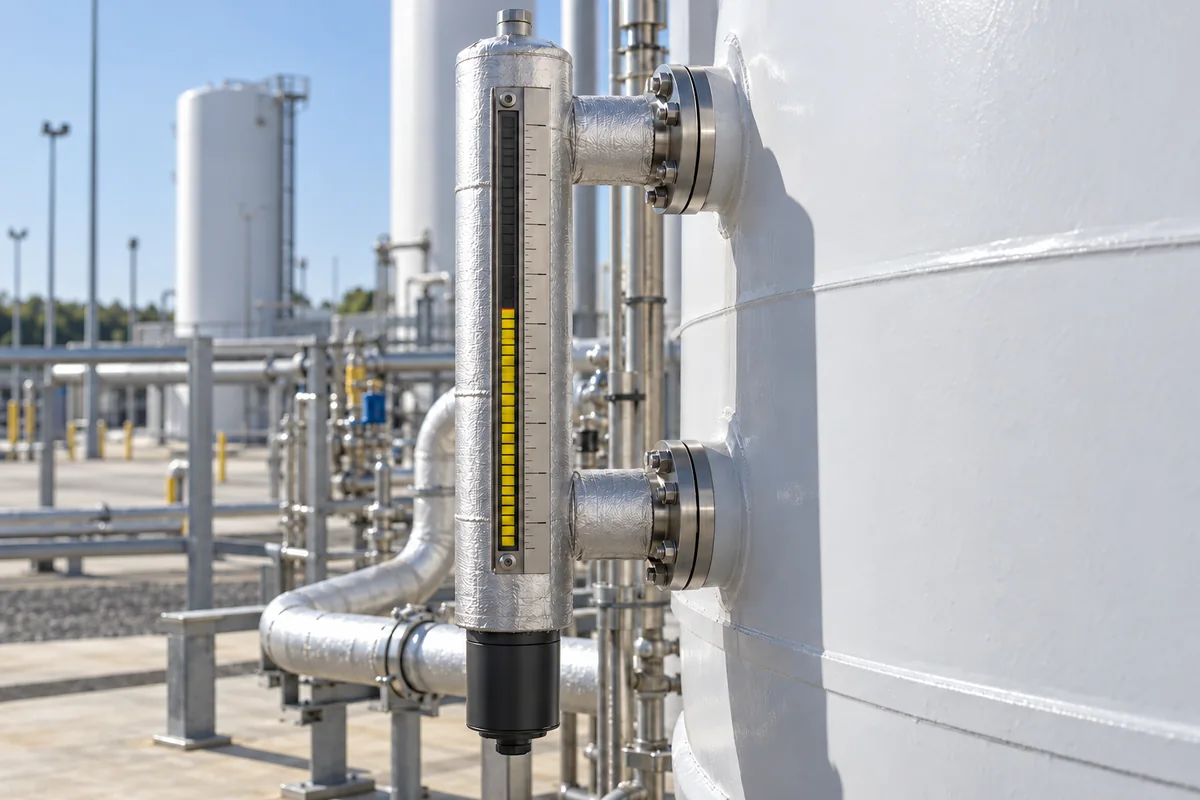
Liquid Level Gauge in a manufacturing environment
Representative product image. Confirm appearance and specifications with the manufacturer.

Product Specifications

Technical details and manufacturing context for Liquid Level Gauge

Definition
The Liquid Level Gauge is a component used in chemical manufacturing to monitor the level of liquid carbon dioxide (CO₂) inside storage tanks. It provides real-time visual or electronic indication of the liquid CO₂ level, enabling operators to maintain proper inventory, prevent overfilling or underfilling, and ensure safe storage conditions. The gauge is designed for use with liquid CO₂ service and is available with a measuring range of 0–3000 mm, customizable per tank height. Accuracy is ±1.5% of full scale. Operating temperature ranges from -40 to 85°C. Process connections are flange or threaded, DN25–DN50, per DIN 2501. Wetted parts are made of 316L stainless steel (ASTM A240). The output signal is 4–20 mA, with HART protocol optional, and supply voltage is 9–36 V DC (two-wire loop powered). Ingress protection is IP65–IP67 (IEC 60529), and explosion-proof rating is Ex d IIC T6 (IEC 60079). Weight ranges from 2.5 to 8.0 kg, depending on length and connection. Materials on file include stainless steel, tempered glass, and brass. The gauge operates via mechanical float mechanisms, pressure differential sensors, or ultrasonic/radar level detection, converting the measurement into a readable display or electronic signal. This directory entry provides reference specifications; actual model-specific values and standards must be verified with the legal manufacturer or supplier.
Working Principle
The gauge measures the height of liquid CO₂ within the tank using one of several methods: a mechanical float that follows the liquid surface, a pressure differential sensor that detects the hydrostatic pressure difference, or an ultrasonic/radar sensor that emits waves and measures their reflection time. The measured height is converted into a visual gauge display (e.g., a dial or sight glass) or an electronic signal (e.g., 4–20 mA) for remote monitoring. The choice of method depends on tank design, required accuracy, and environmental conditions. The gauge must be installed and calibrated according to the manufacturer's instructions to ensure accurate readings.
Common Materials
Stainless Steel, Tempered Glass, Brass
Technical Parameters
ParameterTypical rangeNotes & selection driver
Measuring Range0–3000 mmCustomizable per tank height
Accuracy±1.5 % FSFull scale accuracy
Operating Temperature-40–85 °CFor liquid CO2 service
Process ConnectionDN25–DN50Flange or threadedDIN 2501
Material316LWetted partsASTM A240
Output Signal4–20 mAHART protocol optional
Supply Voltage9–36 V DCTwo-wire loop powered
Ingress ProtectionIP65–IP67Weatherproof for outdoor tanksIEC 60529
Explosion ProofEx d IIC T6For hazardous areasIEC 60079
Weight2.5–8.0 kgDepends on length and connection

Ranges are indicative industry figures for RFQ preparation, not a supplier commitment. Confirm every value and standard with the legal manufacturer before ordering.

Components / BOM
  • Float Part
    Rises and falls with liquid level to provide mechanical indication
    Material: Stainless Steel
  • Gauge Glass Part
    Provides visual observation of liquid level
    Material: Tempered Glass
  • Mounting Flange Part
    Secures the gauge to the tank
    Material: Stainless Steel
  • Scale Plate Part
    Displays measurement markings for level reading
    Material: Aluminum
  • Pressure Differential Sensor Optional
    Derives the liquid level from the hydrostatic pressure difference.
  • Ultrasonic Sensor Optional
    Measures level by the reflection time of emitted waves.

Application & selection

Application Fit & Sizing Matrix

Operational Limits
pressure: 0 to 25 bar (g)
other spec: Liquid CO₂ density range: 700-1200 kg/m³, Accuracy: ±1% of span
temperature: -40°C to +80°C
Media Compatibility
✓ Liquid CO₂ storage tanks ✓ Industrial refrigeration systems ✓ Beverage carbonation systems
Unsuitable: High-viscosity fluids or slurries with particulate matter >100 microns
Sizing Data Required
  • Tank height and required measurement span
  • Process pressure and temperature conditions
  • Required accuracy and output signal type (e.g., 4-20mA, HART)

Risk, maintenance & compliance

Reliability & Engineering Risk Analysis

Failure Mode & Root Cause
Glass breakage or fogging
Cause: Thermal shock from rapid temperature changes, mechanical stress from improper installation, or chemical attack from process fluids
Gasket/seal leakage
Cause: Material degradation from chemical exposure, improper torque during installation, or thermal cycling causing compression loss
Maintenance Indicators
  • Visible fluid leakage around gauge seals or connections
  • Cloudy or discolored glass obscuring level visibility
Engineering Tips
  • Install thermal insulation or protective shields to minimize temperature fluctuations around the gauge
  • Implement regular torque checks on mounting bolts and use chemical-compatible gasket materials for specific process fluids

Indicative industry ranges for design and RFQ preparation. Confirm the exact figures and applicable standard with the manufacturer before specifying.

Compliance & Manufacturing Standards

Applicable Standards
ISO 24450:2020 - Liquid level gauges for pressure vessels ASME B40.100 - Pressure Gauges and Gauge Attachments DIN 16282 - Sight glasses for pressure vessels

Quoted from the published standard.

Manufacturing Precision
  • Level indication accuracy: +/- 1.5% of full scale
  • Mounting flange flatness: 0.05mm across sealing surface
Quality Inspection
  • Hydrostatic pressure test at 1.5x maximum working pressure
  • Visual inspection for clarity and legibility of level markings
Technical documentation
Request current drawings, revision history, and a signed specification sheet.
Manufacturing capability
Verify equipment lists, process limits, capacity, and representative production evidence.
Inspection readiness
Confirm test methods, calibrated equipment, sampling plans, and traceable reports.
Supplier transparency
Check the legal entity, factory address, ownership, certifications, and direct contacts.

Compare the published product scope and source details, then include your specifications and quantity in an enquiry.

Manufacturers of Liquid Level Gauge

4 companies list this product among what they make. Company figures are quoted from each company's own website; every card states where the relationship came from.

Jiangsu Meiante Automation Instrument Co., Ltd
Jiangsu, CN
Listed on the company's own website · profile compiled by CNFX from public sources
Listed there as: “Magnetic float liquid level gauge”
View source page ↗ jsmeiante.com · recorded 2026-09-12
Ningbo Wenhan Fluid Equipments Co., Ltd.
Ningbo, Zhejiang, CN
Listed on the company's own website · profile compiled by CNFX from public sources
Listed there as: “Sanitary Liquid Level Gauge”
View source page ↗ wenhanvalves.com · recorded 2026-09-08
Shanghai XuYan Precision Technology Co., Ltd.
Shanghai, CN
Listed on the company's own website · profile compiled by CNFX from public sources
Listed there as: “Liquid Level Gauge XY-LGR”
View source page ↗ xvyanprecision.com · recorded 2026-09-02
Xiamen Chenmai Wisdom Technology Co., Ltd.
Xiamen, Fujian, CN
Listed on the company's own website · profile compiled by CNFX from public sources
Listed there as: “Input-type liquid level gauge”
View source page ↗ chenmaiwise.com · recorded 2026-09-17

Explore company information and manufacturing capabilities, then discuss the scope of your project with a relevant supplier.

Buyer enquiry

Request manufacturing insight for Liquid Level Gauge

Ask for use case, specification boundaries, supplier type, and RFQ preparation information for this product.

Where it goes
Straight to the CNFX editorial desk, and to the manufacturer if this product is linked to a claimed profile. Nothing is broadcast to a supplier list.
Your details stay here
We do not sell or rent enquiry data, and we do not add you to a mailing list. Used only to answer this request.
No commission, no middleman
CNFX is a directory. We take no cut of any order and never negotiate on a supplier's behalf.
What to include
Share your product specifications, quantity, destination and target delivery date.

Your business information is used only to process this request.

Thank you! Your message has been sent. We'll respond within 1–3 business days.
Sorry, we couldn't send your message. Please try again, or email us at [email protected].

Frequently Asked Questions

What is the measuring range of this liquid level gauge?

The measuring range is 0–3000 mm, customizable per tank height. The actual range must be confirmed for your specific tank dimensions.

What output signals are available?

The standard output is 4–20 mA, with HART protocol optional. Supply voltage is 9–36 V DC, two-wire loop powered.

Is the gauge suitable for hazardous areas?

The gauge has an explosion-proof rating of Ex d IIC T6 (IEC 60079) and ingress protection of IP65–IP67 (IEC 60529). Confirm suitability for your specific hazardous area classification with the manufacturer.

Related equipment

Applied To / Applications

This component is essential for the following industrial systems and equipment:

Industrial Ecosystem & Supply Chain Structure

Specialized Tooling

Industry Taxonomies & Aliases

Commonly used trade names and technical identifiers for Liquid Level Gauge.

Data Basis

Editorial classification, named public sources where available, and source-reviewed manufacturer records.

Preliminary Technical Classification
This page supports structured research, RFQ preparation, and supplier evaluation. It does not replace buyer-led supplier qualification, standards review, or technical approval.

Need to Manufacture Liquid Level Gauge?

Compare manufacturer profiles with relevant product and process capability.

Previous Product
Liquid Distributor
Next Product
Main Flange Body
Get QuotesChat