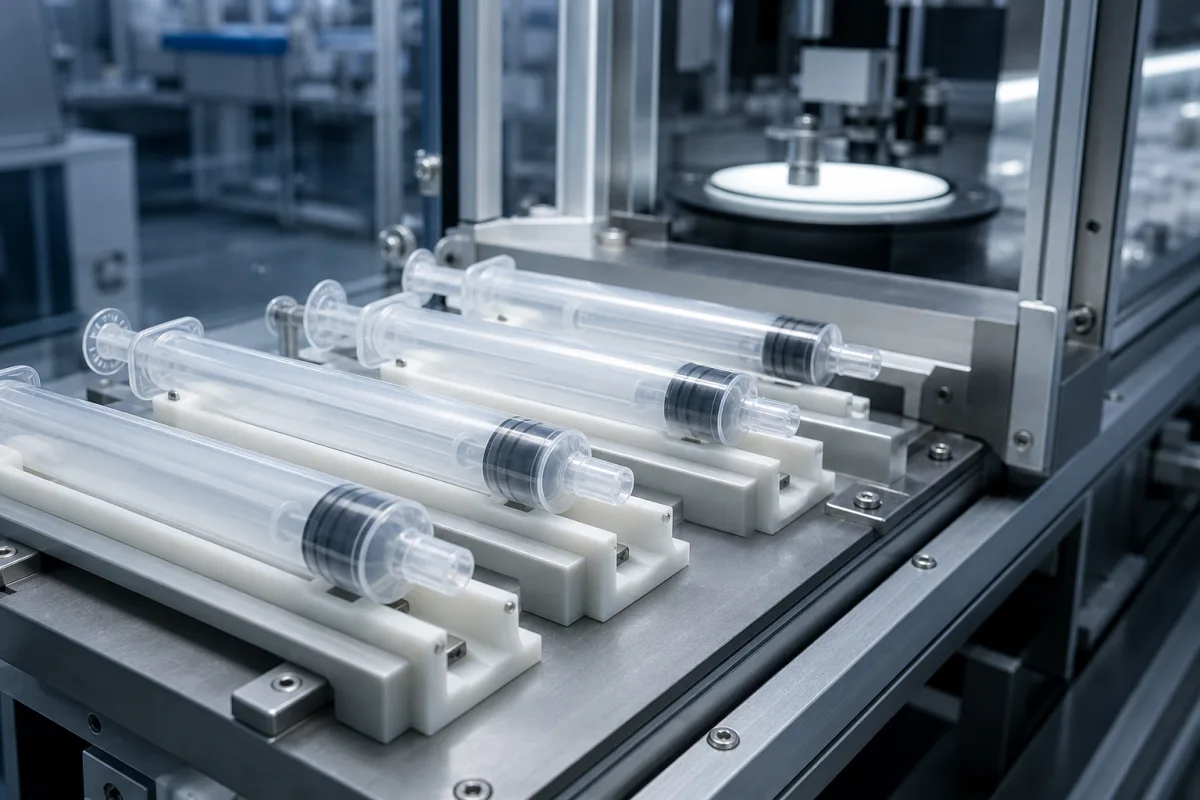
Disposable piston syringes · Bench tests for dead space, leakage and plunger force, US clearance, FDA's evaluation of syringes made in China
A medical-grade polypropylene syringe is a single-use piston syringe, with a moulded barrel and plunger and a Luer slip or Luer lock tip, used to inject fluids into or withdraw them from the body. Ask three things first: what bench test results the supplier has for capacity, dead space, leakage and plunger force, what regulatory clearance the syringe has in your market, and where it is actually manufactured and sterilised.
Sterile single-use plastic piston syringes for injecting or withdrawing fluids, with or without needles. Glass and pre-filled syringes, enteral and oral dosing syringes, insulin pens and syringe pumps are outside this page.
CNFX editorial research · Sources checked October 11, 2026 · 4 sources
The 510(k) summary for JMS piston syringes (K132321, cleared in 2014, product code FMF, 21 CFR 880.5860) describes a single-use syringe of calibrated barrel and movable plunger with Luer slip or Luer lock tip, and lists non-clinical tests: cleanliness, limits for acidity or alkalinity and for extractable metals, amount of lubrication, tolerance on graduated capacity, plunger design, nozzle lumen, dead space, and freedom from air and liquid leakage past the piston under positive and negative pressure — all reported as passing. [1]
Its comparison table gives movability below 98 kPa and leakage resistance above 196 kPa for its 30, 50 and 100 mL syringes, dead space below 0.17 mL for 30 mL and below 0.20 mL for 50 and 100 mL, and E-beam sterilisation for the new device against gamma for the predicate. [1]
Editorial calculation: 0.17 mL of dead space in a 30 mL syringe is about 0.57% of nominal capacity, and 0.20 mL in a 100 mL syringe 0.2%. Ask the supplier for the same tests on the sizes you buy, with the standard and edition they were run to.
Give the supplier the sizes and tip types (Luer slip or lock, centre or eccentric nozzle), needle requirement, sterilisation method, packaging, regulatory clearances needed for your market, test reports required, where the syringes are moulded, assembled and sterilised, and annual volume.
02
Check regulatory status and country of manufacture
FDA's safety communication on plastic syringes made in China, current as of 6 September 2024, explains that since November 2023 FDA has been evaluating device failures such as leaks and breakage in plastic syringes made in China for injecting or withdrawing fluids, which may affect their ability to deliver the correct dose alone or with infusion pumps; glass, pre-filled and topical syringes are not included. [2]
It recommends immediately transitioning away from plastic syringes made by Jiangsu Caina Medical, Jiangsu Shenli Medical Production and Shanghai Kindly Enterprise Development Group, unless absolutely necessary, and from Jiangsu Shenli enteral syringes. For other plastic syringes made in China it advises checking manufacturing location on labelling or with the supplier, using syringes not made in China if possible, otherwise monitoring closely for leaks and breakage, and reporting problems. FDA lists warning letters issued in 2024 and import alerts covering all piston syringes from three firms. [2]
Editorial note: these are FDA's recommendations for the US market as of its last update; buyers should check FDA's current page and their own regulator before sourcing, and should not assume one supplier's status applies to another.
03
Compare what suppliers offer
Suppliers linked to this page list disposable syringes; each card links to the page reviewed.
Listings include two-part and three-part hypodermic syringes, auto-disable and insulin syringes, and related needles and infusion sets.
04
Ask which polypropylene grade the barrel is moulded from
LyondellBasell's product page for Purell RP374R describes a polypropylene random copolymer for injection moulding, designed for empty disposable three-part syringes and showing good transparency. The page states that any application in the pharmaceutical, medical device, laboratory or diagnostics area has to be discussed with the maker's technical and business contacts first. [4]
Its listed properties are a melt flow rate of 25 g/10 min at 230 °C/2.16 kg, density 0.90 g/cm³, tensile modulus 1000 MPa, tensile stress at yield 27 MPa, notched Charpy impact strength of 6.0 kJ/m² at 23 °C and 2.5 kJ/m² at 0 °C, Vicat softening temperature 130 °C, heat deflection temperature 72 °C at 0.45 MPa and haze of 9% on a 1 mm injection-moulded disc. [4]
Editorial note: these are one resin grade's published values, not a syringe specification. Ask the syringe supplier to name the resin maker and grade for the barrel and the plunger, to supply each resin's data sheet, and to confirm that the medical use has been discussed with the resin maker as this page requires. Values for any other grade must come from that grade's own data sheet.
Ask for ISO 7886-1 dead space, leakage and force results by size
A 2022 peer-reviewed review in Medicine (Baltimore) summarises the performance tests of ISO 7886-1:2017 for sterile single-use hypodermic syringes: dead space, operating force, air and liquid leakage, and fit of the plunger in the barrel. It reports the ISO maximum dead space as 0.07 mL for a barrel volume below 5 mL, 0.075 mL from 5 to 10 mL, 0.10 mL from 10 to 20 mL, 0.15 mL from 20 to 30 mL, 0.17 mL from 30 to 50 mL and 0.20 mL above 50 mL. Dead space is measured by weighing a dry syringe, filling it with distilled water, expelling it with the plunger fully pressed and reweighing. [3]
For liquid leakage the review describes filling the syringe to nominal capacity, applying a sideways force of 0.25 to 3 N to the plunger end and pressing to an internal pressure of 200 to 300 kPa for 30 to 35 seconds. For air leakage, a vacuum is drawn to 88 kPa below atmospheric pressure and watched for 60 seconds. The operating-force test uses a reservoir filled to half the syringe's nominal capacity and an 18 gauge needle of about 10 cm. [3]
The review cites one study run to the ISO method in which 4 of 5 brands of 5 mL syringes exceeded 0.075 mL dead space and 1 of 5 brands of 10 mL syringes exceeded 0.1 mL. Ask for measured results for each size you buy, not a general claim of conformity. [3]
Fill the specification fields with values for your order
A syringe quotation needs values for your sizes and market. The table explains each field, gives published values where a reviewed source states them, and says what to obtain from the supplier.
Explore company information and manufacturing capabilities, then discuss the scope of your project with a relevant supplier.
Share this page
Compiled and source-reviewed by the CNFX editorial team.
Published product pages show what a company offers, not tested performance or regulatory clearance. Confirm the legal seller, factory, clearances and scope for your order. How we source and review
· Page last updated 13 October 2026
Buyer questions
What tests do disposable syringes pass for US clearance?
The JMS 510(k) lists cleanliness, acidity/alkalinity, extractable metals, lubrication, graduated capacity, dead space and leakage past the piston, among others. [1]
What did FDA recommend about plastic syringes made in China?
As of September 2024 FDA recommended transitioning away from three named makers and, for others made in China, checking origin and using alternatives where possible. [2]
What dead space does a syringe have?
The JMS 510(k) lists less than 0.17 mL for 30 mL and less than 0.20 mL for 50 and 100 mL syringes. [1]
How are syringe leakage tests run under ISO 7886-1?
A 2022 review in Medicine (Baltimore) describes a liquid test at 200 to 300 kPa held for 30 to 35 seconds with a 0.25 to 3 N sideways force on the plunger, and an air test at 88 kPa below atmospheric pressure observed for 60 seconds. [3]
What properties does a syringe-grade polypropylene resin list?
LyondellBasell lists its Purell RP374R random copolymer for three-part syringes at a melt flow rate of 25 g/10 min (230 °C/2.16 kg), density 0.90 g/cm³, tensile modulus 1000 MPa and haze of 9% on a 1 mm disc. [4]
Sources and what still needs a direct check
Sources checked 2026-10-11. The JMS 510(k) summary is a manufacturer's submission cleared by FDA; the FDA safety communication reflects FDA's position at its last update. Check current regulator pages before sourcing.