Industry-Verified Manufacturing Data (2026)

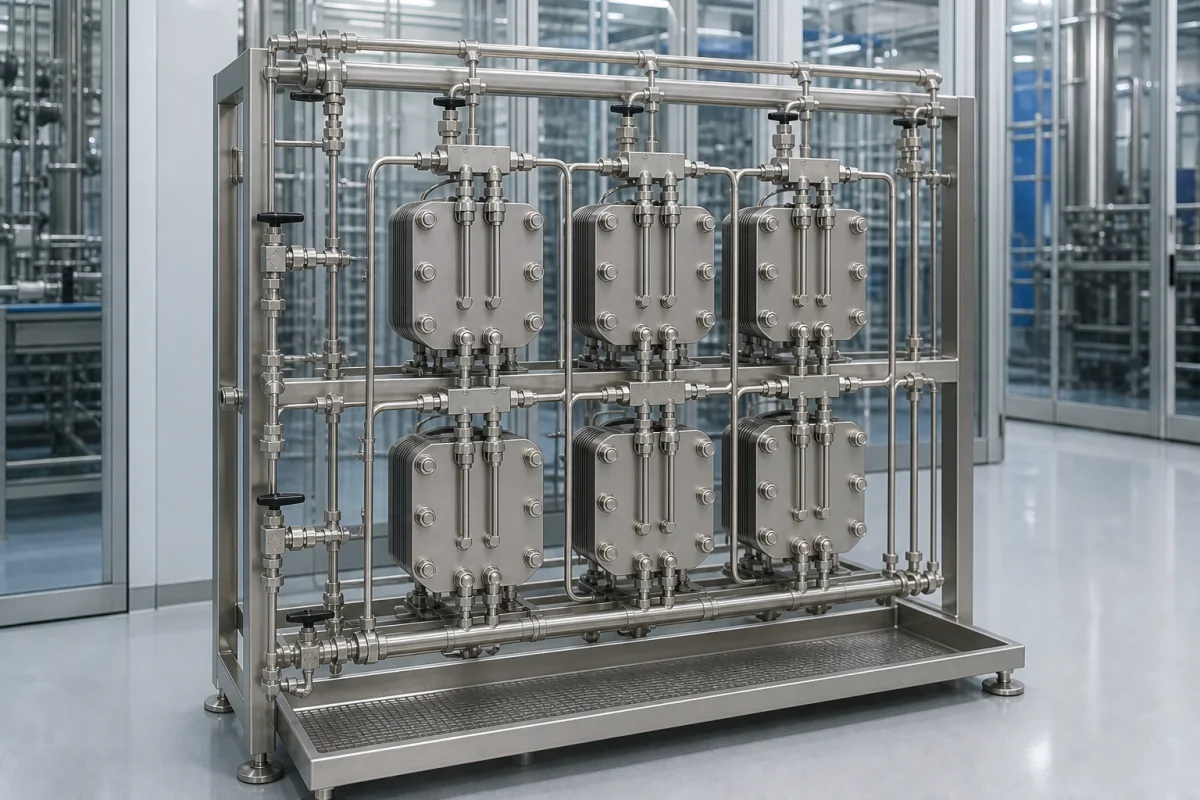
Microreactor Array

Based on aggregated insights from multiple verified factory profiles within the CNFX directory, the standard Microreactor Array used in the Chemical Manufacturing sector typically supports operational capacities ranging from standard industrial configurations to heavy-duty production requirements.

Technical Definition & Core Assembly

A canonical Microreactor Array is characterized by the integration of Microreactor Unit and Distribution Manifold. In industrial production environments, manufacturers listed on CNFX commonly emphasize Silicon construction to support stable, high-cycle operation across diverse manufacturing scenarios.

A modular assembly of multiple microreactors arranged in parallel or series configurations for high-throughput chemical processing.
Product Specifications

Technical details and manufacturing context for Microreactor Array

Definition
Within a Continuous Flow Chemical Synthesis System, the microreactor array serves as the core reaction unit where chemical transformations occur under precisely controlled conditions. It enables parallel processing of multiple reactions simultaneously or sequential multi-step synthesis in a compact footprint, significantly enhancing production capacity and process flexibility compared to single microreactor units.
Working Principle
The array operates by distributing reactant streams through multiple microchannels within individual microreactor units. Each unit provides high surface-to-volume ratios for efficient heat and mass transfer. The array configuration allows for either parallel operation (identical reactions in multiple units) or series operation (sequential reactions across units), with flow control systems managing distribution and collection of streams.
Common Materials
Silicon, Glass, Stainless Steel, Polymers (e.g., PTFE, PEEK)
Technical Parameters
  • Channel dimensions typically range from 10-1000 μm in diameter/width (mm) Standard Spec
Components / BOM
  • Microreactor Unit
    Individual reaction chamber with microchannels for chemical processing
    Material: Silicon/Glass/Stainless Steel
  • Distribution Manifold
    Evenly distributes reactant streams to multiple microreactor units
    Material: Stainless Steel/PEEK
  • Collection Manifold
    Collects product streams from multiple microreactor units
    Material: Stainless Steel/PEEK
  • Heating/Cooling Elements
    Maintains precise temperature control for each reactor unit
    Material: Stainless Steel/Ceramic
  • Sealing Gaskets
    Provides leak-proof connections between array components
    Material: PTFE/Viton
Engineering Reasoning
0.1-100 bar, 20-300°C, 0.01-10 mL/min per reactor
150 bar internal pressure, 350°C wall temperature, 15 mL/min flow rate per reactor
Design Rationale: Thermal stress cracking from differential expansion (coefficient mismatch >5×10⁻⁶ K⁻¹), channel deformation from yield strength exceedance (316L SS yield: 290 MPa), laminar-turbulent transition at Re>2300 causing mixing degradation
Risk Mitigation (FMEA)
Trigger Catalyst particle agglomeration exceeding 10 μm diameter
Mode: Channel blockage with >80% flow restriction
Strategy: In-line 5 μm sintered metal filter with differential pressure monitoring (ΔP>0.5 bar triggers bypass)
Trigger Thermal cycling >1000 cycles between 50-250°C
Mode: Diffusion bonding failure at manifold joints (leak rate >1×10⁻⁶ mbar·L/s)
Strategy: Unibody laser-welded construction with post-weld heat treatment at 1050°C for 30 minutes

Industry Taxonomies & Aliases

Commonly used trade names and technical identifiers for Microreactor Array.

Industrial Ecosystem & Supply Chain DNA

Complementary Systems
Downstream Applications
Specialized Tooling

Application Fit & Sizing Matrix

Operational Limits
pressure: Up to 20 bar
flow rate: 0.1-10 mL/min per channel
temperature: -20°C to 200°C
slurry concentration: Up to 20% solids by volume
Media Compatibility
✓ Organic solvents (e.g., DMF, THF) ✓ Aqueous solutions with pH 2-12 ✓ Gas-liquid mixtures (e.g., hydrogenation reactions)
Unsuitable: Highly corrosive media (e.g., concentrated HF, hot concentrated acids)
Sizing Data Required
  • Required throughput (kg/day or L/day)
  • Reaction kinetics (residence time requirements)
  • Number of parallel reactions or screening conditions

Reliability & Engineering Risk Analysis

Failure Mode & Root Cause
Channel clogging
Cause: Particulate accumulation from process fluids or corrosion products, leading to flow restriction and pressure drop.
Thermal stress cracking
Cause: Rapid temperature cycling or uneven heating/cooling across the array, causing material fatigue and microfractures.
Maintenance Indicators
  • Sudden, unexplained pressure drop or flow rate deviation across the array
  • Visible discoloration, hotspots, or localized corrosion on reactor surfaces
Engineering Tips
  • Implement inline filtration and regular fluid quality monitoring to prevent particulate ingress and chemical degradation.
  • Use controlled ramp rates for temperature changes and ensure uniform thermal distribution via proper heat exchanger design and insulation.

Compliance & Manufacturing Standards

Reference Standards
ISO 9001:2015 (Quality Management Systems) ASTM E2930-13 (Standard Guide for Pressure and Leak Testing of Microreactors) CE Marking (EU Machinery Directive 2006/42/EC)
Manufacturing Precision
  • Channel Width: +/- 0.01 mm
  • Surface Roughness: Ra ≤ 0.4 μm
Quality Inspection
  • Helium Leak Test (ASTM E2930)
  • Optical Profilometry for Dimensional Verification

Factories Producing Microreactor Array

Verified manufacturers with capability to produce this product in China

✓ 97% Supplier Capability Match Found

P Procurement Specialist from Canada Feb 05, 2026
★★★★★
"The technical documentation for this Microreactor Array is very thorough, especially regarding technical reliability."
Technical Specifications Verified
T Technical Director from United States Feb 02, 2026
★★★★★
"Reliable performance in harsh Chemical Manufacturing environments. No issues with the Microreactor Array so far."
Technical Specifications Verified
P Project Engineer from United Arab Emirates Jan 30, 2026
★★★★★
"Testing the Microreactor Array now; the technical reliability results are within 1% of the laboratory datasheet."
Technical Specifications Verified
Verification Protocol

“Feedback is collected from verified sourcing managers during RFQ (Request for Quote) and factory evaluation processes on CNFX. These reports represent historical performance data and technical audit summaries from our B2B manufacturing network.”

16 sourcing managers are analyzing this specification now. Last inquiry for Microreactor Array from Vietnam (1h ago).

Supply Chain Compatible Machinery & Devices

Modular Distillation Column System

Pre-engineered modular system for continuous separation of chemical mixtures via distillation.

Explore Specs →
Automated Batch Crystallization System

Automated system for controlled crystallization of chemical compounds in batch processes.

Explore Specs →
Automated pH Monitoring and Dosing System

Automated system for continuous pH monitoring and chemical dosing in process streams.

Explore Specs →
Automated Powder Dispensing and Blending System

Automated system for precise dispensing and homogeneous blending of powdered chemicals.

Explore Specs →

Frequently Asked Questions

What are the main advantages of using a microreactor array in chemical manufacturing?

Microreactor arrays offer superior heat and mass transfer, precise reaction control, scalability through modular design, reduced reagent consumption, and enhanced safety through small-volume processing compared to traditional batch reactors.

How do I choose between parallel and series configurations for my application?

Parallel configurations maximize throughput for identical reactions, while series configurations enable multi-step synthesis. The choice depends on your process: parallel for screening or production scaling, series for complex reaction sequences requiring intermediate steps.

What maintenance considerations are important for microreactor arrays?

Regular inspection of sealing gaskets for leaks, cleaning protocols compatible with your materials (silicon, glass, stainless steel, or polymers), monitoring heating/cooling element performance, and checking manifold connections for blockages are essential for optimal operation and longevity.

Can I contact factories directly on CNFX?

CNFX is an open directory, not a transaction platform. Each factory profile provides direct contact information and production details to help you initiate direct inquiries with Chinese suppliers.

Get Quote for Microreactor Array

Request technical pricing, lead times, or customized specifications for Microreactor Array directly from verified manufacturing units.

Your business information is encrypted and only shared with verified Microreactor Array suppliers.

Thank you! Your message has been sent. We'll respond within 1–3 business days.

Need to Manufacture Microreactor Array?

Connect with verified factories specializing in this product category

Add Your Factory Contact Us
Previous Product
Metering Valve
Next Product
Microreactor Unit