Industry-Verified Manufacturing Data (2026)

Agitator/Impeller

Based on aggregated insights from multiple verified factory profiles within the CNFX directory, the standard Agitator/Impeller used in the Chemical Manufacturing sector typically supports operational capacities ranging from standard industrial configurations to heavy-duty production requirements.

Technical Definition & Core Assembly

A canonical Agitator/Impeller is characterized by the integration of Impeller Hub and Blades/Vanes. In industrial production environments, manufacturers listed on CNFX commonly emphasize Stainless Steel 316L construction to support stable, high-cycle operation across diverse manufacturing scenarios.

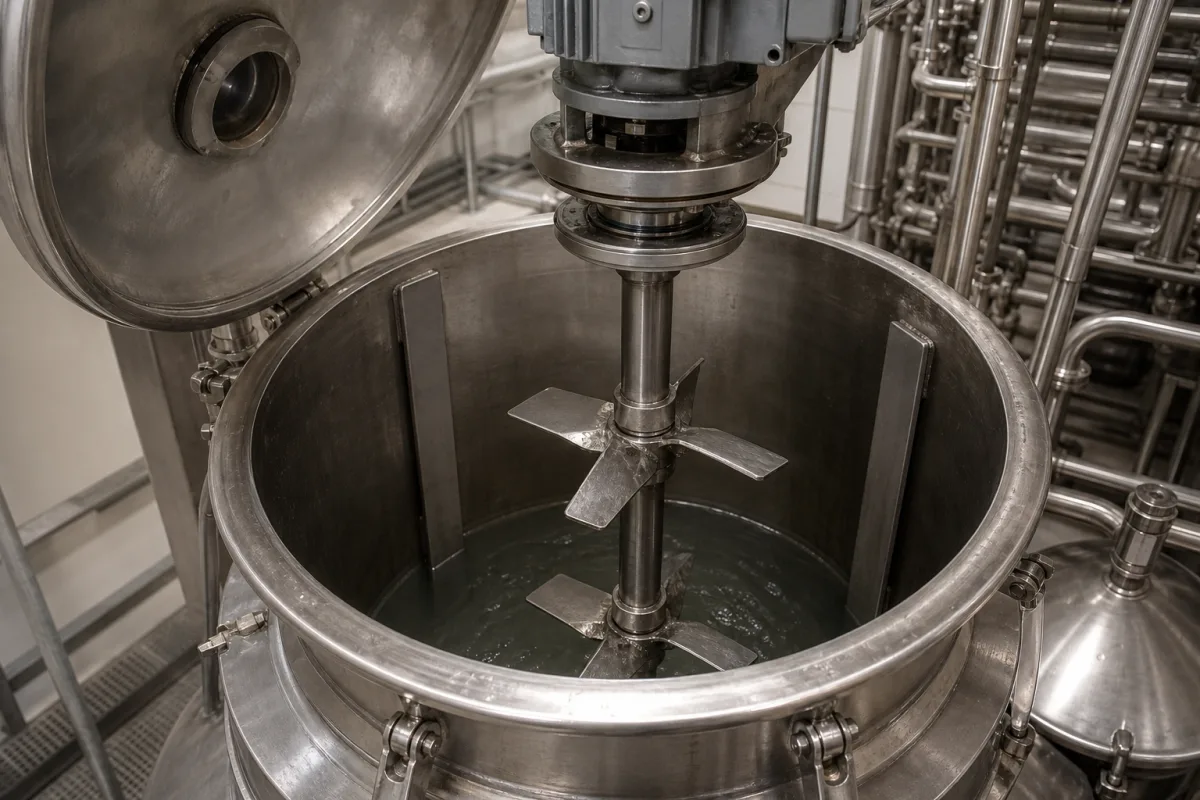
A rotating mechanical component within a neutralization reactor that mixes reactants to ensure uniform chemical reactions.
Product Specifications

Technical details and manufacturing context for Agitator/Impeller

Definition
The agitator/impeller is a critical component of a neutralization reactor responsible for creating fluid motion and turbulence within the vessel. It ensures thorough mixing of acids, bases, or other reactants to achieve complete neutralization, prevent localized concentration gradients, enhance heat transfer, and maintain homogeneous reaction conditions throughout the process.
Working Principle
The agitator/impeller rotates via a connected shaft and motor, imparting kinetic energy to the fluid. Its blades or vanes push the fluid radially and axially, creating flow patterns (such as axial, radial, or tangential) that promote mixing, dispersion, and suspension of reactants within the neutralization reactor.
Common Materials
Stainless Steel 316L, Hastelloy C-276, Titanium
Technical Parameters
  • Diameter of the impeller blades, critical for determining mixing efficiency and power consumption. (mm) Standard Spec
Components / BOM
  • Impeller Hub
    Central mounting point that connects the impeller blades to the drive shaft
    Material: Stainless Steel
  • Blades/Vanes
    Primary mixing elements that impart motion to the fluid
    Material: Corrosion-resistant alloy
  • Shaft Connection
    Mechanical interface for attaching to the agitator drive shaft
    Material: Steel
Engineering Reasoning
0.5-15 m/s tip speed, 0.1-5.0 kW power input, 20-150 rpm rotational speed
Tip speed exceeding 18 m/s causes material yield strength violation (316L SS: 290 MPa at 20°C), power input above 6.0 kW induces shaft deflection >0.15 mm/m
Design Rationale: Cavitation-induced pitting at vapor pressure threshold (2.34 kPa at 20°C water), bending fatigue failure at stress amplitude >103 MPa (10^7 cycles, R=-1)
Risk Mitigation (FMEA)
Trigger Bearing lubrication degradation below 25 μm oil film thickness
Mode: Radial vibration amplitude exceeding 4.5 mm/s RMS at 1× running speed
Strategy: Forced lubrication system with 0.15 MPa minimum pressure and 40°C temperature control
Trigger Chemical corrosion exceeding 0.1 mm/year material loss rate in pH<2 or pH>12 environments
Mode: Stress corrosion cracking initiating at surface defects >50 μm depth
Strategy: Hastelloy C-276 cladding (2.5 mm minimum) with electrochemical potential maintained above -200 mV vs SCE

Industry Taxonomies & Aliases

Commonly used trade names and technical identifiers for Agitator/Impeller.

Applied To / Applications

This component is essential for the following industrial systems and equipment:

Industrial Ecosystem & Supply Chain DNA

Complementary Systems
Downstream Applications
Specialized Tooling

Application Fit & Sizing Matrix

Operational Limits
pressure: Up to 10 bar
flow rate: 5-500 m³/h
temperature: -20°C to 150°C
slurry concentration: Up to 40% solids by weight
Media Compatibility
✓ Acidic solutions (pH 2-6) ✓ Alkaline solutions (pH 8-12) ✓ Water-based slurries
Unsuitable: Highly abrasive slurries with >40% solids or corrosive media exceeding pH 12
Sizing Data Required
  • Reactor volume (m³)
  • Required mixing intensity (RPM or power number)
  • Fluid viscosity (cP)

Reliability & Engineering Risk Analysis

Failure Mode & Root Cause
Fatigue cracking
Cause: Cyclic stress from turbulent flow, material defects, or improper welding leading to crack initiation and propagation, often at blade roots or weld joints.
Corrosion-induced pitting
Cause: Chemical attack from process fluids, galvanic corrosion due to dissimilar metals, or inadequate material selection for the operating environment, resulting in localized material loss and structural weakening.
Maintenance Indicators
  • Excessive vibration or unusual noise (e.g., grinding, knocking) during operation, indicating imbalance, bearing wear, or blade damage.
  • Visible cracks, deformation, or material loss on blades or shaft, especially at stress concentration points like weld seams or blade roots.
Engineering Tips
  • Implement regular vibration analysis and alignment checks to detect early imbalance or misalignment, preventing progressive damage to bearings and blades.
  • Use corrosion-resistant materials (e.g., stainless steel, coatings) suited to the process media, and conduct periodic thickness inspections to monitor wear and pitting rates.

Compliance & Manufacturing Standards

Reference Standards
ISO 2858:2012 (Centrifugal pumps - Design and dimensions) ANSI/ASME B73.1-2012 (Specification for horizontal end suction centrifugal pumps for chemical process) DIN 28136 (Agitators - Main dimensions)
Manufacturing Precision
  • Shaft runout: ≤0.05 mm per meter
  • Impeller blade thickness: ±1.0 mm
Quality Inspection
  • Dynamic balancing test (ISO 1940-1 Grade G6.3)
  • Liquid penetrant testing (ASTM E165/E165M)

Factories Producing Agitator/Impeller

Verified manufacturers with capability to produce this product in China

✓ 92% Supplier Capability Match Found

P Procurement Specialist from United States Feb 16, 2026
★★★★★
"The technical documentation for this Agitator/Impeller is very thorough, especially regarding technical reliability."
Technical Specifications Verified
T Technical Director from United Arab Emirates Feb 13, 2026
★★★★★
"Reliable performance in harsh Chemical Manufacturing environments. No issues with the Agitator/Impeller so far."
Technical Specifications Verified
P Project Engineer from Australia Feb 10, 2026
★★★★★
"Testing the Agitator/Impeller now; the technical reliability results are within 1% of the laboratory datasheet."
Technical Specifications Verified
Verification Protocol

“Feedback is collected from verified sourcing managers during RFQ (Request for Quote) and factory evaluation processes on CNFX. These reports represent historical performance data and technical audit summaries from our B2B manufacturing network.”

9 sourcing managers are analyzing this specification now. Last inquiry for Agitator/Impeller from UAE (1h ago).

Supply Chain Compatible Machinery & Devices

Modular Distillation Column System

Pre-engineered modular system for continuous separation of chemical mixtures via distillation.

Explore Specs →
Automated Batch Crystallization System

Automated system for controlled crystallization of chemical compounds in batch processes.

Explore Specs →
Automated pH Monitoring and Dosing System

Automated system for continuous pH monitoring and chemical dosing in process streams.

Explore Specs →
Automated Powder Dispensing and Blending System

Automated system for precise dispensing and homogeneous blending of powdered chemicals.

Explore Specs →

Frequently Asked Questions

What materials are best for agitator/impellers in corrosive chemical environments?

Stainless Steel 316L offers good general corrosion resistance, Hastelloy C-276 excels in highly corrosive acidic/chloride environments, and Titanium provides superior performance in oxidizing conditions and chlorides.

How does the agitator/impeller ensure uniform reactions in neutralization reactors?

The rotating blades/vanes create consistent fluid motion and turbulence, thoroughly mixing reactants to prevent localized concentration gradients and ensure complete, efficient neutralization reactions.

What are the key components in an agitator/impeller BOM for maintenance?

The main components are blades/vanes (mixing elements), impeller hub (central mounting structure), and shaft connection (interface with drive system) - all available in various materials to match process requirements.

Can I contact factories directly on CNFX?

CNFX is an open directory, not a transaction platform. Each factory profile provides direct contact information and production details to help you initiate direct inquiries with Chinese suppliers.

Get Quote for Agitator/Impeller

Request technical pricing, lead times, or customized specifications for Agitator/Impeller directly from verified manufacturing units.

Your business information is encrypted and only shared with verified Agitator/Impeller suppliers.

Thank you! Your message has been sent. We'll respond within 1–3 business days.

Need to Manufacture Agitator/Impeller?

Connect with verified factories specializing in this product category

Add Your Factory Contact Us
Previous Product
Agitator Head Assembly
Next Product
Agitator/Mixer