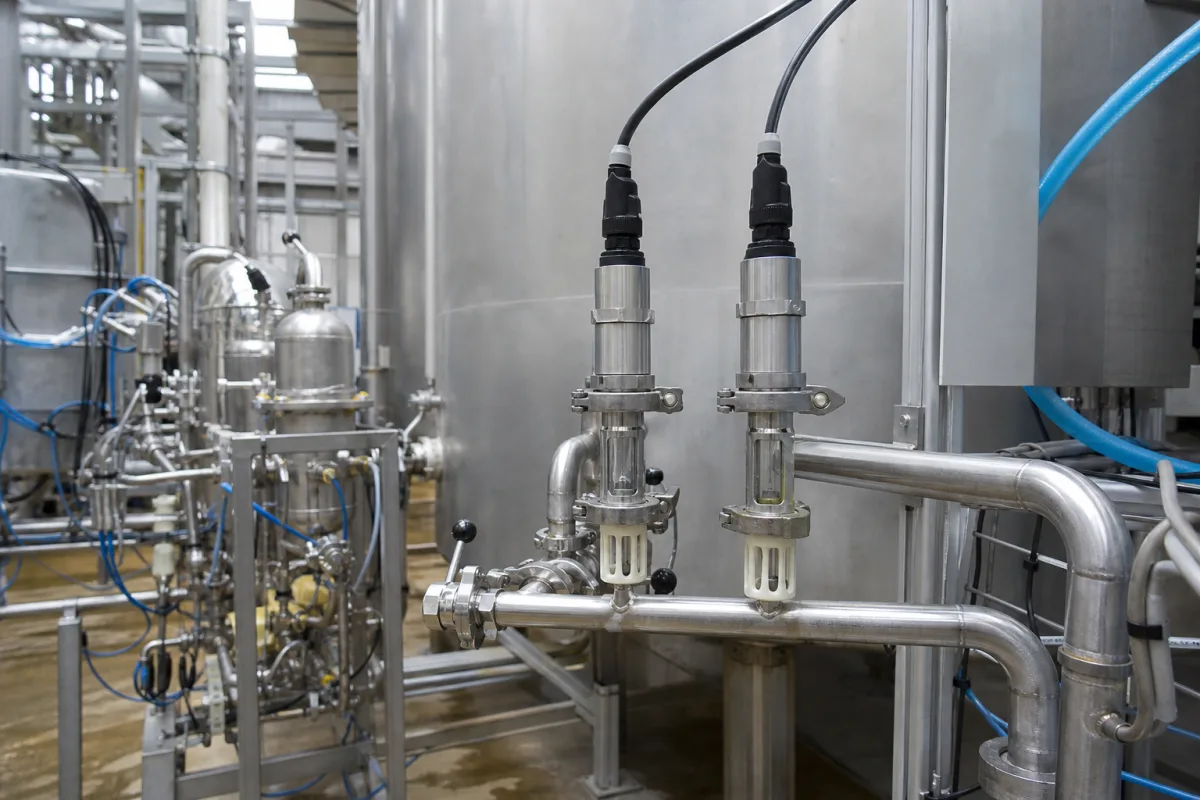
Redundant in-line pH sensors on a neutralization outlet: sensors in series, middle-signal selection, and the excursion minutes a continuously monitored discharge is allowed
Two or three pH sensors in insertion holders on the outlet of a neutralization system, read together so one fouled or drifting electrode cannot send untreated effluent to drain
In a chemical or wastewater neutralization system the pH sensors do two jobs: they feed the reagent dosing loop, and they produce the record that shows the discharge stayed within its limit. A single electrode can fail in ways that look like a good reading, such as a coated glass bulb that responds slowly or a poisoned reference that drifts, and the loop then doses to a wrong value without any alarm. This page covers the set of sensors installed to prevent that: two or three electrodes in insertion holders on the same line, combined by middle-signal selection, placed and cleaned so that each sees the same liquid. The regulatory side is the US rule for continuously monitored pH, which counts excursion minutes.
Sets of two or three process pH sensors in insertion or retractable holders monitoring the outlet of chemical and wastewater neutralization systems: series mounting, flow velocity at the tip, bulb guards, middle-signal selection and its diagnostics, cleaning and buffer calibration, and the continuous-monitoring excursion limits they report against. Glass and combination pH electrodes as products are covered on the pH electrode page; laboratory reference half-cells on the Laboratory reference electrode page; reaction tanks, reagent dosing and the complete neutralization plant on the Industrial chemical neutralization system page.
CNFX editorial research · Sources checked October 13, 2026 · 4 sources
Three electrodes and the middle value: what middle-signal selection ignores and what the deviating electrode tells you
Greg McMillan's 2024 pH best-practices presentation for Emerson lists the advantages of middle-signal selection (MSS) across three electrodes: it ignores a single measurement failure of any type, including a reading stuck at set point; it ignores the slowest electrode; and it reduces noise and spikes, particularly on steep titration curves. [1]
McMillan adds that MSS lets one electrode be removed for cleaning, rejuvenation, calibration or replacement without putting the pH loop in manual, that an electrode is removed only if it consistently performs poorly, and that the requirement for a new, cleaned or rejuvenated electrode's reference junction potential to be steady before it is used for closed-loop control is achieved automatically by MSS. [1]
Editorial note: with only two sensors a controller can see that they disagree but not which one is right; the third electrode is what makes the middle value a vote rather than an average.
Specify the number of electrodes, how the transmitter or control system selects the middle value, and which deviations (lag, span, bias, noise) are alarmed.
02
Mounting the set: in series at least 10 pipe diameters apart, tip down above 20°, and the flow at the bulb
McMillan's installation guidance is written for insertion electrodes in pipelines and vessels. [1]
Editorial calculation: in a 100 mm line, 10 pipe diameters is 1 m between electrodes; at 1.5 m/s (about 5 ft/s) liquid takes about 0.7 s to pass from one to the next, well inside the 6 s transport-delay limit. [1] The pipe size and velocity are assumptions for illustration.
South Fork Instruments, writing on wastewater neutralization, adds that a probe should not sit where reagent is added, that a bulb guard or stilling well protects the glass from abrasives and heavy solids, and that porous reference junctions in wastewater can be diluted, plugged or poisoned by heavy metals, sulfides or proteins that react with silver, giving sluggish response and reagent overdosing. [2]
Installation point
McMillan's value or rule
Multiple electrodes
In series on the same pipeline, at least 10 pipe diameters apart, not in parallel lines, so each sees the same velocity, mixing and composition [1]
Orientation
Tip pointing down at more than 20° to keep bubbles off the tip and internal electrode [1]
Velocity to limit abrasion or contamination
0.1 to 1 ft/s, with the tip protected from impingement [1]
Far enough to reduce concentration fluctuations, with transportation delay under 6 s [1]
Insertion depth
Tip into the pipe centreline and past vessel baffles [1]
Retraction
Ball valve and restraining strap so the electrode can be withdrawn without blowout [1]
Give the line size and velocity at the sensors, solids and coating tendency, whether retraction under pressure is needed, and the distance from the last reagent injection point.
03
The record the sensors produce: 60-minute single excursions, 7 h 26 min a month, and pH 5.0 at the sewer
Under 40 CFR 401.17, a permittee that continuously measures pH under an NPDES permit must keep it within the applicable range, with excursions allowed only within two limits: total time outside the range not more than 7 hours and 26 minutes in any calendar month, and no single excursion longer than 60 minutes. [3]
Editorial calculation: 7 h 26 min is 446 minutes, about 1.0 % of a 31-day month (44,640 minutes), so a sensor set that reads wrong for a few hours unnoticed can use up a month's allowance. [3] For discharges to a publicly owned treatment works, 40 CFR 403.5(b)(2) prohibits discharges with pH lower than 5.0 unless the works is specifically designed for them. [4]
For upkeep, South Fork describes soaking a coated electrode in 2–5 % hydrochloric acid for 5 minutes and rinsing, never using abrasives, and keeping electrodes wet, with pH 7.0 buffer in the storage boot if storage solution is not at hand. [2] McMillan sets offset with pH 7 buffer and slope with pH 4, preferring 4 to 10 because a pH 10 buffer is more readily changed by temperature and CO2 absorption, and adjusts an electrode in service only after consistent deviation from the others or from a representative sample. [1]
State the permitted pH range and whether the discharge is to surface water (NPDES) or a sewer, the recording interval, and how excursions are logged and alarmed.
04
What to send for a neutralization pH monitoring set
Paste it into your enquiry below or into an email to a maker, then replace every bracket.
Stream: [effluent type; solids, oil, sulfide or heavy metals; temperature]
Line: [pipe size; velocity; pressure]
Sensors: [number; holder type; retractable or fixed; bulb guard]
Signal: [transmitter; middle-signal selection; diagnostics]
Cleaning: [manual, spray or automatic retraction]
Compliance: [permitted pH range; NPDES or sewer; recording]
Explore company information and manufacturing capabilities, then discuss the scope of your project with a relevant supplier.
Share this page
Compiled and source-reviewed by the CNFX editorial team.
Each manufacturer above links to the page on that company's own website where the product is listed, with the date we checked it. How we source and review
· Page last updated 13 October 2026
Buyer questions
Why use three pH sensors instead of one?
McMillan (Emerson) notes that middle-signal selection ignores a single electrode failure of any type, ignores the slowest electrode and lets one be serviced without putting the loop in manual. [1]
How far apart should in-line pH sensors be?
In series on the same line at least 10 pipe diameters apart, according to McMillan, so each sees the same velocity, mixing and composition. [1]
How long may a continuously monitored discharge be out of pH range?
Under 40 CFR 401.17, no single excursion over 60 minutes and no more than 7 hours 26 minutes in a calendar month. [3]
Sources and what still needs a direct check
Sources checked 2026-10-13. Four sources: Greg McMillan's 2024 pH measurement best-practices presentation (Emerson), South Fork Instruments' note on pH neutralization in industrial wastewater, and two sections of the US Code of Federal Regulations, 40 CFR 401.17 and 40 CFR 403.5.