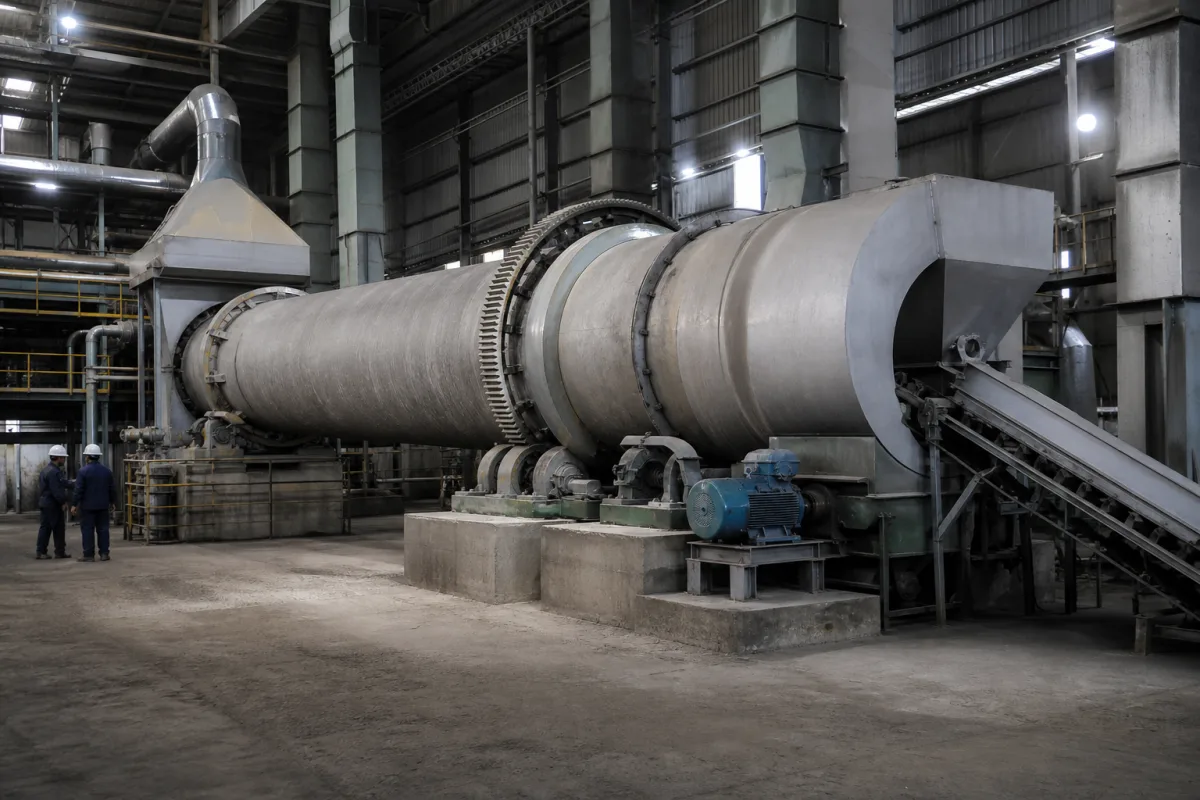
Rotary granulation drum for urea melt: curtain-forming internals, recycle and cooling of a melt-spray drum granulator
Urea melt sprayed onto falling curtains of recycled granules in a rotating drum · lifting flights, deflector pans and fixed baffles that form the curtains, an industrial heat and mass balance, air or water-mist cooling, and the granule it makes
A urea granulation drum is not a dryer: it is a slowly turning horizontal drum full of recycled granules, where lifting flights and fixed internals make the granules fall as curtains through sprays of hot urea melt. Each pass adds a thin layer that freezes before the granule lands, so the product grows layer by layer. This page covers the drum itself — the internals that form the curtains, the flows of melt, recycle and air it handles, how the heat of solidification is taken away, and the granule that results.
Rotary drum granulators in which a urea (or similar) melt is sprayed onto falling curtains of recycled granules: lifting flights, deflector pans and fixed curtain structures, melt spray manifolds, recycle and seed feed, cooling by air or water mist, and product size and strength. Phosphate and NPK ammoniator-granulators fed with slurry and ammonia are covered on the Rotary drum granulator for compound fertilizers page; whole urea finishing plants and the choice between prilling and granulation on the Urea granulation and prilling system page; prill towers on the Prilling tower page; rotary dryers on the Drying drum (rotary drum dryer) page; drum shell fabrication and ovality on the Rotating drum shell page.
CNFX editorial research · Sources checked October 12, 2026 · 3 sources
Forming the curtain: lifting flights, a deflector pan at 35° and fixed baffles
TVA's US patent 3,877,415 (filed 1973) puts a deflector pan, fixed in space inside the upper part of a rotating drum with lifting flights, to catch the particles falling from the flights and gather them into a dense, narrow cascade covering only about 1–10% of the drum cross-section, which is then sprayed. The pan's horizontally projected width may be 40–80% of the drum diameter. [2]
Fertimont's US patent 4,686,115 (priority 1985) replaces the single cascade with fixed inner structures that form two or three vertical curtains, and drops part of the lifted granules directly onto a fixed baffle in the lower half of the drum to form a descending bed. It states that a two-curtain drum offers about twice the sprayed surface of a single-curtain one, and a three-curtain drum, whose middle curtain is sprayed on both sides, about four times — and that spraying less liquid per curtain at the same capacity gives granules with more, thinner layers. [1]
The TVA examples in this patent coat urea with sulfur; TVA's later patent 4,213,924 used the same 4 ft × 6 ft drum with flights canted 15° forward and the 20½ in pan for urea melt granulation (next sections). [3] Editorial note: ask a drum supplier which internal arrangement it uses for urea melt and for its measured curtain density.
Give the supplier the product rate, melt concentration and temperature, the granule size wanted, and whether the drum must also handle coating or additive sprays; ask for the internal arrangement drawing and the number and position of spray manifolds.
02
An industrial example: 21.7 t/h of melt onto 62.5 t/h of recycle in a 2 m × 6 m drum
Example 1 of the Fertimont patent gives a complete operating point for a two-curtain urea drum: 6 m long, 2 m in diameter, 30 blades, 6 rpm. Two manifolds entering from opposite ends, each with 30 single-fluid flat-cone nozzles behind a gauze filter, sprayed urea melt of 99% by weight at 140 °C and 6.5 bar. [1]
Editorial calculation: the recycle ratio is 62,500 ÷ 21,688.7 ≈ 2.9 kg of recycle per kg of melt, and the drum circulates 300,000 ÷ 83,335 ≈ 3.6 times its throughput internally. Air works out at 11,500 ÷ 21,688.7 ≈ 0.53 Nm³ per kg of melt. Melt plus recycle (84,188.7 kg/h) exceeds the product leaving the drum by about 854 kg/h; the patent states that fines entrained by the air were removed in a wet separator and recovered, so that stream belongs in the scrubber design. [1]
Fluid-bed cooled to 49 °C; screened to 2–4 mm grade; oversize ground and returned with fines [1]
Ask for the supplier's balance at your rate: melt, recycle, air flow and temperatures, dust load to the scrubber, and product temperature at the drum outlet.
03
Taking away the heat of solidification: air alone, or a 50–60 µm water mist
TVA's US patent 4,213,924 (filed 1978) absorbs part of the heat released as the melt freezes by evaporating water atomised into the drum as an extremely fine mist, evaporated without striking the granules or the internals. Its urea example in the 4 ft × 6 ft drum gives the figures below. [3]
The patent sets the droplet evaporation time at no more than 2 seconds and preferably no more than 1 second, otherwise the moisture can condense on the granules or a surface inside the granulator, and it reports no increase in product moisture over conventional pan or drum granulation of urea. [3]
Editorial calculation: 76,000 Btu/h is about 70% of the 108,400 Btu/h released by the urea, which is the share of the cooling duty taken off the air. By contrast, the Fertimont drum in the previous section cools with air alone, co-current, heating 11,500 Nm³/h from 25 °C to 85 °C, and finishes cooling in a fluid bed after the drum. [3][1]
108,400 Btu/h from the urea; 76,000 Btu/h by evaporating water [3]
Ask whether the drum is air-cooled, mist-cooled or both, the air flow and its direction, and how the supplier prevents mist reaching the granules or the drum wall.
04
The granule a curtain drum makes: 2.97 mm mean, 9–10 layers, 2.5–3 kg crushing load
Fertimont reports the grade product of its Example 1 as follows, and attributes the hardness, low dusting and sphericity to the larger number of thin layers its multi-curtain drum builds. [1]
For comparison, TVA's mist-cooled urea granulation reports a product moisture no higher than that of conventional pan or drum granulation. [3] Editorial note: crushing loads and dust figures depend on the test method; ask the supplier to state the method, granule size and conditioning behind any strength figure quoted.
Explore company information and manufacturing capabilities, then discuss the scope of your project with a relevant supplier.
Share this page
Compiled and source-reviewed by the CNFX editorial team.
Each manufacturer above links to the page on that company's own website where the product is listed, with the date we checked it. How we source and review
· Page last updated 13 October 2026
Buyer questions
How does a urea drum granulator work?
Flights lift recycled granules and drop them as curtains through urea melt sprays; Fertimont's 2 m × 6 m drum at 6 rpm fed 21,689 kg/h of 99% melt onto 62,500 kg/h of recycle. [1]
What is the deflector pan in a TVA drum?
A fixed pan in the upper drum that gathers falling particles into a dense cascade covering about 1–10% of the cross-section; its projected width may be 40–80% of the drum diameter. [2]
How is heat removed in drum granulation of urea?
By air, or in TVA's process also by a 50–60 µm water mist that removed 76,000 Btu/h of the 108,400 Btu/h released by the urea in its example. [3]
What size and strength of granules does a curtain drum make?
Fertimont reports 2–4 mm grade product of 2.97 mm Sauter mean with 9–10 layers and a 3 kg squeezing load on a 3 mm granule. [1]
Sources and what still needs a direct check
Sources checked 2026-10-12. Drum internals, an industrial operating point and product properties come from Fertimont's US patent 4,686,115; the deflector pan and pilot drums from TVA's US patent 3,877,415; water-mist cooling and its urea example from TVA's US patent 4,213,924.