Industry-Verified Manufacturing Data (2026)

Spray System (Nozzles & Manifold)

Based on aggregated insights from multiple verified factory profiles within the CNFX directory, the standard Spray System (Nozzles & Manifold) used in the Chemical Manufacturing sector typically supports operational capacities ranging from standard industrial configurations to heavy-duty production requirements.

Technical Definition & Core Assembly

A canonical Spray System (Nozzles & Manifold) is characterized by the integration of Spray Nozzle and Manifold (Distribution Header). In industrial production environments, manufacturers listed on CNFX commonly emphasize Stainless Steel (e.g., 316L) construction to support stable, high-cycle operation across diverse manufacturing scenarios.

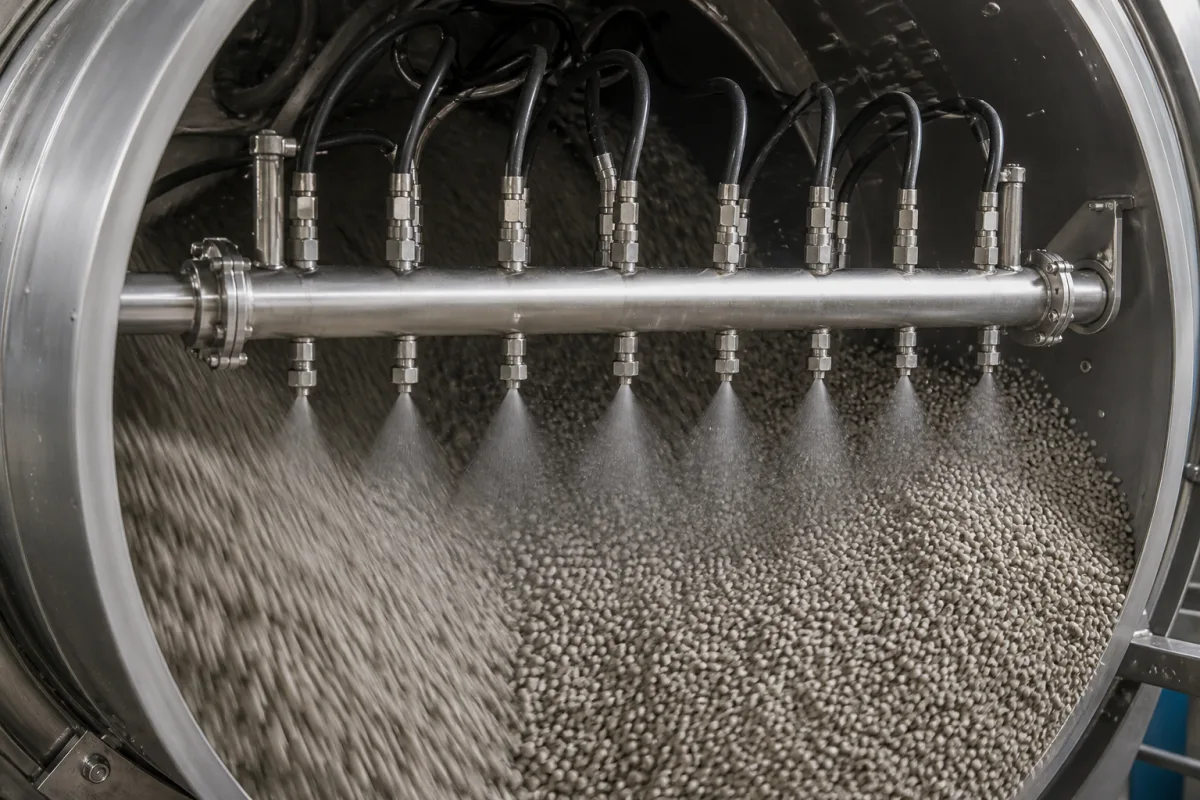
A component assembly that precisely distributes and atomizes liquid binder or coating solutions onto material within a rotary granulation drum.
Product Specifications

Technical details and manufacturing context for Spray System (Nozzles & Manifold)

Definition
The spray system is a critical component of a rotary granulation drum, responsible for the controlled application of liquid binders, coatings, or solutions onto the tumbling bed of powder or seed particles. It consists of a manifold that distributes the liquid from a central supply to multiple nozzles, which atomize the liquid into a fine spray. This ensures uniform wetting and agglomeration of particles, which is fundamental to the granulation process for achieving consistent particle size, density, and product quality.
Working Principle
Liquid is pumped under pressure from a supply tank into the manifold. The manifold acts as a distribution header, channeling the liquid to individual spray nozzles mounted at strategic points along the drum's interior. The nozzles, often of an atomizing type (e.g., pressure-swirl, two-fluid), break the liquid stream into a fine mist or spray pattern. This spray is directed onto the cascading bed of material inside the rotating drum, where the droplets coat particles and initiate agglomeration through liquid bridging.
Common Materials
Stainless Steel (e.g., 316L), PTFE (Teflon), Ceramic
Technical Parameters
  • Nozzle orifice diameter, manifold pipe diameter, and spray pattern width/angle. (mm) Per Request
Components / BOM
  • Spray Nozzle
    Atomizes the liquid stream into a fine spray mist of specific pattern and droplet size.
    Material: Stainless Steel or Ceramic
  • Manifold (Distribution Header)
    Distributes liquid from a single inlet to multiple outlet ports feeding the individual nozzles.
    Material: Stainless Steel
  • Mounting Bracket/Assembly
    Secures the nozzles and manifold in the correct position and orientation inside the drum.
    Material: Stainless Steel
Engineering Reasoning
3.5-8.0 bar (50-116 psi) at 0.5-2.0 L/min flow rate per nozzle
Cavitation occurs at vapor pressure threshold of 0.023 bar absolute (0.33 psi) at 25°C, causing nozzle erosion; mechanical failure at 12.0 bar (174 psi) due to manifold yield strength of 275 MPa (ASTM A106 Grade B)
Design Rationale: Cavitation-induced erosion from Bernoulli principle: pressure drop below liquid vapor pressure causes bubble formation and implosion at nozzle orifice (0.5-1.0 mm diameter), generating localized microjets exceeding 1000 MPa
Risk Mitigation (FMEA)
Trigger Particulate contamination exceeding 25 μm in binder solution (ISO 4406 18/16/13)
Mode: Nozzle orifice clogging with 80% flow reduction within 15 minutes
Strategy: Install dual 10 μm absolute filters (316L stainless steel) with differential pressure monitoring at 0.7 bar (10 psi) trigger
Trigger Thermal cycling from 25°C to 85°C during CIP (Clean-in-Place) procedures
Mode: Stress corrosion cracking in 316L stainless steel manifold at chloride concentration >50 ppm
Strategy: Replace with duplex 2205 stainless steel (PREN 35) and implement controlled temperature ramp rate of 2°C/min during thermal cycles

Industry Taxonomies & Aliases

Commonly used trade names and technical identifiers for Spray System (Nozzles & Manifold).

Applied To / Applications

This component is essential for the following industrial systems and equipment:

Industrial Ecosystem & Supply Chain DNA

Complementary Systems
Downstream Applications
Specialized Tooling

Application Fit & Sizing Matrix

Operational Limits
pressure: Up to 10 bar (145 psi) at manifold inlet
flow rate: 0.5 to 20 L/min per nozzle, adjustable via orifice selection
temperature: Ambient to 80°C (176°F)
slurry concentration: Up to 40% solids by weight, particle size <200 microns
Media Compatibility
✓ Aqueous polymer binders (e.g., PVP, HPMC) ✓ Solvent-based coating solutions (e.g., ethyl cellulose in ethanol) ✓ Food-grade liquid additives (e.g., oils, syrups)
Unsuitable: Highly abrasive slurries with >40% solids or particles >200 microns
Sizing Data Required
  • Required total liquid flow rate (L/min)
  • Desired droplet size (microns) for atomization
  • Number and arrangement of spray zones in the drum

Reliability & Engineering Risk Analysis

Failure Mode & Root Cause
Abrasive erosion
Cause: Suspended solids in the fluid stream causing gradual material removal from nozzle orifices and internal surfaces, leading to flow rate changes and spray pattern distortion.
Cavitation
Cause: Pressure drop below vapor pressure at constriction points (nozzle orifices, valve seats) causing vapor bubble formation and implosion, resulting in pitting, vibration, and material fatigue.
Maintenance Indicators
  • Irregular or asymmetric spray patterns (visual)
  • Unusual high-frequency vibration or hissing sounds from manifold (audible)
Engineering Tips
  • Install dual-stage filtration upstream (e.g., 100-micron pre-filter + 10-micron final filter) to remove abrasive particles and prevent erosion.
  • Maintain system pressure at least 10-15% above fluid vapor pressure and use gradual pressure reduction stages to prevent cavitation at nozzles.

Compliance & Manufacturing Standards

Reference Standards
ISO 9001:2015 Quality Management Systems ANSI/ASME B46.1-2019 Surface Texture DIN 19569-10:2016 Wastewater Treatment Plants - Principles for Design, Construction and Operation
Manufacturing Precision
  • Nozzle Bore Diameter: +/-0.02mm
  • Manifold Flatness: 0.1mm per 300mm length
Quality Inspection
  • Dye Penetrant Test for Surface Cracks
  • Pressure Test to 1.5x Maximum Operating Pressure

Factories Producing Spray System (Nozzles & Manifold)

Verified manufacturers with capability to produce this product in China

✓ 95% Supplier Capability Match Found

T Technical Director from Brazil Jan 22, 2026
★★★★★
"Testing the Spray System (Nozzles & Manifold) now; the technical reliability results are within 1% of the laboratory datasheet."
Technical Specifications Verified
P Project Engineer from Canada Jan 19, 2026
★★★★☆
"Impressive build quality. Especially the technical reliability is very stable during long-term operation. (Delivery took slightly longer than expected, but technical support was excellent.)"
Technical Specifications Verified
S Sourcing Manager from United States Jan 16, 2026
★★★★★
"As a professional in the Chemical Manufacturing sector, I confirm this Spray System (Nozzles & Manifold) meets all ISO standards."
Technical Specifications Verified
Verification Protocol

“Feedback is collected from verified sourcing managers during RFQ (Request for Quote) and factory evaluation processes on CNFX. These reports represent historical performance data and technical audit summaries from our B2B manufacturing network.”

16 sourcing managers are analyzing this specification now. Last inquiry for Spray System (Nozzles & Manifold) from Mexico (1h ago).

Supply Chain Compatible Machinery & Devices

Automated Batch Crystallization System

Automated system for controlled crystallization of chemical compounds in batch processes.

Explore Specs →
Automated pH Monitoring and Dosing System

Automated system for continuous pH monitoring and chemical dosing in process streams.

Explore Specs →
Automated Powder Dispensing and Blending System

Automated system for precise dispensing and homogeneous blending of powdered chemicals.

Explore Specs →
Automated Solvent Recovery and Purification System

Automated system for recovering and purifying industrial solvents.

Explore Specs →

Frequently Asked Questions

What materials are recommended for spray systems handling corrosive chemical binders?

For corrosive chemical applications, we recommend 316L stainless steel for structural components, PTFE (Teflon) coatings for corrosion resistance, and ceramic nozzles for maximum durability against abrasive solutions.

How does the spray system ensure uniform coating in rotary granulation drums?

Our precision-engineered manifold (distribution header) evenly distributes liquid to multiple spray nozzles that atomize the solution into fine droplets, ensuring consistent coverage across all material surfaces within the rotating drum.

What maintenance is required for chemical manufacturing spray systems?

Regular inspection of nozzle orifices for clogging, checking PTFE seals for wear, and verifying manifold pressure distribution. Stainless steel components require standard cleaning protocols, while ceramic nozzles offer extended service life with minimal maintenance.

Can I contact factories directly on CNFX?

CNFX is an open directory, not a transaction platform. Each factory profile provides direct contact information and production details to help you initiate direct inquiries with Chinese suppliers.

Get Quote for Spray System (Nozzles & Manifold)

Request technical pricing, lead times, or customized specifications for Spray System (Nozzles & Manifold) directly from verified manufacturing units.

Your business information is encrypted and only shared with verified Spray System (Nozzles & Manifold) suppliers.

Thank you! Your message has been sent. We'll respond within 1–3 business days.

Need to Manufacture Spray System (Nozzles & Manifold)?

Connect with verified factories specializing in this product category

Add Your Factory Contact Us
Previous Product
Spectroscopic Analyzer
Next Product
Static Mixer Element