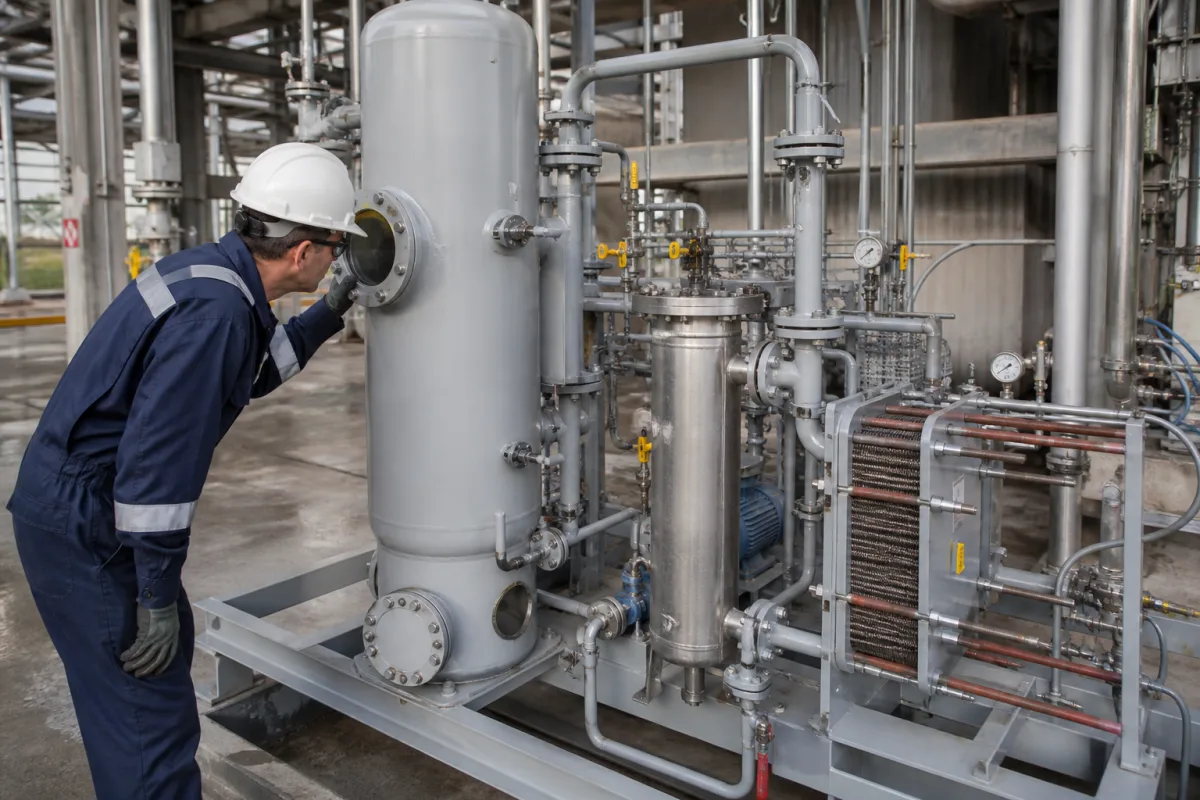
Separation unit for continuous flow processes: in-line membrane and gravity liquid–liquid and gas–liquid separators
In-line separation units for continuous flow chemistry · Membrane liquid–liquid and gas–liquid separators, gravity settlers, flow range, pressure and wetted materials
A separation unit in a continuous flow process is the in-line device that takes a two-phase stream, such as an organic product phase with an aqueous wash, or a liquid carrying gas, and sends each phase to its own outlet while the line keeps running. Membrane separators do this by wetting a porous membrane with one phase; gravity separators let the phases settle and draw them off at a detected interface. Buyers should check three things first: whether the separation principle suits the phases and any solids, whether the flow range and pressure rating match the line, and which wetted materials touch the process fluids.
In-line liquid–liquid and gas–liquid separation units used downstream of continuous flow reactors, quench and extraction steps: membrane separators, tube-in-tube gas–liquid separators and continuous gravity separators, with their membranes and pressure control. Continuous flow reactors for pharmaceutical synthesis, with their residence time, heat transfer and ICH Q13 control strategy, are covered on the Continuous flow reactor for pharmaceutical synthesis page. Air separation units, centrifuges and distillation columns are outside this page.
CNFX editorial research · Sources checked October 12, 2026 · 4 sources
Choose the separation principle: membrane wetting or gravity settling
Zaiput describes its separators as separating an immiscible liquid–liquid or gas–liquid stream by differences in how the phases wet a porous membrane: the wetting phase fills the pores and is pushed through by a pressure differential set by an internal pressure controller, while the non-wetting phase is retained. Because separation is interfacial rather than gravity-based, Zaiput states the devices work regardless of the density difference between the phases. Membranes are PTFE, hydrophobic or hydrophilic, in different pore sizes; the lower the interfacial tension, the smaller the pore size needs to be, and a smaller pore reduces the maximum viscosity the membrane can pass. [1]
For gas–liquid separation between two telescoped reactors, a team at the University of Leeds with AstraZeneca used a tube-in-tube separator, a porous ePTFE tube encased in a stainless-steel tube, to separate the phases at 7 bar; only the liquid permeated the tubing, so only liquid was sampled to the HPLC and the gas flow did not alter residence time in the second reactor. [3]
Membranes have limits. In a University of Liège continuous synthesis of nitrofuran pharmaceuticals, membrane separation could not be sustained because solid particles formed sporadically, and gravity separation with optical interface detection was hampered because both phases were dark. The team built an automated filtration and gravity separation unit that tracks the phase boundary magnetically and drives automated valves. [4]
Editorial note: tell the supplier whether the stream carries solids, how dark or opaque the phases are, the interfacial tension if known, and the viscosity of each phase, because these decide between a membrane unit and a gravity unit with filtration.
Give the supplier the two phases and their compositions, flow rate of each phase, temperature, line pressure and outlet pressures, solids content, interfacial tension and viscosity if known, which phase is the product, wetted-material restrictions, and whether one unit or a multistage countercurrent arrangement is needed.
02
Size the unit for flow range, pressure and hold-up volume
Zaiput publishes three sizes. SEP-10 (laboratory) handles a total flow of 0.05–10 mL/min, has about 0.5 mL internal volume, a 2 MPa (290 psi) maximum pressure, 90 °C maximum temperature and perfluorinated polymer wetted parts. SEP-200 (pilot) handles 20–200 mL/min with about 35 mL internal volume, 130 °C for the stainless steel 316 and Hastelloy C276 models and 90 °C for the fluoropolymer model. SEP-3000 (production) handles 200–3000 mL/min with about 610 mL internal volume, 2 MPa at 20 °C falling to 1.2 MPa at 100 °C, and ½-inch Swagelok ports. Listed maximum gas flows are about 500, 20,000 and 300,000 sccm. [1]
Zaiput adds that the outlet pressures of the two phases should not differ considerably, and that membranes may need replacing sooner when the fluid carries a significant amount of solids. [1]
Editorial calculation: dividing internal volume by maximum total flow gives a hold-up of about 3 s for SEP-10 (0.5 mL at 10 mL/min), about 10.5 s for SEP-200 (35 mL at 200 mL/min) and about 12.2 s for SEP-3000 (610 mL at 3000 mL/min); 3000 mL/min equals 0.18 m³/h. [1]
Separation performance also depends on contact before the separator. Ghent University recovered dihydrolevoglucosenone from water into ethyl acetate or 2-MeTHF using a SEP-10 at 1.5 mL/min with in-line static mixers ahead of it. After five consecutive extractions, recovery reached 56% at 25 °C and 92% at 65 °C with ethyl acetate, and 99% at 75 °C with 2-MeTHF. Five separators combined in a countercurrent platform reached around 55–60% with ethyl acetate at room temperature while using one fifth of the extraction solvent of five consecutive extractions. [2]
03
Compare separation unit types
The reviewed sources describe these arrangements.
Type
What the source describes
Ask about
Membrane liquid–liquid separator
Porous PTFE membrane wetted by one phase, internal pressure controller, 0.05 to 3000 mL/min across three sizes. [1]
Membrane type and pore size; flow range.
Multistage countercurrent platform
Five separators linked, aqueous outlet of one feeding the next, organic flowing the opposite way. [2]
Number of stages; solvent ratio.
Tube-in-tube gas–liquid separator
Porous ePTFE tube inside a stainless-steel tube, operated at 7 bar. [3]
Pressure; gas and liquid flows.
Gravity separator with interface tracking
Continuous gravity settling with magnetic phase-boundary detection, automated valves and upstream filtration. [4]
Interface detection method; solids handling.
04
Where phases split: chamber, membrane, pressure controller and interface detector
Part
Role
Fix in the order
Separation chamber or shell
Holds the two phases; metal shell allows in-line pressure up to 2 MPa. [1]
Material and internal volume.
Membrane or porous tube
Passes the wetting phase or the liquid only. [1][3]
Explore company information and manufacturing capabilities, then discuss the scope of your project with a relevant supplier.
Share this page
Compiled and source-reviewed by the CNFX editorial team.
Each manufacturer above links to the page on that company's own website where the product is listed, with the date we checked it. How we source and review
· Page last updated 13 October 2026
Buyer questions
Does a membrane separator need a density difference between phases?
Zaiput states its separation is interfacial, not gravity-based, so it can be used regardless of density difference. [1]
When is a gravity separator chosen over a membrane?
In the Liège nitrofuran process, sporadic solids ruled out a membrane, so a filtration and gravity separation unit with magnetic interface tracking was built. [4]
Sources and what still needs a direct check
Sources checked 2026-10-12. Zaiput Flow Technologies publishes specifications for its own separators. Ghent University, the University of Leeds with AstraZeneca, and the University of Liège report separation units used in published continuous flow studies.