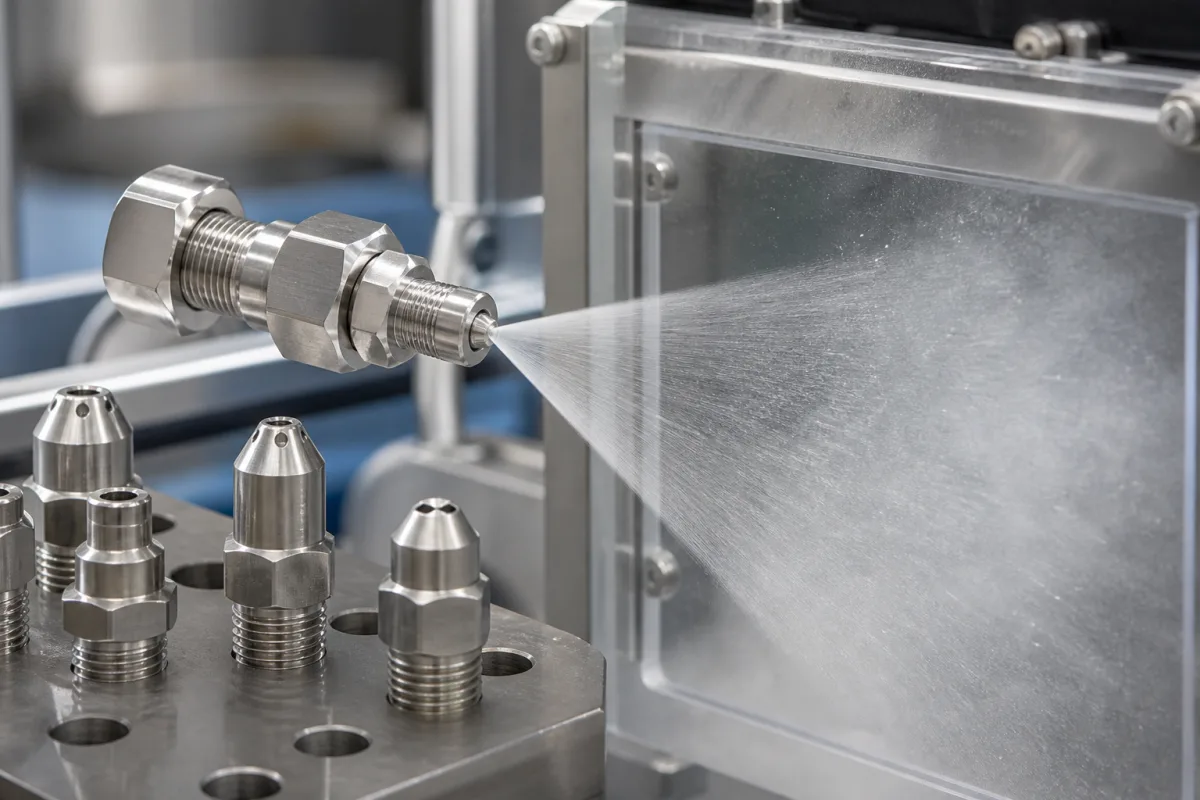
Process equipment · Pattern, flow, drop size and wear
A hydraulic spray nozzle turns liquid pressure into a pattern of drops. Pick the pattern for the job, size the orifice for the flow you need at your pressure, choose a material that resists the liquid and its solids, and check flow and pattern regularly, because wear is rarely visible.
Hydraulic (single-fluid) and air atomizing spray nozzles for cooling, cleaning, coating, dust suppression and process use in machinery and plants. Fire hose nozzles, drill-bit jet nozzles and paint or powder spray guns are outside this page.
CNFX editorial research · Sources checked October 11, 2026 · 8 sources
Spraying Systems Co. groups nozzles by pattern: full cone nozzles give a solid cone of medium to large drops for cooling, washing, rinsing and dust suppression; flat spray nozzles give a thin rectangular pattern, with tapered versions giving higher impact for descaling and high-pressure washing; hollow cone nozzles give a circular pattern with a good air-to-drop interface for gas cooling and dust suppression; solid stream nozzles give the highest impact per unit area. [2]
Its technical manual states that air atomizing nozzles achieve the smallest drop sizes and full cone hydraulic nozzles the largest. [1]
Tell the supplier what the spray must do (cool, clean, coat, wet dust), the target width and distance, and the liquid. Pattern follows the task; flow and drop size follow the pattern.
02
Size the flow at your pressure, not the catalogue pressure
Spraying Systems' manual gives the approximation Q1/Q2 = (P1/P2)^n, where n is 0.50 for hollow cone, flat, solid stream and spiral nozzles, 0.46 for standard full cone nozzles and 0.44 for wide-angle full cone nozzles. Its worked example: a full cone nozzle rated 1.9 gpm at 40 psi delivers about 3.5 gpm at 150 psi. Liquids heavier than water flow less. [1]
The same manual notes that catalogue spray angles are measured with water, and that the effective angle changes with distance, viscosity, capacity and pressure; more viscous liquids need a higher minimum pressure and give narrower angles. [1]
Ask the supplier for the flow and angle at your working pressure and for your liquid, not only the catalogue line.
03
Specify drop size the way it is measured
Spraying Systems explains that every spray contains a range of drop sizes, and that lower pressures give larger drops while higher pressures give smaller ones; small-capacity nozzles produce the smallest drops. It expresses drop size as volume median diameter (VMD, Dv0.5): half the sprayed volume is in drops larger than this value, half in smaller. [1]
Where drop size matters, as in gas cooling, fire suppression or spray drying, the manual advises requesting measured drop size data for the specific nozzle. A drop size figure without the pressure, flow and measuring basis (VMD, Sauter mean or another diameter) cannot be compared between suppliers. [1]
04
Choose material and plan for wear
Spraying Systems states: "Materials having harder surfaces generally provide longer wear life. Standard nozzle materials include brass, steel, cast iron, various stainless steels, hardened stainless steels, many plastics and various carbides." It adds that corrosion depends on the liquid, its concentration and temperature. [1]
Wear enlarges the orifice: flow rises, drops get larger and the pattern distorts. Full cone patterns put more liquid in the centre, flat sprays develop streaks and lose effective angle, and hollow cones become uneven. Because, in Spraying Systems' words, nozzle wear "usually isn’t visible", it advises recording flow, pressure, drop size, pattern and alignment when nozzles are new and checking them regularly. [3][4]
Spraying Systems also lists clogging, caking at the orifice, corrosion, heat damage and improper assembly as problems that affect nozzle performance. Line strainers or built-in strainers help keep particles out, and orifices should be cleaned only with tools softer than the nozzle, never wire brushes or knives. [4][1]
05
Compare what suppliers offer
Suppliers linked to this page list standard flat fan, full cone, hollow cone, spiral, misting and air atomizing nozzles, in materials including stainless steel, brass, plastics and carbide. [6][7][8]
BY Spray lists HVV, HU and TP flat fan nozzles with 1/8 to 1 inch threads and spray angles from 0° to 110°; Mistec lists nozzle materials including 303, 304 and 316 stainless steel, brass, ceramic, silicon carbide and plastics; CYCO lists the BB full cone nozzle and states that its BBG version has a body and vane that can be removed for cleaning without taking the base off the header. Confirm whether a supplier's figures are for water and at what pressure. [6][7][5]
06
Trace the nozzle parts
This is a functional reference built from the sources cited; it is not one maker's parts list.
Part
Role
Fix in the order
Orifice
Meters the flow and shapes the stream; wear enlarges it. [3]
Orifice size and material.
Vane or swirl insert
Forms full cone or hollow cone patterns; can be removable. [5][3]
Vane type and whether it is replaceable.
Body and connection
Holds the parts and connects to the pipe or header. [5]
Thread type and size; body material.
Strainer
Traps particles that clog or wear the orifice. [1]
Fill the specification fields with values for your system
A spray nozzle quotation needs values for your liquid and your system. The table explains each field, gives published relationships where a reviewed source states them, and says what to obtain from the supplier.
Field
What it means and published values
Ask the supplier for
Operating pressure (MPa)
Raises flow, impact and wear; lowers drop size. [1]
Rated pressure range.
Flow rate (L/min)
Varies with pressure by exponent n of 0.44 to 0.50 depending on pattern. [1]
Send the liquid, the duty and the system data together
Paste it into your enquiry below or into an email to a maker, then replace every bracket.
Duty: [cooling, cleaning, coating, dust suppression or other; target width and spray distance]
Liquid: [name; specific gravity; viscosity; temperature; solids and size]
System: [pressure at the nozzle; total flow; number of nozzles; header layout]
Nozzle: [pattern; spray angle; flow per nozzle at your pressure; drop size and its basis]
Construction: [material; thread size and standard; strainer; quick-change body]
Documents: [performance data at your pressure; material certificate; drawing]
Explore company information and manufacturing capabilities, then discuss the scope of your project with a relevant supplier.
Share this page
Compiled and source-reviewed by the CNFX editorial team.
Published product pages show what a company offers, not tested performance. Confirm the legal seller, factory and scope for your order. How we source and review
· Page last updated 13 October 2026
Buyer questions
How does spray nozzle flow change with pressure?
Spraying Systems gives Q1/Q2 = (P1/P2)^n, with n from 0.44 to 0.50 depending on the pattern; a full cone rated 1.9 gpm at 40 psi gives about 3.5 gpm at 150 psi. [1]
How can I tell if a spray nozzle is worn?
Spraying Systems says nozzle wear "usually isn’t visible"; look for higher flow, lower pressure, larger drops and a distorted pattern compared with readings taken when the nozzles were new. [3]
Which nozzle gives the smallest drops?
Spraying Systems states air atomizing nozzles give the smallest drops and full cone hydraulic nozzles the largest; higher pressure and smaller capacity also reduce drop size. [1]
Sources and what still needs a direct check
Sources checked 2026-10-11. Spraying Systems Co. is a spray nozzle manufacturer; its technical manual and spraying-basics pages explain flow, drop size and wear. Supplier pages describe their own offers.