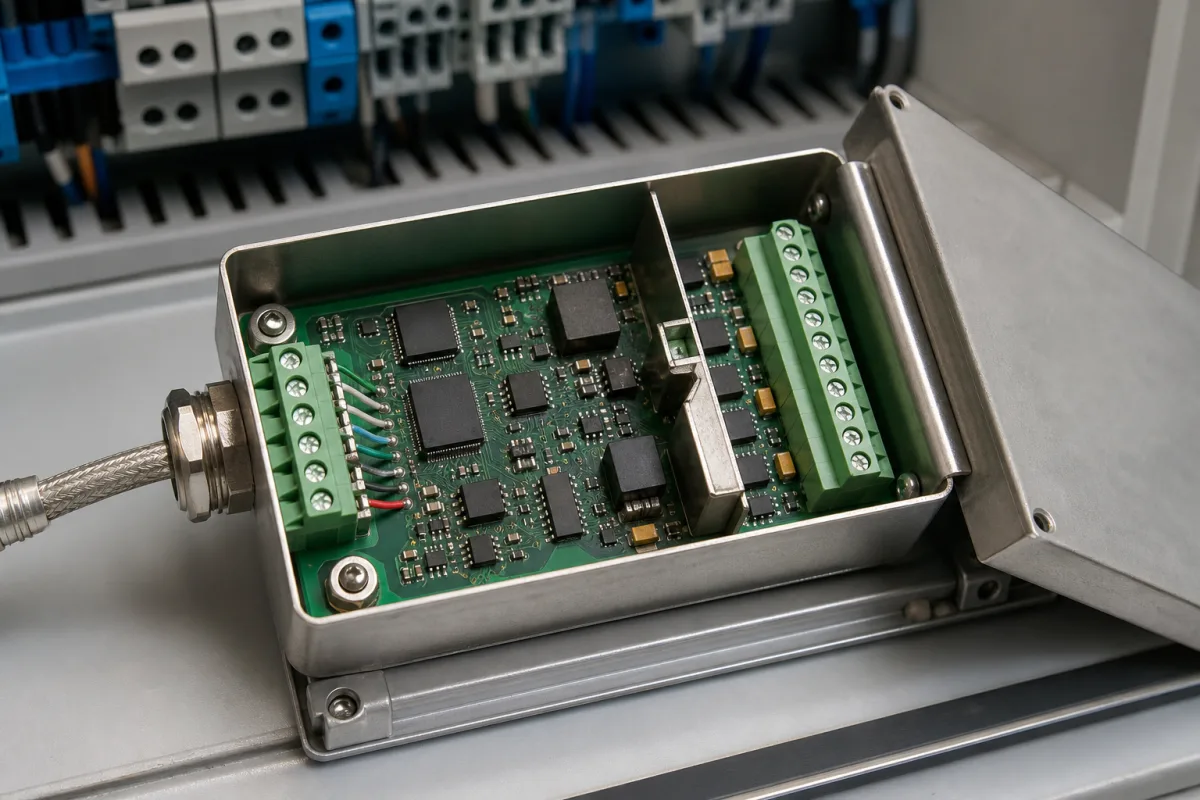
Load-cell signal conditioner (strain-gauge bridge amplifier with 4–20 mA or 0–10 V output)
Load-cell signal conditioners · bridge excitation and how many cells it can drive, mV/V sensitivity setting, current-loop load, zero and span drift, field enclosure
A load-cell signal conditioner sits between a strain-gauge bridge and a PLC, meter or controller: it powers the bridge, amplifies a full-scale signal of a few millivolts and turns it into 4–20 mA or 0–10 V. The parts of the order that go wrong are the bridge side, not the output: how much excitation voltage and current the unit can deliver, which mV/V range it can be set to, and how far its zero drifts with temperature compared with the small signal. Settle the bridge resistance and number of cells, the cell's rated output in mV/V, the loop or input the output must drive, and where the conditioner will be mounted.
Analogue amplifiers and signal conditioners for strain-gauge load cells and other full-bridge sensors, from boards fitted inside a sensor to sealed field boxes and DIN-rail units: excitation, sensitivity setting, analogue output, drift and enclosure. Multi-input DIN-rail isolators and conditioners for thermocouple, RTD, current and voltage signals are covered on the Industrial signal conditioner page; portable load-cell simulators and calibrators for checking such loops are covered on the Portable calibration module for load cells and 4–20 mA loops page. Weighing indicators with displays, digital (RS485 or fieldbus) weighing transmitters and the load cells themselves are outside this page.
CNFX editorial research · Sources checked October 12, 2026 · 3 sources
Excitation voltage and current: how many 350 Ω load cells one conditioner can power
Mantracourt states that its SGA conditioner provides excitation for up to four 350 Ω strain-gauge bridges. Its specification lists bridge excitation of 9.75 to 10.25 V on the 10 V range and 4.85 to 5.15 V on the 5 V range, with a minimum bridge resistance of 85 Ω. [1]
Editorial calculation: four 350 Ω cells wired in parallel present 350 ÷ 4 = 87.5 Ω, just above the SGA's 85 Ω minimum, and at 10 V draw about 10 ÷ 87.5 ≈ 114 mA of excitation current. A fifth cell would bring the parallel resistance to 70 Ω, below that minimum. [1]
Novatech's SY011 is a smaller amplifier with a factory-set load-cell supply of 5 V DC at 15 mA or 10 V DC at 30 mA. [3] Editorial calculation: one 350 Ω cell takes 10 ÷ 350 ≈ 28.6 mA at 10 V and 5 ÷ 350 ≈ 14.3 mA at 5 V, so each setting covers one 350 Ω bridge; check the rating before connecting more than one.
Mantracourt's 2-wire ICA5S works the other way: it runs from the 4–20 mA loop and excites the bridge at 1.05 to 1.16 V (1.11 V typical) with a 1000 Ω load cell. It accepts bridge impedances from 350 to 5000 Ω, with 1000 Ω recommended, and the maker answers that one load cell can be attached. [2] Editorial calculation: 1.11 V across 1000 Ω is about 1.1 mA, which leaves room inside the 4 mA minimum loop current for the amplifier itself.
Give the supplier the number of load cells, the bridge resistance of each (input and output resistance from the cell certificate), the excitation voltage the cells are calibrated at, cable length, and whether sense lines (6-wire) are used.
02
mV/V sensitivity, full-scale signal and zero drift
A load cell's rated output in mV/V multiplied by the excitation voltage gives the full-scale signal the conditioner has to amplify. The SGA's sensitivity is switchable from 0.06 to 30 mV/V, with a fine pot and coarse offset switches of ±1.25 to ±80% of full range. [1] The SY011 is set at the factory to anything between 0.5 and 100 mV/V and stated in the last part of the order code, for example 1.0 or 2.0 mV/V. [3] The ICA5S leaves the factory at 2.5 mV/V and covers 0.5 to 55 mV/V with an alternate calibration resistor. [2]
Editorial calculation: on the SY011, 0.5 µV/°C against a 20 mV full-scale signal is 0.5 ÷ 20,000 = 0.0025% of full range per °C, close to the SGA's stated 0.002 %FR/°C. The ICA5S works with a signal about nine times smaller than the SGA's at 2.5 mV/V because of its low excitation, yet states its drift in %FR, so compare drift as a percentage of full range at your own mV/V rather than as microvolts. [3][1][2]
Linearity is listed as 0.03 %FR for the SGA, 0.02 %FR typical for the ICA5S and ±0.05% of full range typical for the SY011. [1][2][3] The SGA also has on-board shunt calibration, which shunts one arm of the connected cell to produce a known output change for checking the cell and its wiring. [1]
Zero 0.001 typ., 0.005 max ±%FR/°C; span 0.007 typ., 0.014 max ±%FR/°C [2]
03
Output: 4–20 mA loop load, voltage ranges and bandwidth
The SGA's output is set by an on-board switch to ±10 V, ±5 V, 0–10 V, 0–5 V, 0–20 mA or 4–20 mA; current output drives 0 to 500 Ω, voltage output up to 2 mA. Mantracourt notes that switching between 4–20 mA and 0–10 V loses the calibration. [1]
The ICA5S is loop-powered from 7.5 to 28 V (24 V typical) and drives an output load of up to 800 Ω, with reverse-polarity protection to −30 V. [2] The SY011 runs from a nominal 24 V DC (17 to 30 V DC) and draws up to 120 mA; its voltage version gives a bipolar ±5 V or ±10 V from that single supply so that tension and compression read as positive and negative. [3]
Bandwidth separates process weighing from test work: the SGA runs from DC to 6000 Hz unfiltered with switchable filter cut-offs from 1 to 5000 Hz, while the ICA5S and SY011 list 1000 Hz and 1 kHz (−3 dB). [1][2][3] Ask for the filter setting that suits the measurement, since a silo or hopper reading needs heavy filtering and an impact or press-force test does not.
04
Inside the sensor, in a sealed field box or on a DIN rail
The three designs reviewed are built for three mounting places, and each comes with its own temperature range.
Editorial note: on an outdoor weighbridge or silo the conditioner's temperature range can be narrower than the load cells'; a unit rated 0 to +50 °C needs a heated or sheltered box where the cells see frost. Ask for the ingress rating and the cable-gland sizes that match your load-cell cable.
Design
Housing and size
Operating temperature
Mantracourt ICA5S board
19.5 mm diameter × 7.6 mm, fits inside a sensor; optional ILE in-line enclosure [2]
Paste it into your enquiry below or into an email to a maker, then replace every bracket.
Load cells: [number; bridge resistance; rated output mV/V; calibrated excitation]
Wiring: [4-wire or 6-wire; cable length]
Output: [4–20 mA 2-wire or 3-wire; 0–10 V; ±10 V; loop load or input impedance]
Supply: [loop powered; 24 V DC; AC]
Signal: [bandwidth or filter; zero and span drift limit]
Mounting: [inside sensor; field box with IP rating; DIN rail]
Environment: [ambient temperature range]
Calibration: [factory set to cells; shunt calibration; certificate]
1 company lists this product among what they make. Company figures are quoted from each
company's own website; every card states where the relationship came from.
Shenzhen Brightwin Technology Co., Ltd.
Manufacturing site to be confirmed for the order
Lists load-cell input signal conditioners, including the RW-ST01A amplifier for full-bridge load cells with 4–20 mA and 0–5/0–10 V output, an 18–27 V DC supply and a sealed enclosure.
Explore company information and manufacturing capabilities, then discuss the scope of your project with a relevant supplier.
Share this page
Compiled and source-reviewed by the CNFX editorial team.
Each manufacturer above links to the page on that company's own website where the product is listed, with the date we checked it. How we source and review
· Page last updated 13 October 2026
Buyer questions
How many load cells can one signal conditioner power?
It depends on its excitation rating: Mantracourt's SGA drives up to four 350 Ω bridges at 10 V with an 85 Ω minimum bridge resistance; its ICA5S takes one load cell. [1][2]
What does the mV/V sensitivity setting mean on a load-cell amplifier?
It matches the amplifier's gain to the load cell's rated output per volt of excitation; Novatech factory-sets the SY011 between 0.5 and 100 mV/V to suit the cell, for example 1.0 or 2.0 mV/V. [3]
Can a load-cell amplifier be powered from the 4–20 mA loop?
Yes; Mantracourt's ICA5S is a 2-wire loop-powered unit running from 7.5 to 28 V, exciting a 1000 Ω cell at about 1.11 V and driving up to 800 Ω. [2]
Sources and what still needs a direct check
Sources checked 2026-10-12. Mantracourt and Novatech are UK makers publishing specifications for their own strain-gauge amplifiers; the drift, excitation and bandwidth figures are their stated values, not independent tests.