Industry-Verified Manufacturing Data (2026)

Automated Multi-Stage Lens Assembly and Testing System

Based on aggregated insights from multiple verified factory profiles within the CNFX directory, the standard Automated Multi-Stage Lens Assembly and Testing System used in the Computer, Electronic and Optical Product Manufacturing sector typically supports operational capacities ranging from standard industrial configurations to heavy-duty production requirements.

Technical Definition & Core Assembly

A canonical Automated Multi-Stage Lens Assembly and Testing System is characterized by the integration of Precision Robotic Handling Module and Active Optical Alignment Station. In industrial production environments, manufacturers listed on CNFX commonly emphasize Stainless Steel Frame construction to support stable, high-cycle operation across diverse manufacturing scenarios.

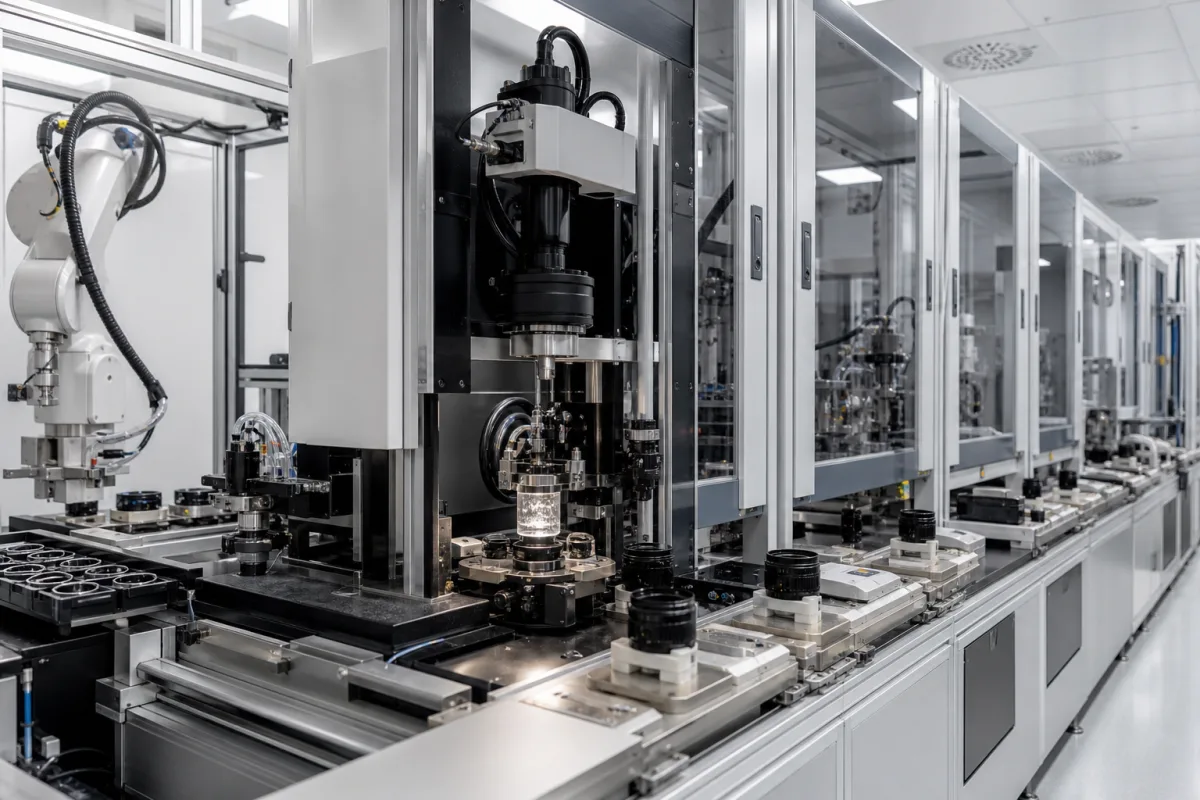
Integrated production line for assembling and testing complex optical lens systems
Product Specifications

Technical details and manufacturing context for Automated Multi-Stage Lens Assembly and Testing System

Definition
A fully automated industrial production system designed for the high-volume assembly and quality verification of multi-element optical lens systems. This integrated line coordinates multiple specialized modules including precision handling, optical alignment, bonding, and metrology stations. It ensures consistent production of camera lenses, microscope objectives, and other optical instruments requiring precise component stacking. The system minimizes human intervention while maintaining micron-level accuracy throughout the assembly process.
Working Principle
Utilizes robotic arms and precision stages to transport lens elements between modular workstations where automated alignment, adhesive application, curing, and optical testing occur in sequence under controlled environmental conditions.
Common Materials
Stainless Steel Frame, Aluminum Alloy Mounting Plates, Precision Linear Guides, Optical Grade Glass Handling Components
Technical Parameters
  • Maximum lens diameter capacity (mm) Per Request
  • Maximum production throughput (units/hour) Per Request
Components / BOM
Engineering Reasoning
0.1-1.0 μm positioning accuracy, 18-24°C temperature, 40-60% relative humidity
Positioning error >1.5 μm, temperature deviation >±2°C from setpoint, humidity >70% or <30%
Design Rationale: Thermal expansion of aluminum structural components (α=23.1×10⁻⁶/°C) causing misalignment, hygroscopic expansion of polymer lens mounts, piezoelectric actuator hysteresis at >1.5 μm displacement
Risk Mitigation (FMEA)
Trigger Piezoelectric actuator voltage drift exceeding ±0.5V from 100V nominal
Mode: Lens positioning error accumulation beyond 1.5 μm tolerance
Strategy: Closed-loop capacitive position feedback with 0.01 μm resolution and PID control at 10 kHz sampling
Trigger Interferometric testing laser wavelength instability >0.1 nm at 632.8 nm HeNe wavelength
Mode: Wavefront error measurement inaccuracy exceeding λ/20 RMS
Strategy: Temperature-stabilized laser cavity with ±0.01°C control and reference etalon wavelength lock

Industry Taxonomies & Aliases

Commonly used trade names and technical identifiers for Automated Multi-Stage Lens Assembly and Testing System.

Industrial Ecosystem & Supply Chain DNA

Complementary Systems
Downstream Applications
Specialized Tooling

Application Fit & Sizing Matrix

Operational Limits
pressure: Atmospheric to 1.5 bar (21.8 psi) clean dry air supply
other spec: Class 1000 cleanroom, 0.1-5% slurry concentration for polishing stages, 50-60 Hz power, <1 μm vibration isolation
temperature: 15-30°C (59-86°F) controlled environment
Media Compatibility
✓ Optical glass substrates ✓ Polymer optical elements ✓ Ceramic lens housings
Unsuitable: Corrosive chemical environments or conductive metal particle contamination
Sizing Data Required
  • Maximum lens diameter (mm)
  • Annual production volume (units/year)
  • Number of optical elements per assembly

Reliability & Engineering Risk Analysis

Failure Mode & Root Cause
Misalignment-induced optical distortion
Cause: Gradual wear in precision linear guides and servo motor encoders, exacerbated by thermal expansion/contraction cycles and particulate contamination from the assembly environment, leading to cumulative positional errors in lens placement stages.
Contamination-induced surface defects
Cause: Inadequate cleanroom protocols or filter degradation in the environmental control system, allowing microscopic particles (dust, oils, fibers) to settle on lens surfaces during handling or testing, causing scratches, adhesion issues, or failed optical performance tests.
Maintenance Indicators
  • Audible: Unusual high-pitched whining or grinding noises from servo motors or linear actuators, indicating bearing wear, lubrication failure, or mechanical obstruction.
  • Visual: Increased rejection rate or inconsistent readings on automated interferometers or MTF (Modulation Transfer Function) testers, signaling optical misalignment, calibration drift, or sensor degradation.
Engineering Tips
  • Implement predictive maintenance via vibration analysis and thermal imaging on high-precision motion components (e.g., ball screws, linear guides) to detect early wear patterns, and use automated laser alignment tools for weekly verification of optical axis integrity.
  • Enhance contamination control with HEPA-filtered laminar flow enclosures for critical stages, establish strict particle count monitoring, and use antistatic materials for lens handling; regularly calibrate test instruments with NIST-traceable standards to maintain measurement accuracy.

Compliance & Manufacturing Standards

Reference Standards
ISO 10110-7:2017 (Optics and photonics - Preparation of drawings for optical elements and systems - Surface imperfection tolerances) ANSI Z80.1-2020 (Ophthalmic Lenses - Prescription Requirements) DIN 3140-7:2018 (Optics and optical instruments - Preparation of drawings for optical elements and systems - Surface form tolerances)
Manufacturing Precision
  • Centering tolerance: +/- 0.01 mm (for lens alignment in mounts)
  • Surface irregularity: λ/4 (at 632.8 nm wavelength for optical performance)
Quality Inspection
  • Interferometric surface testing (for optical quality and flatness verification)
  • Automated optical inspection (AOI) with image analysis for assembly verification and defect detection

Factories Producing Automated Multi-Stage Lens Assembly and Testing System

Verified manufacturers with capability to produce this product in China

✓ 97% Supplier Capability Match Found

T Technical Director from Canada Jan 22, 2026
★★★★★
"Standard OEM quality for Computer, Electronic and Optical Product Manufacturing applications. The Automated Multi-Stage Lens Assembly and Testing System arrived with full certification."
Technical Specifications Verified
P Project Engineer from United States Jan 19, 2026
★★★★☆
"Great transparency on the Automated Multi-Stage Lens Assembly and Testing System components. Essential for our Computer, Electronic and Optical Product Manufacturing supply chain. (Delivery took slightly longer than expected, but technical support was excellent.)"
Technical Specifications Verified
S Sourcing Manager from United Arab Emirates Jan 16, 2026
★★★★★
"The Automated Multi-Stage Lens Assembly and Testing System we sourced perfectly fits our Computer, Electronic and Optical Product Manufacturing production line requirements."
Technical Specifications Verified
Verification Protocol

“Feedback is collected from verified sourcing managers during RFQ (Request for Quote) and factory evaluation processes on CNFX. These reports represent historical performance data and technical audit summaries from our B2B manufacturing network.”

19 sourcing managers are analyzing this specification now. Last inquiry for Automated Multi-Stage Lens Assembly and Testing System from Mexico (1h ago).

Supply Chain Commonly Integrated Components

Stereo Camera Array

A multi-camera system that captures synchronized images from multiple perspectives to enable 3D depth perception and pattern recognition.

Explore Specs →
Structured Light Projector

Optical device that projects precisely controlled light patterns onto surfaces for 3D scanning applications

Explore Specs →
Main Processor Board

The central computing and control unit of a 5-axis CNC controller that processes motion commands, executes algorithms, and coordinates all system operations.

Explore Specs →
Alignment Sensor Array

A multi-sensor component that detects and measures positional alignment in industrial systems.

Explore Specs →

Frequently Asked Questions

What is the alignment accuracy of this lens assembly system?

The system achieves micron-level alignment accuracy (μm) through its Active Optical Alignment Station, ensuring precise positioning of optical components for high-quality lens assemblies.

What environmental controls are included for optical manufacturing?

The system features a controlled environment enclosure meeting cleanroom standards (class), maintaining temperature, humidity, and particulate levels to protect sensitive optical components during assembly.

What types of lens systems can this automated line handle?

This system accommodates complex optical assemblies with maximum lens diameters up to mm and minimum element thicknesses down to mm, suitable for various optical instruments and photographic equipment.

Can I contact factories directly on CNFX?

CNFX is an open directory, not a transaction platform. Each factory profile provides direct contact information and production details to help you initiate direct inquiries with Chinese suppliers.

Get Quote for Automated Multi-Stage Lens Assembly and Testing System

Request technical pricing, lead times, or customized specifications for Automated Multi-Stage Lens Assembly and Testing System directly from verified manufacturing units.

Your business information is encrypted and only shared with verified Automated Multi-Stage Lens Assembly and Testing System suppliers.

Thank you! Your message has been sent. We'll respond within 1–3 business days.

Need to Manufacture Automated Multi-Stage Lens Assembly and Testing System?

Connect with verified factories specializing in this product category

Add Your Factory Contact Us
Previous Product
Automated Metrology Module
Next Product
Automated Optical Inspection (AOI) System